A recent Kaspersky report on SOC revealed that many organisations are looking to implement SOC as a strategic cybersecurity move. Are you one of them? If yes, you are at the right place.
In 2026, environments are more complex than ever. Cloud workloads, remote endpoints, SaaS platforms and third-party integrations have expanded your attack surface significantly. Threats have kept pace, and in many cases outpaced the tools designed to stop them. Selecting the right SOC partner demands a structured approach. This SOC service provider evaluation checklist focuses on what may matter not only in 2026 but beyond.
Traditional SOC model is under pressure
Perhaps you know that already. The constant stress is why so many organisations are rethinking their SOC strategy in the first place.
Alert overload and analyst fatigue
Security tools generate thousands of alerts every day. Most of them do not require immediate action. But your analysts still have to review them and that volume creates a serious problem.
Teams spend more time filtering noise than investigating real threats. Skilled analysts burn out faster. Investigation quality drops. And by the time a genuine incident surfaces, the team may already be exhausted. Traditional SOC models were not built for the alert volumes that modern environments produce.
Scaling challenges in complex environments
Your environment has changed. Most now operate across a mix of:
- Cloud infrastructure and SaaS platforms
- Remote users and endpoints
- Third-party integrations
- Hybrid on-premise and cloud workloads
Each layer adds operational complexity. Expanding your internal team is expensive. Adding more tools often creates more silos rather than better visibility. Traditional models simply were not built to scale this way without a significant increase in cost and headcount.
This is why AI-managed SOC models have become the standard for forward-looking security operations.
Is AI-managed SOC the ultimate solution?
An AI-managed SOC combines automation, machine learning and human expertise to run security operations more efficiently. Instead of relying on manual triage for every alert, these models use AI to reduce noise, prioritise threats and accelerate investigation workflows.
How AI improves detection and response
AI-driven analysis helps correlate alerts across multiple systems simultaneously. It identifies patterns that a human analyst might miss when reviewing individual alerts in isolation. The result is faster detection with fewer false positives reaching your team.
Automation also handles repetitive investigation tasks, enriching indicators, cross-referencing threat intelligence and mapping activity to known attack frameworks. Analysts spend their time on meaningful threats rather than mechanical triage.
The operational difference between AI-assisted and AI-managed SOC
Not every provider uses AI the same way. Some bolt basic automation onto a traditional monitoring service and call it AI-driven. A genuinely AI-managed SOC applies intelligence across the entire operations cycle, from alert triage and investigation to response orchestration and compliance reporting. The difference shows up in response times, alert quality and the depth of insight your team receives.
Understanding this distinction is essential before you begin evaluating providers.
SOC service provider evaluation checklist: key criteria to assess
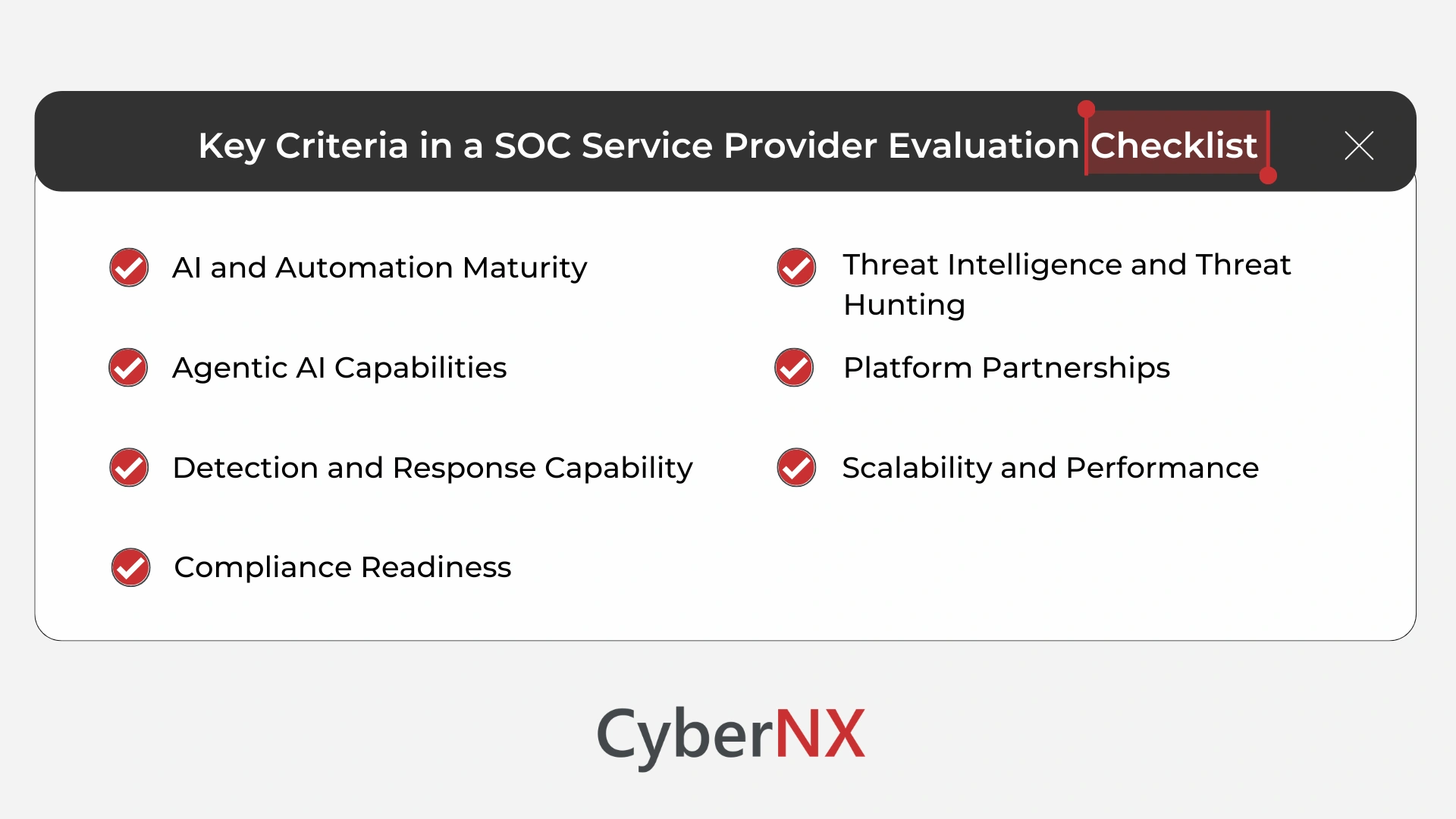
A thorough SOC evaluation covers 15 criteria, from coverage and visibility to platform partnerships, data ownership and proven outcomes. We cover the most critical ones below.
Use these criteria to build a structured, consistent evaluation across every provider you consider.
AI and automation maturity
Some providers position basic rule-based automation as AI capability. Others use genuine machine learning for behavioural analysis, anomaly detection and automated investigation. The difference in operational outcomes is significant. When evaluating AI maturity, assess:
- Alert prioritisation: does AI reduce noise based on context, or just volume?
- Behaviour-based detection: can the system identify threats that bypass signature-based rules?
- Automated investigation: how much of the triage process is automated versus manual?
- Explainability: can the SOC clearly explain why an AI-driven alert was flagged?
Automation should improve clarity, not create a black box your team cannot understand or trust.
Agentic AI capabilities
Agentic AI takes automation a step further. Instead of waiting for human approval at every decision point, an agentic SOC can take context-driven actions autonomously during an active incident.
This matters when speed is critical. A SOC that pauses for manual confirmation at each step during a live attack loses valuable containment time. Agentic capabilities allow the SOC to isolate endpoints, block lateral movement and trigger response workflows in real time-without slowing down at every decision.
When evaluating this capability, ask:
- Autonomous response scope: what actions can the SOC take without analyst intervention?
- Guardrails and oversight: how are autonomous actions logged, reviewed and controlled?
- Escalation logic: at what point does the system hand off to a human analyst?
Agentic AI is still an emerging capability. Providers who have it, and can explain it clearly, are ahead of the curve.
Detection and response capability
Detection speed directly affects outcomes. Every hour between initial compromise and containment increases the potential impact on your business. Assess how the provider handles the full detection-to-response cycle:
- Mean Time to Detect (MTTD): how quickly does the SOC identify a threat after it enters your environment?
- Mean Time to Respond (MTTR): how quickly do they contain and remediate after detection?
- Detection quality: what percentage of alerts are actionable versus noise?
Compliance readiness
This is true for organisations in BFSI, healthcare and technology sectors operating under Indian regulatory frameworks. Evaluate whether the provider supports your specific compliance obligations, including:
- CERT-In’s incident reporting and monitoring requirements
- RBI and SEBI sector-specific cybersecurity guidelines for financial institutions
- ISO 27001 information security management requirements
- PCI DSS for organisations handling cardholder data
Compliance support should mean continuous monitoring aligned with these frameworks, not just annual audit preparation. Look for audit-ready reporting, centralised log retention with appropriate retention periods and compliance-focused dashboards your team can access in real time. The right SOC reduces your compliance burden.
Threat intelligence and threat hunting
Detection tools catch what they are configured to look for. Threat hunting finds what they miss. Effective threat intelligence and hunting capability includes:
- Indicator of Compromise (IOC) enrichment contextualising alerts with known threat actor data
- Global intelligence feeds with real-time threat data from industry sources
- Dark web monitoring identifying credential exposure or brand impersonation before it becomes an incident
- Structured threat hunting with proactive investigation for adversaries already inside your environment
Ask whether threat hunting is a reactive service (triggered by an alert) or a proactive one (scheduled and continuous). Proactive hunting is significantly more effective at identifying advanced threats that bypass automated detection.
Platform partnerships
A SOC’s technology partnerships directly affect the quality of its integrations, the speed of its support and the depth of its detection capability. Providers with certified partnerships with leading security platforms such as CrowdStrike have deeper access to APIs, faster access to threat intelligence updates and stronger vendor support during incidents.
When evaluating this criterion, ask:
- Which platform partnerships does the provider hold, and at what certification level?
- How do those partnerships translate into faster detection or better integration for your environment?
- Does the provider have preferred status with the platforms already deployed in your stack?
Platform partnerships are often an indicator of operational maturity. They signal that a provider has been independently evaluated by the vendors whose tools they rely on.
Scalability and performance
Your environment will change. New cloud workloads, acquisitions, new regulatory requirements, your SOC needs to scale alongside your business without a proportional increase in cost or operational overhead. Evaluate scalability explicitly:
- Environment expansion: how does the provider handle onboarding new infrastructure, cloud accounts or business units?
- Pricing model: is it fixed or usage-based? Does cost scale predictably as your environment grows?
- Performance under load: does detection and response quality hold up during high-volume events such as incidents or audits?
The best SOC partnerships are designed for where you are going, not just where you are today.
Additional criteria your evaluation should cover
The seven criteria above form the operational core of any SOC evaluation. A complete assessment goes further. When shortlisting providers, also evaluate:
Coverage and visibility: whether the SOC monitors across endpoints, cloud, networks, identity systems and applications from a single unified view
- SOC team and expertise: the credentials, experience and depth of the analysts behind the platform
- Integration depth: how seamlessly the SOC connects with your existing SIEM, EDR, SOAR and cloud-native tools
- Customisation and flexibility: how detection rules, workflows and reporting are tailored to your specific environment and risk profile
- Data strategy and ownership: who owns your logs and telemetry data, where it is stored and what happens to it when the contract ends
- Metrics and continuous improvement: how the provider tracks performance over time and improves detection quality based on your environment’s patterns
- Experience and proven outcomes: verifiable case studies and references from clients in your sector
For a detailed breakdown of all 15 criteria, including evaluation questions and scoring guidance: Download our SOC Buyer’s Guide.
Conclusion
Selecting a SOC provider is one of the most consequential security decisions your organisation will make. The stakes in 2026, between increasing threat sophistication, expanding attack surfaces and tightening regulatory requirements, are higher than ever.
This SOC service provider evaluation checklist gives you a structured framework to assess what actually matters. Use it as your starting point for every provider conversation. Push for specifics. Request references. Evaluate operational fit ahead of feature count.
At CyberNX, our AI-managed SOC is built to deliver on each of these criteria—combining intelligent automation with 24/7 human expertise to protect complex environments across BFSI, healthcare and technology sectors. Ready to put our SOC through this checklist? Talk to the CyberNX team and let’s walk through it together.
SOC service provider evaluation checklist FAQs
What is a SOC service provider evaluation checklist?
A SOC service provider evaluation checklist is a structured framework used to assess and compare managed SOC providers. It covers key criteria including coverage and visibility, detection capability, AI maturity, integration depth, compliance readiness and threat intelligence. Using a checklist helps organisations evaluate providers consistently rather than relying on vendor demos alone.
How do I evaluate an AI-managed SOC provider?
Start by asking how AI is applied operationally-not just whether AI is mentioned in the marketing. Assess alert prioritisation accuracy, behavioural detection capability, automated investigation workflows and the explainability of AI-driven actions. Request case studies and ask for MTTD and MTTR benchmarks from comparable environments.
What metrics should I track when assessing SOC performance?
The two most important metrics are Mean Time to Detect (MTTD) and Mean Time to Respond (MTTR). Also track alert-to-investigation ratio (a proxy for noise reduction), false positive rate and compliance reporting turnaround time. These metrics give you an objective view of operational performance rather than relying on self-reported capability claims.
Why does compliance readiness matter in a SOC evaluation?
For organisations in regulated sectors-particularly BFSI and healthcare in India, compliance is not a separate function from security operations. Your SOC needs to support continuous monitoring aligned with CERT-In, RBI, SEBI, ISO 27001 or PCI DSS requirements and provide audit-ready evidence without placing additional burden on your internal team. A SOC that cannot support compliance will force you to run two parallel programmes.