Most of the times, a buyer’s procurement team (from US or other international markets) asks for your SOC 2 report when doing business. And there’s a chance that many leaders first encounter SOC 2 when a deal stalls. Suddenly, a contract worth month of pipeline is sitting behind a compliance requirement you haven’t started.
SOC 2 is widely referenced but widely misunderstood too. The word “certification” gets used in sales conversations and vendor profiles. But it is technically incorrect. SOC 2 is an attestation, a CPA firm’s independent opinion about your controls and not a badge issued by an accreditation body.
This guide explains what SOC 2 is, what the five Trust Services Criteria cover, how the audit process works and what it means for Indian businesses with global ambitions. By the end, you will know exactly what your buyer asks for and what precisely it takes to deliver it.
What is SOC 2?
SOC 2 is not a product, a licence or a one-time exam. It is a framework for evaluating how well your organisation protects client data, and a report that tells buyers what an independent auditor found.
Where SOC 2 comes from
The American Institute of Certified Public Accountants (AICPA) developed SOC 2 as part of its System and Organization Controls (SOC) suite. The framework was designed to give buyers independent assurance that service providers protect sensitive data effectively.
The AICPA does not issue SOC 2 reports. Licensed CPA firms do. This matters because the quality of a SOC 2 report depends on the auditor, their methodology, the depth of testing and how rigorously they sample evidence.
SOC 2 vs SOC 1 vs SOC 3
The SOC family has three members, each serving a different purpose:
- SOC 1: Covers controls relevant to financial reporting. Banks and financial institutions often request it from providers who process transactions on their behalf.
- SOC 2: Covers data security, availability and trust. This is what technology companies, SaaS providers and outsourcing firms are asked for.
- SOC 3: It is a public-facing summary of a SOC 2 report. It carries the same audit rigour but less detail-useful for marketing, not for procurement due diligence.
When a US enterprise buyer asks for “your SOC 2,” they mean a full SOC 2 report-almost always Type II.
Why SOC 2 is an attestation and not a certification
No certificate is issued at the end of a SOC 2 engagement. There is no pass or fail. A licensed CPA firm examines your controls, gathers evidence and issues a report containing their professional opinion.
An ISO 27001 certification confirms you meet a defined international standard. A SOC 2 attestation report, on the other hand, describes what the auditor examined, how they tested it and what they found. This includes any exceptions where controls did not operate as intended. The report’s value depends entirely on scope, criteria, systems covered and the quality of exceptions noted.
The five Trust Services Criteria
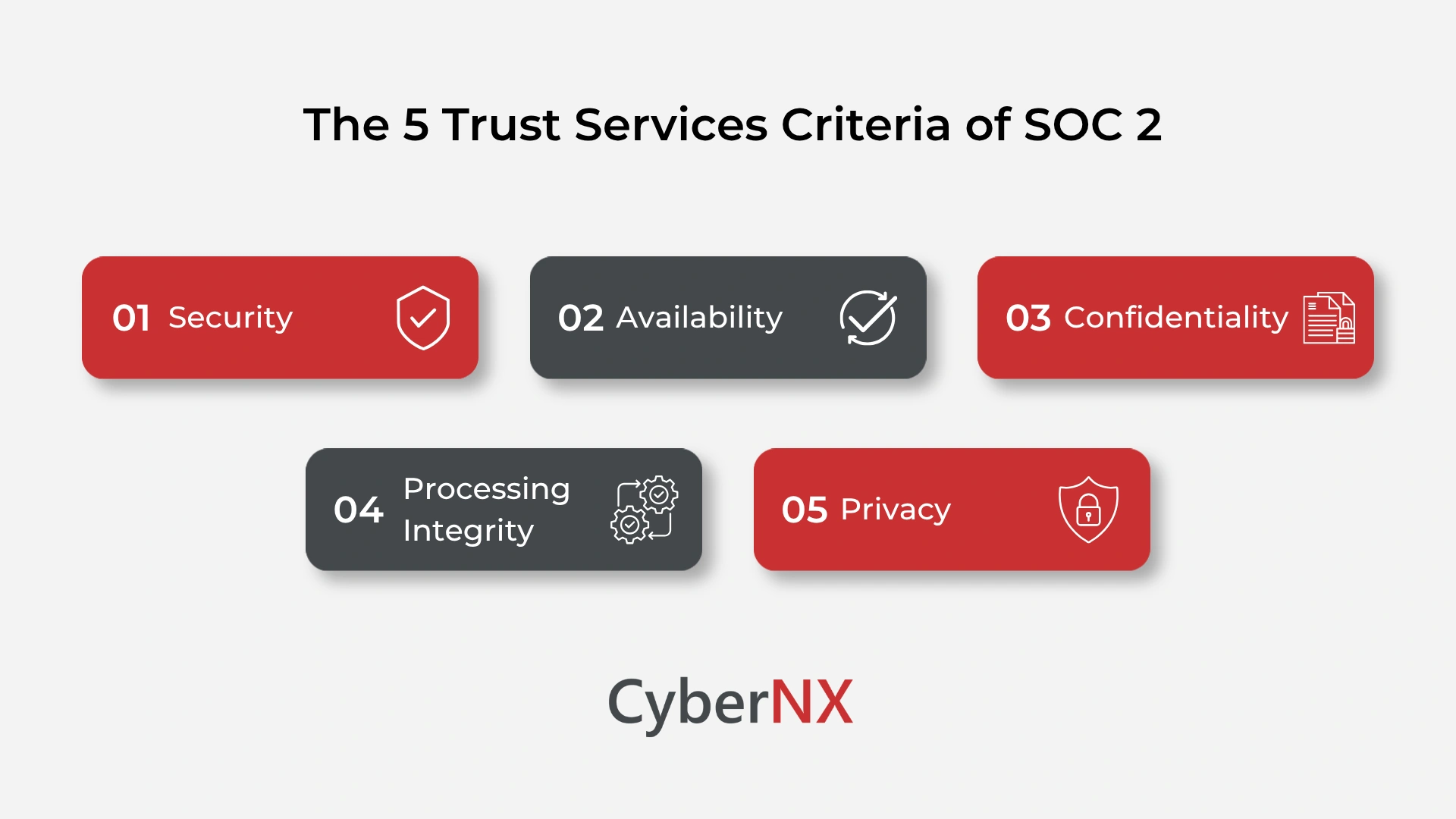
SOC 2 is built on five Trust Services Criteria (TSC) defined by the AICPA. One is mandatory. The other four are optional but that does not mean unimportant.
1. Security-the mandatory foundation
Security is the Common Criteria (CC) and appears in every SOC 2 engagement without exception. It covers the controls your organisation uses to protect systems and data from unauthorised access. Controls tested here include:
- Access management: how you grant, review and revoke user access
- Encryption: data protected in transit and at rest
- Monitoring and logging: continuous visibility into system activity
- Incident response: how you detect, contain and report security events
- Change management: how software and infrastructure changes are controlled
2. The four optional criteria
The remaining four criteria are scoped in based on what your organisation does and what your clients care about:
- Availability: your systems are accessible at the times and levels committed to clients
- Confidentiality: sensitive information is protected throughout its lifecycle
- Processing integrity: data is processed accurately, completely and on time
- Privacy: personal data is collected, used and disposed of according to your stated privacy notice
How to decide what belongs in scope
Scope is a commercial decision. A SOC 2 covering only Security with a narrowly defined system boundary can be technically clean with an unqualified opinion and still fail to satisfy a buyer whose workload is outside that boundary. Choose criteria that reflect what your clients entrust to you.
What is the difference between SOC 2 Type I and Type II?
Type I and Type II are the same framework applied at different depths. The table below shows the key differences at a glance.
| SOC 2 Type I | SOC 2 Type II | |
| What it tests | Control design as of a specific date | Control operation over an observation window |
| Auditor question | Are controls designed appropriately? | Did controls run effectively? |
| Time coverage | Point-in-time snapshot | 3 to 12 months of continuous evidence |
| Evidence sampled | Policy documents and system descriptions | Access reviews, logs, tickets, incident records across the full period |
| Typical use | First-time programmes; urgent deals | Standard buyer requirement; annual renewal |
| Buyer acceptance | Accepted temporarily while Type II is in progress | Required by most enterprise procurement teams |
| Timeline to complete | 2 to 4 months from readiness | 9 to 14 months including observation period |
Enterprise buyers almost always want Type II. It proves sustained performance, not just good design. The standard sequence for first-time SOC 2 programmes is a Type I to unblock an urgent deal, followed by a Type II covering the subsequent observation period. Buyers understand and accept this sequence.
How the SOC 2 audit process works
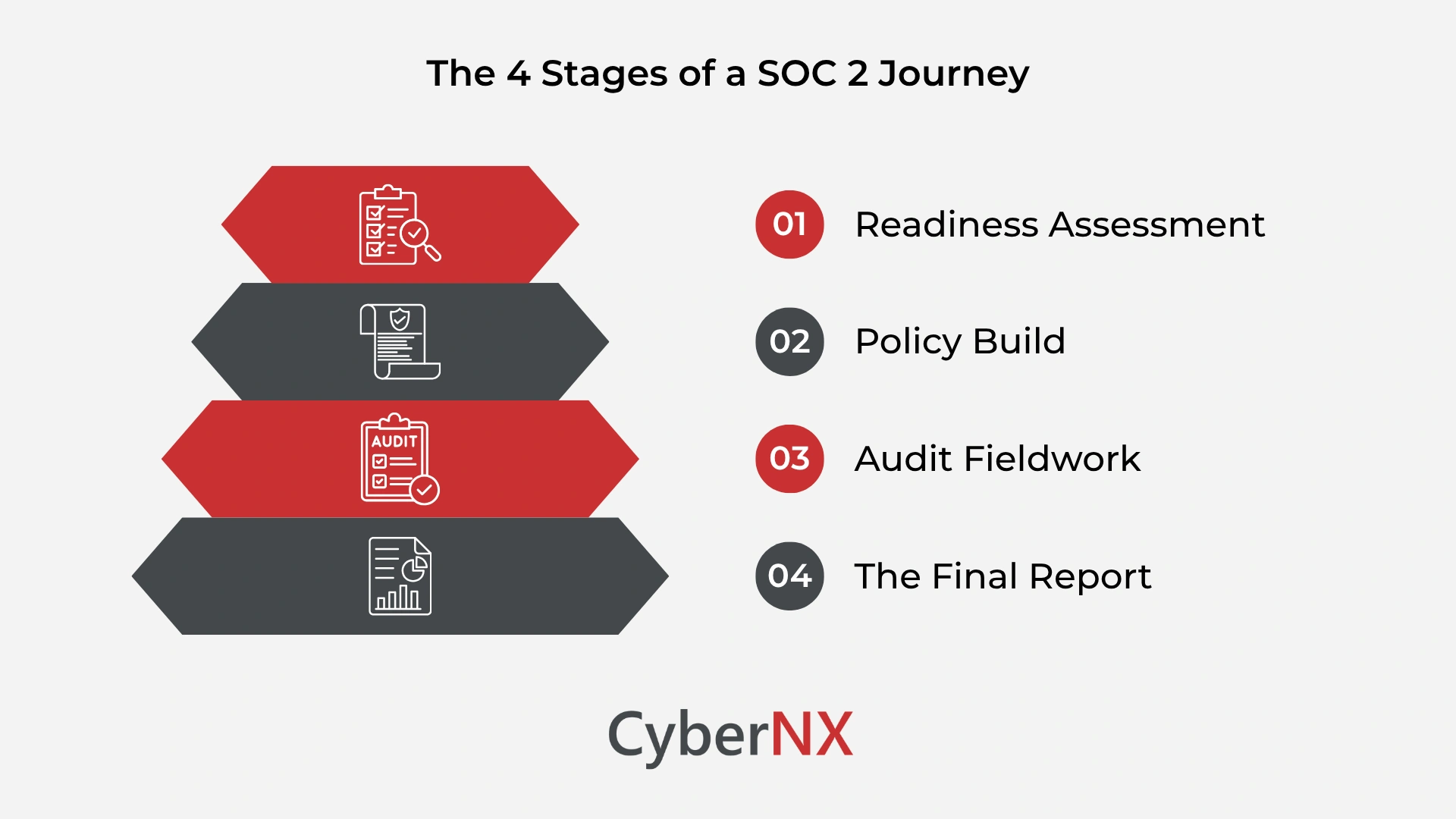
A SOC 2 engagement is not a single event. It is a programme with distinct phases, each building on the one before.
1. Readiness assessment and gap analysis
Before the formal audit begins, a readiness assessment maps your current controls against the Trust Services Criteria. It identifies missing controls, undocumented processes and inconsistencies that would not survive auditor sampling. The output tells you exactly how much remediation work lies between your current state and audit-readiness.
2. Policy build and remediation
Gaps identified in the readiness phase must be closed before the audit begins. Policies that do not exist need to be written. Control owners need to be assigned. Technical controls-multi-factor authentication (MFA), access provisioning workflows, logging configurations-need to be implemented and tested. This phase typically takes two to four months.
3. Audit fieldwork
The CPA firm requests evidence, conducts interviews and tests a sample of controls against the Trust Services Criteria in scope. For a Type I report, this covers your control environment at a specific point in time. For a Type II report, the auditor samples evidence across the full observation window-usually six to twelve months-testing whether controls ran consistently throughout.
4. The final report
The final report contains the auditor’s opinion. There are four possible outcomes: unqualified (controls operated effectively), qualified (exceptions found but not pervasive), adverse (controls were inadequate) or disclaimer of opinion (the auditor could not form a conclusion). Enterprise buyers read the exceptions section before they read anything else-a qualified opinion with a clear management response is often more credible than a clean report with no context.
What SOC 2 means for Indian businesses
SOC 2 demand in India is growing-but it is almost entirely driven by buyers, not regulators. Understanding that distinction shapes how you plan your programme.
Why the demand comes from buyers, not regulators
No Indian regulation requires SOC 2. The Reserve Bank of India (RBI), CERT-In and the Securities and Exchange Board of India (SEBI) have their own cybersecurity frameworks. SOC 2 sits outside those mandates entirely.
The demand comes from US and European enterprise procurement teams who include SOC 2 Type II as a vendor security requirement. For Indian SaaS companies, IT services exporters and Business Process Outsourcing (BPO) providers, it functions as a revenue gate-not a regulatory obligation. SOC 2 is worth investing in when your buyers are asking for it or when you are targeting markets where they will.
How SOC 2 sits with ISO 27001, DPDPA and CERT-In
- If your organisation already holds ISO 27001 certification, a large portion of your controls carry over. Access management, encryption, incident response and vendor risk management overlap significantly between the two frameworks-industry estimates place the overlap at 70 to 80 percent.
- The Digital Personal Data Protection Act (DPDPA) adds a privacy obligation that maps naturally to SOC 2’s Privacy criterion. Organisations building a SOC 2 programme that includes Privacy will find meaningful alignment with DPDPA’s reasonable security safeguards requirement.
- CERT-In reporting timelines remain a separate obligation, but a mature SOC 2 control environment makes evidencing CERT-In compliance significantly easier.
Conclusion
Three things are worth taking from this guide:
- SOC 2 is an attestation report issued by a licensed CPA firm.
- The scope you choose determines the report’s commercial value more than the opinion does.
- And Type II is what enterprise buyers want, because it proves sustained performance over months of real operating conditions, not just a well-written policy on the day of the audit.
For Indian businesses expanding into global markets, getting there requires a structured programme: framework design, policy documentation, internal controls, a managed observation period and a licensed CPA firm who understands your environment.
CyberNX offers end-to-end SOC 2 Type II implementation-from readiness assessment and gap analysis through policy build, internal audit, observation period guidance and CPA coordination. We work alongside your team, not hand you a checklist and walk away.
Ready to unblock your next international deal? Explore our SOC 2 implementation service or talk to our team about where you stand today.
SOC 2 guide FAQs
Is SOC 2 mandatory in India?
No Indian regulation requires SOC 2. It is entirely voluntary. The demand comes from clients—typically US or European enterprise buyers who include it as a procurement condition. For Indian companies actively targeting those markets, it becomes effectively mandatory for certain deals even though no law requires it.
Can you fail a SOC 2 audit?
There is no pass or fail. The auditor issues one of four opinions: unqualified, qualified, adverse or disclaimer of opinion. An unqualified opinion means controls operated effectively. A qualified opinion means exceptions were found but were not pervasive. Buyers read the exceptions section carefully-exceptions matter commercially even without a technical fail on record.
How long is a SOC 2 report valid?
A SOC 2 Type II report covers a defined observation period-usually 6 to 12 months. There is no formal expiry date, but enterprise buyers expect a current report. Most organisations renew annually to maintain continuous assurance and avoid coverage gaps that buyers will notice.
Do you need ISO 27001 before SOC 2?
No. ISO 27001 is not a prerequisite. However, if you already hold it, you have a significant head start-roughly 70 to 80 percent of underlying controls overlap. Many Indian organisations pursue both in sequence to serve different buyer markets with one shared control programme, reducing duplication and overall compliance cost.