Choose Language
Google Translate
Skip to content
Facebook X-twitter Instagram Linkedin Youtube
  • sales@cybernx.com
  • +91 90823 52813
CyberNX Logo
  • Home
  • About
    • About Us
    • CERT-In Empanelled Cybersecurity Auditor
    • Awards & Recognition
    • Our Customers
  • Services

    Peregrine

    • Managed Detection & Response
    • AI Managed SOC Services
    • Elastic Stack Consulting
    • CrowdStrike Consulting 
    • Threat Hunting Services
    • Digital Risk Protection Services
    • Threat Intelligence Services
    • Digital Forensics Services
    • Brand Risk & Dark Web Monitoring
    • Full Stack Observability

    Pinpoint

    • Red Teaming Services
    • Vulnerability Assessment
    • Penetration Testing Services
    • Secure Code Review Services
    • Cloud Security Assessment
    • Phishing Simulation Services
    • Breach and Attack Simulation Services

    nCompass

    • Cybersecurity Audit Services
    • Virtual CISO Services
    • DPDP Act Consulting
    • ISO 27001 Consulting
    • RBI Master Direction Compliance
    • SEBI CSCRF Framework Consulting
    • SEBI Cloud Framework Consulting
    • Security Awareness Training
    • Cybersecurity Staffing Services

    NXRadar

    • SBOM Solutions
    • CBOM Solutions
    • AIBOM Solutions
  • Industries
    • Banking
    • Financial Services
    • Insurance
  • Resources
    Blogs
    Case Studies
    Downloads
    Whitepapers
    Buyer’s Guide
    Research & Guides
    Data Sheets
  • Careers
  • English (US)
    • English
Contact Us
CyberNX Logo
  • English (US)
    • English
  • Home
  • About
    • About Us
    • CERT-In Empanelled Cybersecurity Auditor
    • Awards & Recognition
    • Our Customers
  • Services

    Peregrine

    • Managed Detection & Response
    • AI Managed SOC Services
    • Elastic Stack Consulting
    • CrowdStrike Consulting
    • Threat Hunting Services
    • Digital Risk Protection Services
    • Threat Intelligence Services
    • Digital Forensics Services
    • Brand Risk & Dark Web Monitoring
    • Full Stack Observability

    Pinpoint

    • Red Teaming Services
    • Vulnerability Assessment
    • Penetration Testing Services 
    • Secure Code Review Services
    • Cloud Security Assessment
    • Phishing Simulation Services
    • Breach and Attack Simulation Services

    nCompass

    • Cybersecurity Audit Services
    • Virtual CISO Services
    • DPDP Act Consulting
    • ISO 27001 Consulting
    • RBI Master Direction Compliance
    • SEBI CSCRF Framework Consulting
    • SEBI Cloud Framework Consulting
    • Security Awareness Training
    • Cybersecurity Staffing Services

    NXRadar

    • SBOM Solutions
    • CBOM Solutions
    • AIBOM Solutions
  • Industries
    • Banking
    • Financial Services
    • Insurance
  • Resources
    Blogs
    Case Studies
    Downloads
    Whitepapers
    Buyer’s Guide
    Research & Guides
    Data Sheets
  • Careers
  • Contact

SEBI CSCRF for Stock Brokers: A Complete Compliance Guide

3 min read
7 Views
  • SEBI CSCRF

A stock broker’s trading platform runs on client trust. One breach can freeze that platform, expose client accounts and trigger a regulatory review within hours. Cyberattacks on India’s financial sector have grown sharper and faster, and a single weak link in a broker’s systems can ripple across the exchange it connects to.

SEBI built the Cybersecurity and Cyber Resilience Framework to close that gap. CSCRF gives every registered stock broker a clear set of controls to follow: how to classify risk, monitor systems and report incidents on time. This guide breaks down what SEBI CSCRF for stock brokers actually requires, how classification works and where brokers most often fall short.

Table of Contents

What SEBI CSCRF means for stock brokers

SEBI CSCRF for stock brokers builds on the NIST Cybersecurity Framework, organised around six goals: Govern, Identify, Protect, Detect, Respond and Recover. It supersedes every earlier SEBI cybersecurity circular for brokers, depositories and other regulated entities into a single rulebook.

Every broker registered with a stock exchange falls under it, regardless of size. What changes is the depth of obligation, which depends on your classification tier.

How SEBI CSCRF classification works

SEBI groups regulated entities into five tiers: Market Infrastructure Institutions, Qualified REs, Mid-size REs, Small-size REs and Self-certification REs. Stock brokers are classified according to the thresholds prescribed by SEBI, based mainly on the number of registered clients and annual clientele trading volume. SEBI has also issued detailed clarification on how trading volume should be calculated for client-based brokers.

Core SEBI CSCRF requirements for stock brokers

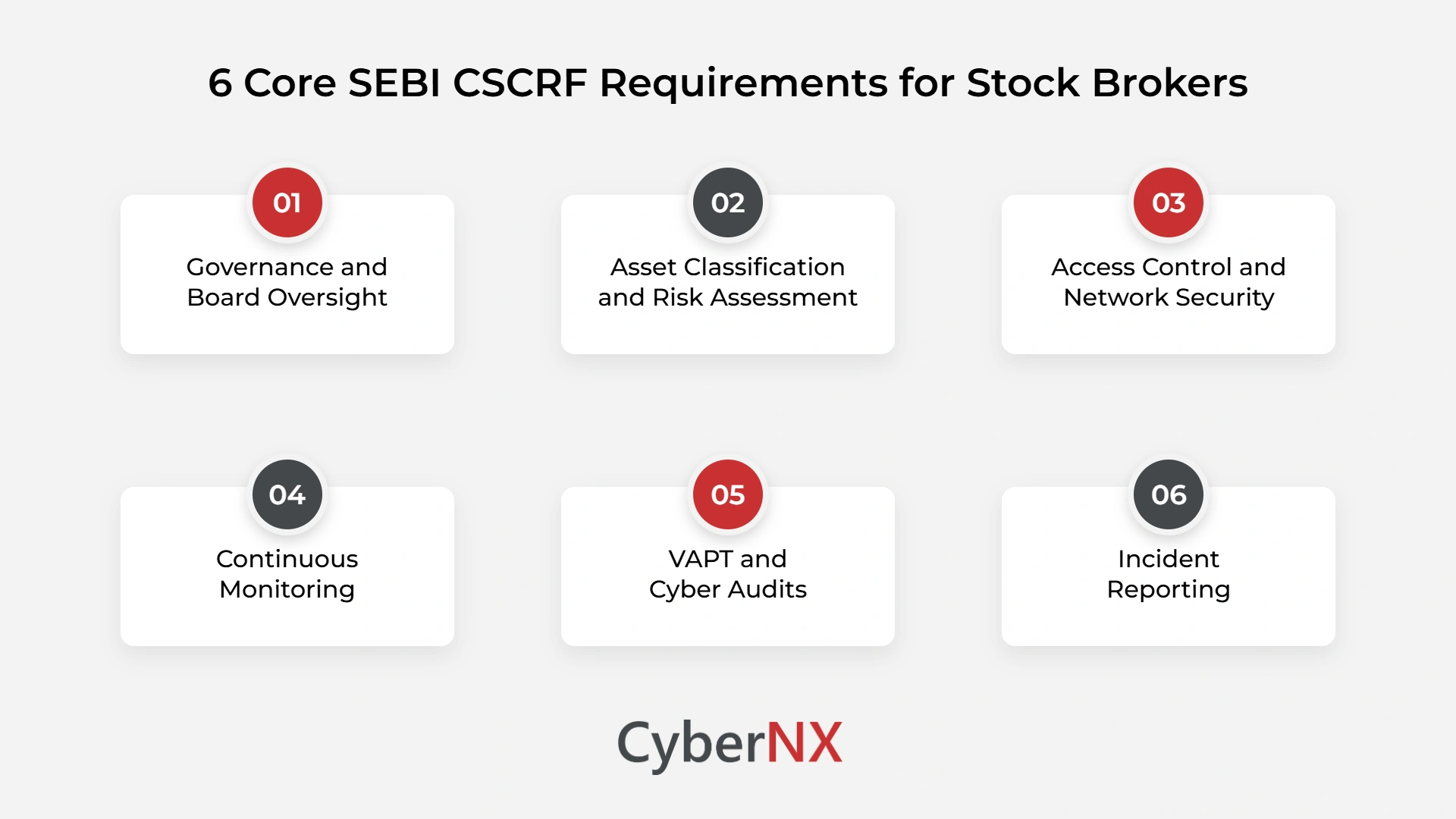
Once classified, most brokers above the smallest tier need to demonstrate the following controls, with evidence, not just policy documents.
6 Core SEBI CSCRF Requirements for Stock Brokers

  • Governance and board oversight: A designated CISO and board-level visibility into cyber risk, not just an IT sign-off.
  • Asset classification and risk assessment: Every critical system inventoried and ranked by exposure.
  • Access control and network security: MFA, network segmentation and least-privilege access across trading and back-office systems.
  • Continuous monitoring: A SOC or managed SOC watching trading platforms and client-facing systems around the clock.
  • VAPT and cyber audits: Periodic vulnerability assessment and penetration testing, plus periodic cybersecurity audits by auditors meeting SEBI’s prescribed eligibility requirements.
  • Incident reporting: Cyber incidents must be reported to CERT-In within the timelines prescribed under CERT-In Directions and to the relevant stock exchange/reporting authority in accordance with SEBI CSCRF requirements.

Higher tiers add obligations like threat hunting, red teaming and a formal Cyber Capability Index assessment.

Where stock brokers commonly fall short

Two gaps show up repeatedly during audits.

  • The first is an inflated self-assessed Cyber Capability Index score that the broker cannot back up with actual evidence when an auditor asks for it.
  • The second is incomplete documentation and evidence for cloud deployments, third-party environments and critical systems, making it difficult to demonstrate compliance during assessments..

Third-party risk is the other recurring issue. Brokers lean on vendors for trading platforms, cloud hosting and KYC processing. Each vendor is a potential entry point, and CSCRF expects you to extend your controls to them, not just your own systems.

Conclusion

SEBI CSCRF for stock brokers is not just a one-time filing anymore. It is an ongoing programme that includes governance, continuous monitoring, audits and incident response, with your obligations changing directly with your tier. Getting classification right and keeping evidence audit-ready is what separates a smooth annual review from a scramble.

CyberNX can help you achieve compliance with their SEBI CSCRF consulting services. We address your key challenges like understanding your SEBI CSCRF needs, developing a compliance roadmap, keeping up with control implementations, periodic assessments and measuring your effectiveness. If you’re unsure where your brokerage stands, connect with our experts for a structured path to SEBI CSCRF compliance.

SEBI CSCRF for stock brokers FAQs

What is SEBI CSCRF for stock brokers?

It is SEBI’s unified cybersecurity and cyber resilience framework, issued in August 2024, that sets governance, monitoring, audit and incident reporting requirements for every SEBI-registered stock broker.

How does stock broker classification work under CSCRF?

SEBI classifies stock brokers using thresholds based mainly on the number of registered clients and annual clientele trading volume, placing them into one of five tiers that determine applicable cybersecurity obligations and audit requirements.

What do you need to submit during a CSCRF audit?

Auditors expect documented policies, asset inventories, VAPT reports, incident logs and evidence supporting your Cyber Capability Index score, not just a completed checklist.

Why Cyber Capability Index matters for stock brokers

The Cyber Capability Index (CCI) measures cybersecurity maturity across multiple test parameters that are defined by SEBI. Higher-category entities must demonstrate and evidence the required maturity levels during assessments.

Gopakumar Panicker

Author
Gopakumar Panicker
LinkedIn

An accomplished security professional with extensive experience in Digital Security, Cloud Security, Cloud Architecture, Security Operations, and BFSI Compliance, Gopa has contributed to designing and strengthening enterprise-grade security environments, ensuring alignment with both technical and regulatory requirements. His work focuses on building resilient, scalable architectures and guiding organisations in elevating their operational maturity while meeting the stringent expectations of modern BFSI and cloud-driven ecosystems.

Share on

WhatsApp
LinkedIn
Facebook
X
Pinterest

For Customized Plans Tailored to Your Needs, Get in Touch Today!

Connect with us

RESOURCES

Related Blogs

Explore our resources section for insightful blogs, articles, infographics and case studies, covering everything in Cyber Security.
SEBI CSCRF Compliance for RTAs

SEBI CSCRF for RTAs: Compliance Requirements Explained

A single Registrar and Transfer Agent can hold folio records for millions of investors for dozens of listed companies. That

Agentic GRC under SEBI CSCRF

Agentic GRC Under SEBI CSCRF: Why the Audit Trail Still Has to Hold Up

Agentic AI simply means it can act autonomously, and that can create few challenges for compliance posture. It is especially

SEBI CSCRF Reporting Requirements: A Guide for Indian REs

SEBI CSCRF Reporting Requirements: A Complete Guide for Indian REs

Organisations across India’s securities market are quite relieved once their cybersecurity controls clear review and their compliance checklist is signed

RESOURCES

Cyber Security Knowledge Hub

Explore our resources section for insightful blogs, articles, infographics and case studies, covering everything in Cyber Security.

BLOGS

Stay informed with the latest cybersecurity trends, insights, and expert tips to keep your organization protected.

CASE STUDIES

Explore real-world examples of how CyberNX has successfully defended businesses and delivered measurable security improvements.

DOWNLOADS

Learn about our wide range of cybersecurity solutions designed to safeguard your business against evolving threats.
CyberNX Footer Logo
Book a Free Call

Peregrine

  • Managed Detection & Response
  • AI Managed SOC Services
  • Elastic Stack Consulting
  • CrowdStrike Consulting
  • Threat Hunting Services
  • Digital Risk Protection Services
  • Threat Intelligence Services
  • Digital Forensics Services
  • Brand Risk & Dark Web Monitoring
  • Full Stack Observability

Pinpoint

  • Red Teaming Services
  • Vulnerability Assessment
  • Penetration Testing Services
  • Secure Code Review Services
  • Cloud Security Assessment
  • Phishing Simulation Services
  • Breach and Attack Simulation Services

nCompass

  • Cybersecurity Audit Services
  • Virtual CISO Services
  • DPDP Act Consulting
  • ISO 27001 Consulting
  • RBI Master Direction Compliance
  • SEBI CSCRF Framework Consulting
  • SEBI Cloud Framework Consulting
  • Security Awareness Training
  • Cybersecurity Staffing Services

NXRadar

  • SBOM Solutions
  • CBOM Solutions
  • AIBOM Solutions
  • About
  • CERT-In
  • Awards
  • Careers
  • Sitemap
Facebook Twitter Instagram Youtube

Copyright © 2026 CyberNX | All Rights Reserved | Terms and Conditions | Privacy Policy

  • English (US)
    • English
Copyright © 2026 CyberNX | All Rights Reserved | Terms and Conditions | Privacy Policy
Scroll to Top

WhatsApp us

Not Sure Where to Start with Cybersecurity?

We value your privacy. Your personal information is collected and used only for legitimate business purposes in accordance with our Privacy Policy.