In 2026, many AI startups are shipping products faster than they are securing them. And for this reason, AI-native attacks are becoming very common.
For example, a retrieval-augmented generation (RAG) assistant leaks internal data because an attacker slipped a hidden instruction inside a user query. That query reached the retrieval pipeline, pulled confidential data and handed it right back. The assistant did exactly what it was built to do and the attacker got what they came for.
This is the nature of AI-native attacks. They do not send suspicious signals. Instead, they work with the model, not against the infrastructure around it. And most startups aren’t even testing for any of it.
Most AI startups still run conventional penetration testing or security reviews. These are valuable, but they were never built to check how an attacker manipulates a model.
This is why AI red teaming is fast becoming a non-negotiable security function for startups shipping AI products.
Why traditional pentesting leaves AI startups exposed
Conventional penetration testing is built around a straightforward idea: find weaknesses in your infrastructure, APIs, authentication flows and application code.
That model works well for traditional software. AI systems are different. A large language model (LLM) can function exactly as intended from a technical standpoint, while also leaking sensitive data, producing dangerous outputs or following instructions it was never meant to follow.
Standard pentests don’t evaluate:
- Prompt injection attacks: where attackers manipulate inputs to override system instructions
- Indirect instruction attacks: where malicious commands are hidden inside documents or webpages the model reads
- Context poisoning: where retrieval pipelines are fed corrupted content
- Unsafe tool execution: where an AI agent connected to APIs takes unintended actions
- Model jailbreaks: where safety guardrails are bypassed through crafted inputs
- Insecure agent behaviour: where autonomous workflows are manipulated into harmful actions
A startup can pass a conventional test with flying colours while its AI layer remains wide open.
The attack surface most startups aren’t thinking about
When most early-stage AI companies think about security risks, they picture infrastructure compromise like a server breach, a stolen credential, a misconfigured cloud bucket.
Attackers have moved on. The model interaction layer is now a primary target. That includes:
- The prompts your system sends and receives
- Your retrieval pipelines and embedding models
- External tool integrations and API connections
- Third-party models or plugins in your stack
- Training and fine-tuning datasets
A modern AI application has become a probabilistic system that interacts dynamically with external data, user inputs and real-world tools. Every one of those interactions is a potential attack path. Red teaming for AI-native startups has to reflect this reality.
What AI red teaming actually tests
AI red teaming mimics realistic adversarial behaviour against AI systems. The goal is to understand how the model behaves under hostile conditions, and what that means for your users and your data. Here’s what a structured red teaming engagement covers:
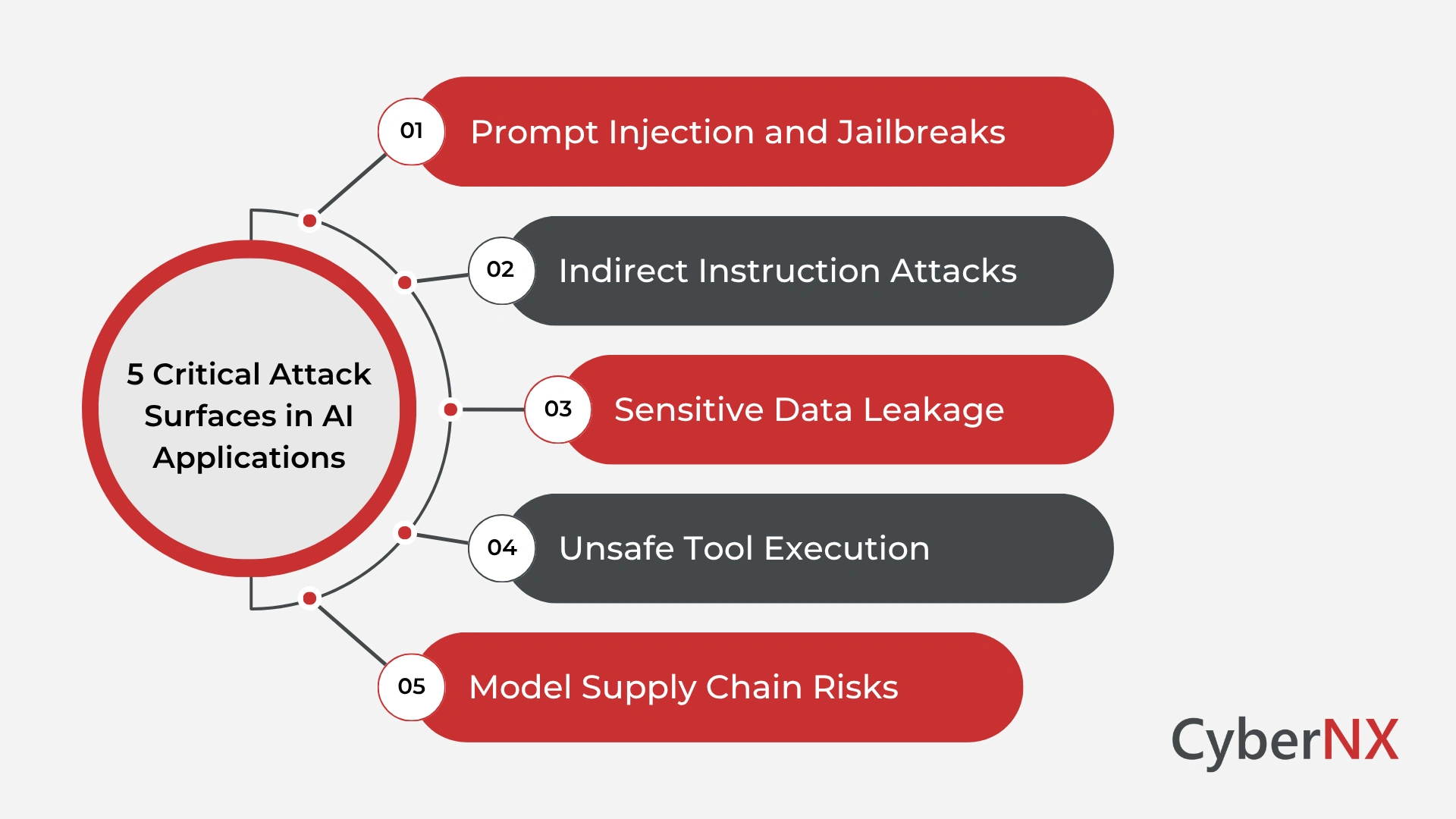
Prompt injection and jailbreaks
Attackers craft inputs designed to override your system prompt, bypass instructions or extract information the model was told to keep restricted.
Indirect instruction attacks
Harmful instructions are embedded inside content the model consumes – a document, a webpage, a support ticket etc. The model reads it and follows the hidden command without the user or developer realising what happened.
Sensitive data leakage
Models can unintentionally reveal system prompts, internal configuration details, user data or proprietary information, especially when pushed with well-structured adversarial inputs.
Unsafe tool execution
When AI agents are connected to APIs, databases or internal workflows, adversarial prompts can trigger unintended actions. Sending emails, modifying records, accessing restricted systems – the blast radius depends on what permissions the agent has.
Model supply chain risks
Third-party models, open-source libraries, plugins and training datasets introduce dependencies you don’t fully control. Any of them can carry hidden vulnerabilities or unexpected behaviours.
How AI attacks unfold differently
Traditional attacks usually target infrastructure weaknesses. They leave forensic traces – unusual login attempts, port scans, anomalous network traffic.
AI attacks target trust, logic and model behaviour. An attacker doesn’t need to breach your infrastructure. Instead, they might:
- Manipulate a prompt to retrieve data the model was never supposed to return
- Poison a retrieval source used by your RAG pipeline
- Trigger an autonomous workflow through a carefully constructed input
- Exploit a reasoning flaw in how the model interprets ambiguous instructions
The model technically behaves “normally” throughout. That’s what makes AI security testing much harder than traditional application security – and why it requires a fundamentally different adversarial mindset.
What to look for in an AI red teaming partner
AI security testing needs expertise beyond traditional offensive security. Your testing partner should understand:
- LLM architectures and their known failure modes
- RAG systems and retrieval pipeline vulnerabilities
- Agentic workflows and tool-use risks
- Prompt injection techniques and emerging bypass methods
- AI governance and responsible disclosure
More importantly, look for partners who simulate realistic attacker behaviour, not teams running through a fixed checklist. The quality of adversarial testing is almost entirely a function of the creativity and realism of the methodology.
The bottom line
AI applications introduce attack surfaces that traditional security testing was never designed to find. The earlier you test your AI systems under realistic conditions, the easier it becomes to scale securely, build customer trust and avoid a costly incident that hits you at the worst possible time.
At CyberNX, we help AI-native organisations stress-test and secure their AI environments through specialised adversarial red teaming exercises. Our approach focuses on real-world exploitation paths – from prompt injection and unsafe agent behaviour to sensitive data leakage and retrieval manipulation.
If you’re building AI products and want to strengthen your red teaming for startups strategy, connect with our experts to strengthen your AI security posture before the gaps are found by attackers.
Red Teaming for Startups FAQs
What is AI red teaming?
AI red teaming is the process of simulating adversarial attacks against AI systems to identify risks such as prompt injection, data leakage and unsafe model behaviour—risks that standard security testing doesn’t cover.
Why isn’t traditional pentesting enough for AI startups?
Traditional pentesting focuses on infrastructure and application security. AI systems introduce behavioural risks at the model layer, and those require specialised adversarial testing with a different methodology.
When should a startup begin AI red teaming?
Before you scale. Ideally before your product goes into production, especially if it handles customer data or runs autonomous workflows. The cost of finding a vulnerability at 1,000 users is a fraction of finding it at 1,000,000.
What are the most common AI security risks for startups?
Prompt injection, indirect instruction attacks, unsafe tool execution, sensitive data leakage and insecure third-party model dependencies are the most frequently exploited attack vectors.
How often should AI systems be red teamed?
Continuously – or at minimum, at every major model update, prompt change or workflow expansion. AI systems evolve fast. Your testing should keep pace.