A clean vulnerability scan report is often read as a green light. Then a SEBI CSCRF or RBI audit cycle comes around, an auditor asks for the vulnerability assessment and penetration testing (VAPT) report, and the two documents do not match up. That gap, between running a scan and proving real-world exploitability, is where compliance timelines slip and security budgets get spent on the wrong service.
Vendor pitches and industry conversations often use penetration testing vs. vulnerability scanning interchangeably, even though the two answer different questions and carry different weight with regulators.
This guide breaks down the actual difference between penetration testing and vulnerability scanning, explains where SEBI CSCRF and the RBI Master Direction come in, and helps you decide what your business needs first.
What is vulnerability scanning?
Vulnerability scanning is an automated process. It uses specialised tools to check your networks, servers, applications and cloud assets against a database of known weaknesses, then reports what it finds.
Think of it as a health check-up. It tells you where a problem might exist. It does not tell you how bad the problem is if someone actually tried to exploit it.
Vulnerability scans are:
- Automated and fast to run at scale
- Broad in coverage, checking hundreds of systems at once
- Best run frequently, since new vulnerabilities appear daily
- Limited in depth, since they flag issues without proving exploitability
What is penetration testing?
Penetration testing goes a step further. The process involves a skilled tester, often called an ethical hacker, who actively tries to break into your systems the way a real attacker would.
Instead of just flagging a weak configuration, a pen test proves whether that weakness can actually be exploited, and how far an attacker could get once inside. It combines manual technique, creativity and attacker mindset with the findings a scan produces.
Penetration testing is:
- Manual and expert-led, not fully automated
- Narrower in scope, focused on specific, high-value systems
- Conducted periodically, typically once or twice a year
- Deeper in outcome, showing real business impact, not just a list of flaws
Key differences between penetration testing and vulnerability scanning
Here is a quick side-by-side view to help you compare vulnerability scanning against penetration testing across the key factors:
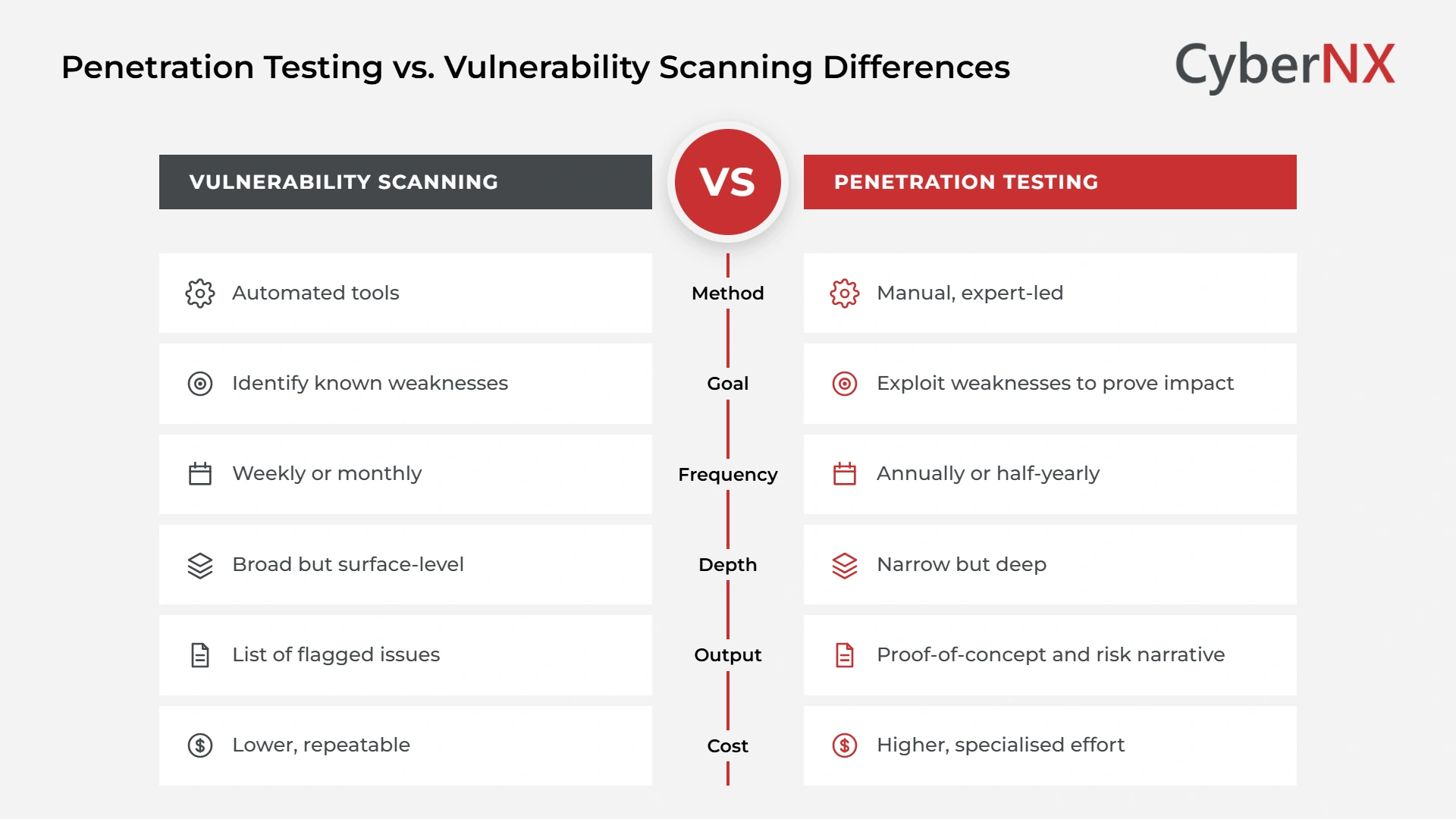
A few points worth talking about from this comparison:
- Scans find the open window, tests check if someone can climb through it. A vulnerability scan flags a missing patch. A pen test shows whether that missing patch actually lets an attacker into your customer database.
- Frequency needs differ by design. Since new CVEs surface constantly, scanning works best as a continuous or monthly habit. Pen testing, being resource-intensive, is often scheduled around major releases or regulatory deadlines.
- Neither replaces the other. A scan without a test leaves exploitability unverified. A test without regular scanning means new vulnerabilities go unnoticed between engagements.
Why Indian compliance frameworks require both
For regulated Indian businesses, this is a compliance requirement, and the two activities are treated as distinct obligations.
Under the SEBI Cybersecurity and Cyber Resilience Framework (CSCRF), regulated entities must complete vulnerability assessment and penetration testing (VAPT) through a CERT-In empanelled auditor. Market infrastructure institutions and qualified stockbrokers must run this twice a year, while most other regulated entities follow an annual cycle. Vulnerabilities flagged during VAPT must be closed within three months of the report, with high-severity patch gaps fixed far sooner.
The RBI Master Direction on IT Governance, which applies to banks, NBFCs and payment system operators, sets a similar but distinct rhythm. Regulated entities are expected to conduct periodic vulnerability assessments and penetration testing based on applicable RBI guidelines, system criticality and risk. Payment system operators face an added trigger: VAPT before any new service goes live, not only on a fixed calendar.
Reading these frameworks together, the pattern is clear. Vulnerability scanning covers you between audits. Penetration testing is what regulators, and genuine attackers, actually want proof against.
Which one does your business need first?
If you are early in your security journey, start with regular vulnerability scanning. It is affordable, fast and gives you visibility across your entire environment.
As your business grows, handles regulated data, or falls under SEBI, RBI or CERT-In requirements, penetration testing becomes non-negotiable. Consider penetration testing sooner if:
- You handle customer financial data or personal data under DPDPA
- You are preparing for a SEBI CSCRF or RBI audit
- You have launched a new customer-facing application or API
- A previous vulnerability scan flagged issues you are not sure are exploitable
Most mature security programmes eventually run both together: continuous scanning to catch new issues as they appear, and scheduled penetration testing to validate real-world risk and satisfy audit requirements.
Conclusion
Vulnerability scanning and penetration testing solve different problems. One gives you continuous visibility into new weaknesses. The other proves what an attacker could actually do with them, and satisfies the VAPT obligations set out under SEBI CSCRF and RBI Master Direction guidelines.
The right approach almost always combines both. If you are ready to move from guesswork to a structured programme, CyberNX’s vulnerability assessment service and penetration testing services are built around this exact penetration testing vs. vulnerability scanning distinction, so you get continuous coverage and audit-ready proof from a single, CERT-In empanelled partner. Talk to our team to build a testing rhythm that fits your compliance calendar.
Penetration Testing vs. Vulnerability Scanning FAQs
Is vulnerability scanning the same as penetration testing?
No. Vulnerability scanning is automated and identifies known weaknesses. Penetration testing is manual and actively exploits those weaknesses to show real-world impact.
How often should each be performed?
Vulnerability scans work best monthly or continuously. Penetration tests are typically run annually or more frequently where required by sector-specific regulations.
Can a vulnerability scan replace a penetration test for compliance?
No. SEBI CSCRF and RBI frameworks require VAPT, which combines both activities. A scan alone does not satisfy the penetration testing component.
Does penetration testing need to be done by a CERT-In empanelled auditor?
Yes, for SEBI and RBI regulated entities. Reports from a CERT-In empanelled organisation are required for audit submissions and closure tracking.