Ask three teams inside the same company how ready they are for India’s data protection law and you may get three different answers.
Legal points to the policy drafted last quarter. Engineering points to the consent banner that went live. Procurement is still waiting on updated vendor contracts. Every answer is partly right, but that is exactly the problem.
A DPDPA readiness maturity model turns that scattered picture into one reliable and complete answer. This guide breaks down the five levels of readiness, what each level looks like, where Indian enterprises sit today and what it takes to climb one step up.
What is a DPDPA readiness maturity model?
It is a simple way to grade how far your organisation has moved from intent to evidence under the Digital Personal Data Protection Act (DPDPA). Instead of asking “are we compliant”, it asks a sharper question. Can you prove it today, and can you prove it again next quarter?
The grading matters because the law arrives in stages. The DPDP Rules, 2025 provide an 18-month phased implementation period, with core obligations taking effect on May 13, 2027. Notice, consent, data principal rights, security safeguards, breach reporting, retention and erasure all become enforceable on May 13, 2027. The Schedule to the DPDP Act allows penalties of up to ₹250 crore for failing to maintain reasonable security safeguards.
The five levels of DPDPA readiness
The five levels below are a practical assessment framework, not an official maturity model prescribed by the DPDP Act or Rules. Each level is defined by what you can show an auditor, not by how much you have discussed internally.
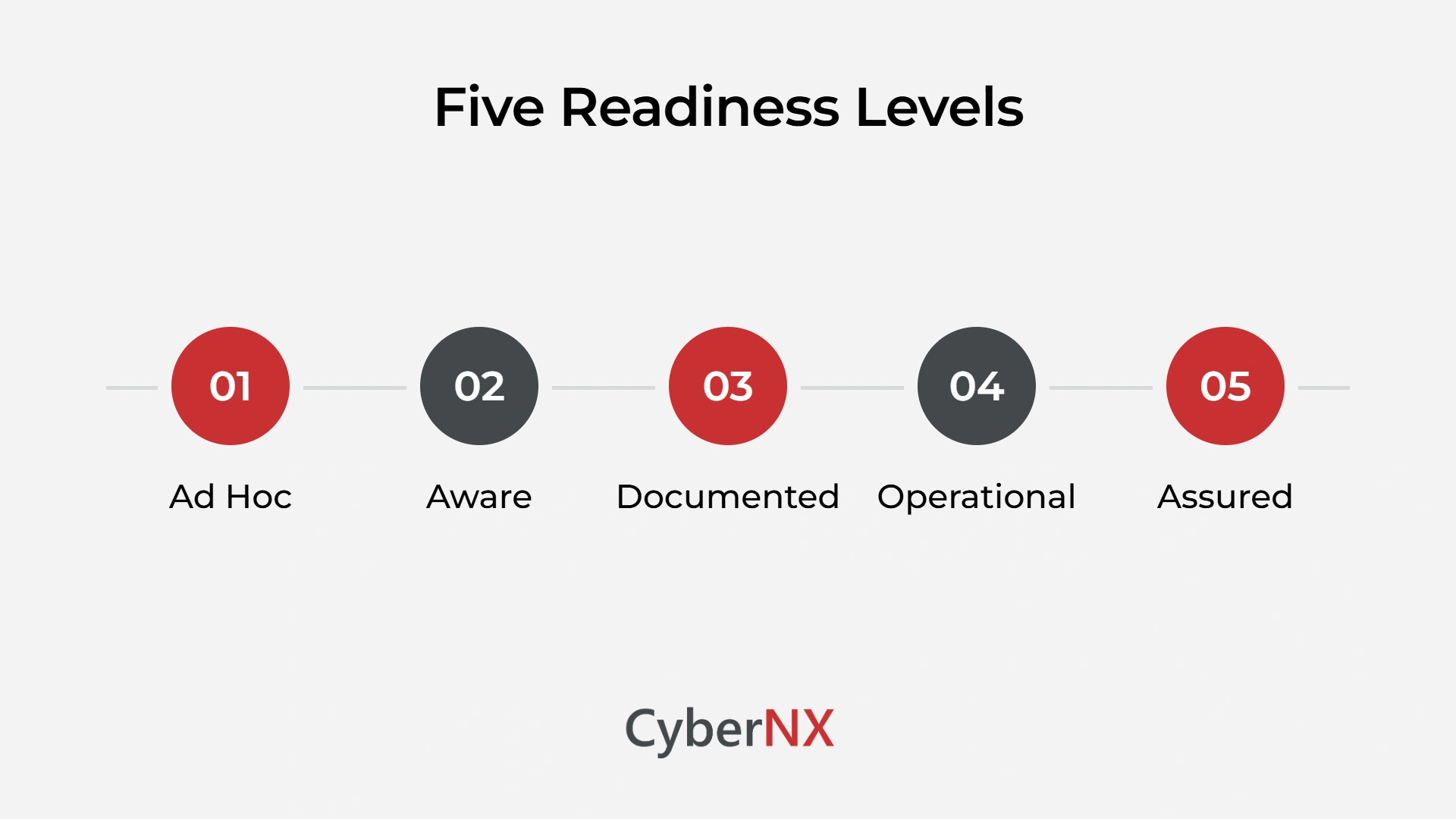
- Ad hoc: No named owner for personal data. Privacy questions get answered case by case, usually during a customer audit or a large sales deal.
- Aware: Leadership understands the law and a gap assessment is done. Findings exist, but no funded roadmap or accountable owner sits behind them.
- Documented: A data inventory, records of processing, refreshed privacy notices and a retention policy are in place. A privacy or data protection owner is named, with a Data Protection Officer appointed where required under the DPDP framework.
- Operational: Consent capture and withdrawal work in production. Data principal requests are closed inside defined timelines. Breach response has been rehearsed, not just written. Deletion runs on schedule.
- Assured: Controls are monitored continuously. Impact assessments and independent audits are routine. Evidence is board ready and can be handed to a regulator without a scramble.
Very few organisations sit completely on one level. Marketing may run at Level 4 while HR still operates at Level 1. Your real score is the lowest level across any function that touches personal data.
Where Indian enterprises stand today
EY India’s report, India’s digital privacy crossroads: Understanding the DPDP Act’s impact and enterprise readiness, surveyed more than 150 professionals across sectors. Its findings map neatly onto the levels above.
- Nearly 48% have started a gap assessment, which is classic Level 2 behaviour.
- Nearly 44% have documented data processing activities.
- Close to 38% have categorised personal data and identified third party processors.
- More than 83% have not yet begun comprehensive implementation of the Act’s requirements.
Sector progress is uneven. Consumer, retail and e-commerce lead with 50% having begun the journey, while healthcare and life sciences trail at 9.9%. The same EY India report places overall maturity in the early to intermediate stage, with advanced practices such as real time monitoring, data masking and access governance still limited.
How to move up one level
Progress comes from closing the gap between what is written and what can be shown. A few moves carry the most weight.
- Fix ownership first: One accountable owner beats five part-time contributors
- Map before you buy: Data discovery and classification decide whether consent and deletion tooling will work at all
- Test the breach clock: Run a tabletop exercise against the reporting timelines instead of assuming the plan holds
- Pull vendors in early: Processor contracts and cross border flows are usually the slowest items to renegotiate
- Keep evidence, not intent: Logs, approvals and audit trails are what a regulator asks to see
There is one more reason to start early. Business Standard reported in Jan 2026 that MeitY had proposed cutting the compliance window for Significant Data Fiduciaries from 18 months to 12. A final decision was still awaited, but large banks, insurers and platforms should plan for the tighter end of that range.
Conclusion
Placing your organisation honestly on this maturity model answers two practical questions.
- Which function is holding the score down?
- What should the next 90 days actually fund?
The work between documentation and operation is where the engineering and contract effort sits, and it does not compress well in the last quarter before May 13, 2027.
At CyberNX, our Digital Personal Data Protection Act consulting team helps Indian enterprises test their readiness, prioritise gaps and build evidence for the DPDP framework. Talk to our experts and find out which level your organisation sits on today.
DPDPA readiness maturity model FAQs
What is a DPDPA readiness maturity model?
It is a staged framework that grades how far an organisation has moved from awareness of the Digital Personal Data Protection Act to provable, day-to-day compliance. The five levels run from ad hoc handling through documentation, live operation and finally independent assurance. Its value is diagnostic. It tells you which level you can defend with evidence right now.
What are the key DPDPA compliance dates for Indian organisations?
The DPDP Rules, 2025 were notified on Nov 13, 2025, and the Data Protection Board of India was constituted the same day. Consent Manager registration opens on Nov 13, 2026. Most operational obligations, including notice, consent, data principal rights, security safeguards and breach reporting, apply from May 13, 2027.
Which level should an enterprise target before May 2027?
For this maturity model, Level 4 is a sensible target before May 2027 because it represents controls operating in production rather than existing only on paper. Organisations that are Significant Data Fiduciaries should also build toward the enhanced obligations applicable to them, including DPIAs and periodic audits.
How often should DPDPA readiness be reassessed?
Re-grade every quarter while the programme is being built, then move to an annual cycle aligned with your audit calendar. Also, reassess after any material change, such as a new product launch, a new processor, a cross-border flow or a change in the volume of personal data you handle.