CrowdStrike Falcon Complete MDR is CrowdStrike’s own fully managed detection and response service, staffed by their analysts, operating on their playbooks. Partner-delivered MDR runs the same Falcon platform, but a specialist services partner operates it around your environment. Both are legitimate and the difference is rarely about technology quality.
In this blog, we compare the two ways of utilizing Falcon, using the criteria that determine which one will be suitable and beneficial, let’s say, in eighteen months.
What CrowdStrike Falcon Complete MDR includes
Falcon Complete is CrowdStrike’s managed service layer on top of the Falcon platform. You are essentially buying analyst capacity and response authority and not just software.
The core service components
The scope is broad, and worth stating plainly before any comparison.
- Continuous monitoring: Round-the-clock coverage of Falcon telemetry from endpoints, and from identity and cloud modules where you have licensed them.
- Alert triage and investigation: CrowdStrike analysts validate detections so your team is not chasing false positives.
- Proactive threat hunting: Analyst-led hunts informed by CrowdStrike’s global adversary intelligence.
- Hands-on remediation: This is the differentiating piece. The service extends to active containment and cleanup rather than notification alone.
- Unified operational visibility: CrowdStrike consolidated MDR operations into a single view showing active incidents, remediation status and performance metrics.
If you want the full inclusion and exclusion breakdown, our CrowdStrike MDR guide covers what the service does and does not carry. This post assumes you have read that and are now choosing a delivery model.
What “response” means in practice
The word response is where evaluations go wrong. Ask precisely what actions the service is authorised to take without waiting for you.
Isolating an endpoint is standard plus killing a process is also standard. Disabling an account, resetting credentials, changing a firewall rule or touching a domain controller usually are not, because they sit in systems outside the Falcon sensor’s reach. That boundary is the single most important thing to establish in your evaluation, and it applies to both delivery models.
What partner-delivered MDR on Falcon changes
A partner-delivered model uses the same platform and the same telemetry. What differs is who operates it and how far their remit extends.
Environment knowledge instead of playbook knowledge
CrowdStrike analysts know the Falcon platform better than anyone. However, they may be unaware that your payments application throws odd process behaviour every month-end, or that a particular admin account legitimately touches forty servers on Friday nights.
A partner operating your environment builds that knowledge deliberately. Over time this reduces the escalation volume that lands on your team, because context is applied before escalation rather than after.
Response beyond the Falcon boundary
This is the practical advantage. A partner running your security operations can usually act in your identity provider, network controls and ticketing system, because those are inside the engagement scope.
That means containment does not stop where the sensor stops. When a compromised identity is the actual problem, the difference between isolating a laptop and disabling the account across your estate is the difference between slowing an attacker and stopping one.
Coverage of what Falcon does not see
No MDR service protects what it cannot observe. Most enterprises run systems the Falcon sensor cannot reach, including legacy operating systems, network appliances and operational technology.
A partner model can wrap those into the monitoring scope through log ingestion, alongside Falcon telemetry. Our guidance on correlating cloud, identity and endpoint signals explains how that consolidated view is constructed.
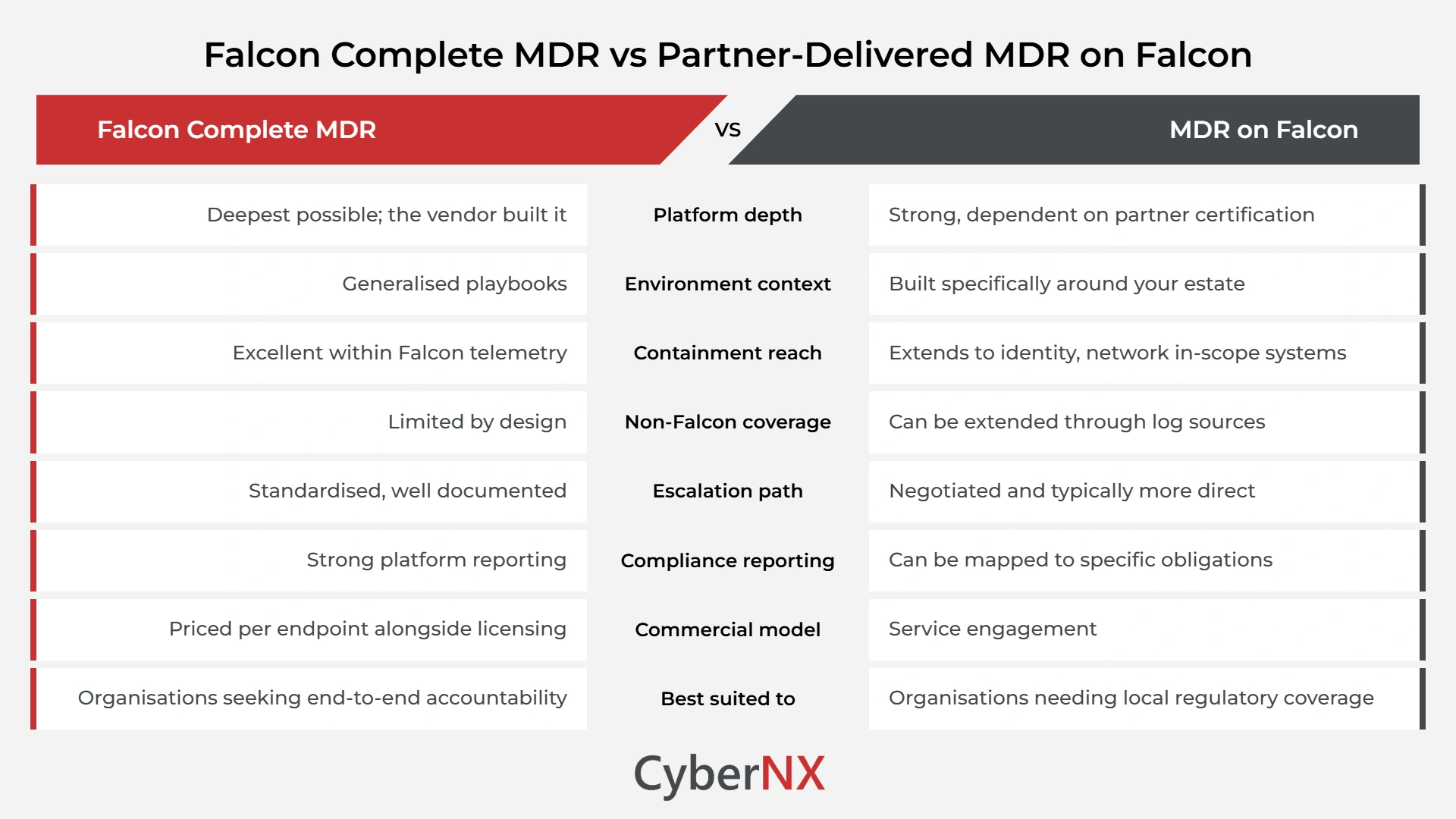
Comparing the two models on what matters
Here is the comparison:
The criterion most evaluations miss
Ask both options this question: when a genuine incident runs for six hours, who is talking to my board.
Falcon Complete gives you excellent incident documentation and a clear remediation record. A partner engagement usually gives you a named person who joins your bridge call and explains what is happening in language your leadership understands. Neither is better in the abstract. One of them matches how your organisation handles pressure.
Choose the operating model, not the brochure
Falcon Complete MDR and partner-delivered MDR both work, and both run on the strongest endpoint platform available. The decision comes down to three things:
- how far you need containment to reach beyond the Falcon sensor
- how much your environment’s quirks affect alert quality and
- who you want on the call when something serious is happening
At CyberNX, our CrowdStrike Consulting team delivers managed detection and response built around your environment – and we can walk your own incident scenario through both models with you.
We are a certified CrowdStrike strategic partner and our partnership combines our detection engineering and managed SOC expertise with CrowdStrike’s AI-native unified platform.
Against the three deciding criteria in this blog:
- On containment reach, CyberNX’s partner-delivered model extends beyond the Falcon sensor boundary into identity, network and in-scope systems, so containment does not stop where the sensor does
- On environment context, our team builds knowledge of your estate deliberately over time, reducing the escalation volume that generic playbooks generate
- On who is on the call, we provide a named person who joins your bridge, explains what is happening in terms your leadership understands and is backed by the full depth of CrowdStrike’s AI-native platform and threat intelligence.
For Indian regulated organisations, that model also maps evidence and reporting directly to RBI, SEBI, CERT-In and DPDPA obligations – which standardised service tiers rarely do. Working through this decision now? Talk to our CrowdStrike Consulting team before you sign.
CrowdStrike Falcon Complete FAQs
What is the difference between Falcon Complete and standard CrowdStrike MDR?
Falcon Complete is CrowdStrike’s own MDR service, delivered by CrowdStrike analysts with hands-on remediation included. The broader term CrowdStrike MDR can also describe partner-operated services running on the same Falcon platform. The platform is identical, so the real difference is who operates it, what they are authorised to do and how far their scope extends beyond Falcon telemetry.
Can you switch from Falcon Complete to partner-delivered MDR later?
Yes, and it is a reasonably common path once an organisation’s security operations mature. Because both models run on the same platform, your telemetry, detections and historical data stay in place. Plan for a transition period covering detection tuning, playbook handover and escalation redesign rather than treating it as a switch flip.
Which model works better for mid-sized enterprises in regulated sectors?
It depends less on size than on obligations. If your reporting requirements are driven by Indian regulators or sector-specific rules, partner delivery usually fits better, because reporting and evidence can be mapped to those frameworks directly. If your priority is single-vendor accountability with minimal internal coordination, Falcon Complete is the cleaner arrangement.