Brand trust takes years to build and minutes to damage. Most organisations learn this the hard way. A fake domain launches a phishing campaign. A cloned social account posts harmful content. Customers lose trust before security teams even see the alert.
This is where brand risk monitoring becomes critical. It gives security and risk leaders visibility beyond internal systems. It helps spot threats that misuse your brand in the open internet. That includes domains, social media, mobile apps and dark web chatter.
We see many organisations focus on internal controls first. Firewalls, endpoint protection and identity tools get attention. Yet brand misuse often happens outside the perimeter. This guide explains what brand monitoring really means. We explore why it matters, the risks it addresses and how to approach it with clarity and confidence.
What is brand risk monitoring?
Brand risk monitoring is the continuous surveillance of digital channels for misuse of your brand. This includes your name, logos, domains, executives and trusted assets.
It is not limited to marketing or legal teams. Security teams rely on it to detect phishing campaigns early. Risk teams use it to assess exposure. Leadership teams use it to protect reputation and revenue. At its core, brand monitoring answers one simple question. Who is using our brand, and for what purpose? When done well, it connects external threat signals with internal response processes. That alignment is what reduces impact.
High-Impact brand risks for the modern enterprise
Here are the key brand risks organisations face today:
1. Phishing and brand impersonation
Attackers create lookalike domains and emails that appear legitimate. These often target customers, partners and employees. The risk is not only financial loss. Trust erosion is harder to repair. Customers may hesitate to engage even after incidents are resolved.
2. Fake social media accounts
Impersonated social profiles spread misinformation, scams or harmful content. They often surface during high visibility events such as product launches or crises. Security teams rarely monitor social platforms by default. Brand risk monitoring fills that gap.
3. Mobile app impersonation
Fake apps using brand names or logos appear in app stores. Users download them assuming legitimacy. This can lead to credential theft and malware infections. Once again, this risk sits outside traditional security controls.
4. Executive impersonation
Attackers impersonate senior leaders to conduct fraud or social engineering. This is common in business email compromise attacks. Monitoring executive names alongside brand assets helps reduce this exposure.
Brand monitoring: how it stops breaches you can’t see coming
Brand monitoring should matter to business leaders because that’s what helps security teams defend against powerful cyberattack campaigns.
1. Brand abuse fuels modern attacks
Most phishing campaigns rely on trust. Attackers copy logos, domains and language that users recognise. Without visibility into these external assets, response is always delayed.
Our experience shows that early detection can stop attacks before they scale. Catching a spoofed domain during registration is far easier than cleaning up after customers are affected.
2. Reputation damage moves faster than incidents
Security incidents can be contained. Reputation damage spreads on social platforms within minutes. A single fake post can be shared widely before it is taken down.
Brand risk monitoring helps teams act early. It gives factual insight rather than relying on customer complaints or media reports.
3. Regulatory pressure is rising
Regulators expect organisations to manage third party and reputational risk. Brand misuse that leads to fraud can quickly become a governance issue.
For CISOs and CXOs, brand risk monitoring supports a more defensible security posture. It shows proactive oversight rather than reactive clean-up.
The mechanics of brand risk monitoring
Effective brand risk monitoring is not a single capability. It is a system of connected components that work together to reduce exposure and response time. When one component is weak, attackers find space to operate. When all are aligned, brand misuse becomes easier to detect and harder to exploit.
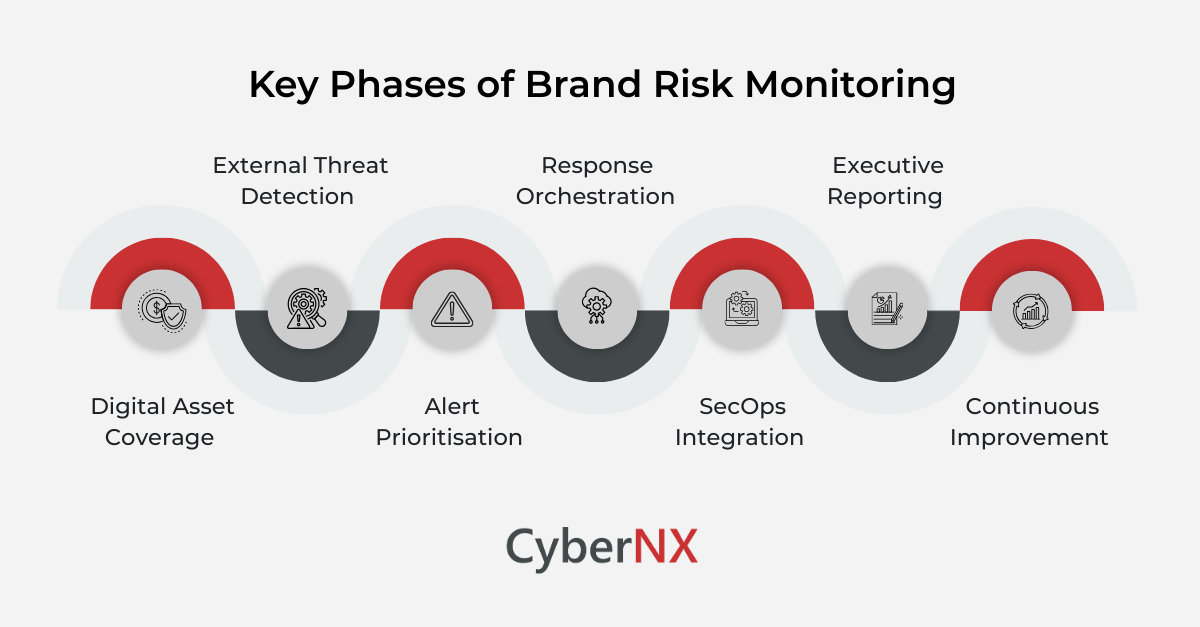
1. Digital asset discovery and coverage/ Digital asset coverage
The first component is knowing what needs protection. Many organisations underestimate how widely their brand exists online. Official domains, regional websites, marketing microsites and partner portals often grow faster than documentation.
Brand risk monitoring starts by mapping these assets. This includes brand names, product names, logos, slogans and executive identities. It also includes variations, misspellings and regional formats that attackers commonly abuse.
Without accurate discovery, monitoring remains partial. Blind spots appear, and threats slip through unnoticed. Strong programmes regularly review and update this asset inventory as the business evolves.
2. External threat detection across channels/External threat detection
Brand misuse rarely happens in one place. Attackers move across domains, social platforms, mobile app stores and messaging channels. Monitoring must reflect this reality.
This component focuses on scanning external environments for suspicious activity linked to the brand. That includes newly registered domains, cloned websites, fake social accounts and malicious apps.
Depth matters here. Superficial scanning creates noise. Effective detection looks at behaviour, context and intent. It distinguishes curiosity from clear abuse. This reduces false positives and speeds up response.
3. Alert prioritisation and risk scoring/Alert prioritisation
Not every alert represents the same level of risk. A parked domain is different from an active phishing site. A fake profile with no followers is different from one running paid campaigns.
This component assigns context to alerts. Risk scoring helps teams focus on what matters most. It considers factors such as activity level, audience reach and similarity to official assets.
Without prioritisation, teams burn time chasing low impact issues. With it, they can act decisively on threats that carry real business risk.
4. Takedown and response orchestration/Response orchestration
Detection alone does not reduce risk. Response does.
This component covers how quickly and effectively an organisation can act once brand misuse is confirmed. It includes engagement with domain registrars, social platforms and app stores. It also includes internal coordination between security, legal and communications teams.
Clear workflows are essential. Who approves takedowns? Who contacts platforms? Who informs customers if needed? When these steps are predefined, response becomes faster and more consistent.
5. Integration with security operations/SecOps integration
Brand risk monitoring should not operate in isolation. Its value increases when connected to broader security processes.
This component focuses on integration with incident response, threat intelligence and email security. For example, a detected spoofed domain can immediately inform filtering rules or awareness alerts.
Integration reduces duplication and improves visibility. It also helps leadership see brand monitoring as part of the wider security strategy rather than a standalone activity.
6. Reporting and executive visibility/Executive reporting
Security leaders need more than alerts. They need insight.
This component translates activity into meaningful reporting. Trends, response times and impact reduction matter more than raw numbers. Boards and executives want to understand risk, not technical detail.
Clear reporting builds confidence. It also supports funding decisions and long term planning. When leaders see tangible outcomes, brand risk monitoring earns sustained support.
7. Continuous improvement and maturity growth/Continuous improvement
Threats change. Brands grow. Monitoring must adapt.
This final component focuses on regular review and refinement. Coverage expands as new channels emerge. Thresholds adjust as noise patterns change. Lessons from incidents feed back into detection and response.
Mature programmes treat brand monitoring as a living capability. Continuous improvement keeps it effective without becoming burdensome.
Read our Brand Risk Monitoring Best Practices blog to tighten and boost your brand risk monitoring program.
Choosing the right brand risk monitoring tools
Not all solutions offer the same depth. Some focus only on domain monitoring. Others include social, mobile and dark web coverage.
When evaluating brand risk monitoring tools, consider visibility, accuracy and response support. Coverage should match your risk profile. Alerts should be relevant and timely.
Equally important is integration. Tools should fit into existing security operations rather than operate in isolation. We often advise clients to start small. Expand coverage as maturity grows. This avoids tool fatigue and improves adoption.
How brand risk monitoring fits into a wider security strategy
Brand monitoring works best when linked to threat intelligence and incident response. It should complement email security, identity protection and fraud prevention.
For example, early detection of spoofed domains can feed into email filtering rules. Social impersonation alerts can inform customer advisories. This connected approach reduces dwell time. It also strengthens confidence at board level. Leaders can see clear linkage between investment and risk reduction.
Brand monitoring: few emerging trends we observed
So, what are the emerging trends shaping brand monitoring. Find out below:
- AI driven impersonation: Attackers are using automation to scale brand abuse. Fake content is created faster and looks more convincing. This raises the bar for detection. Manual monitoring alone cannot keep up.
- Expansion beyond traditional channels: Brand misuse now spans messaging apps, forums and niche platforms. Coverage needs to extend beyond mainstream sites. Security leaders should regularly review monitoring scope to avoid blind spots.
- Increased collaboration with platforms: Some platforms are improving takedown processes. Organisations that build relationships and clear evidence trails see faster results. Brand risk monitoring data supports these engagements with factual proof.
Measuring success without vanity metrics
Success is not the number of alerts generated. It is the reduction of impact. Key indicators include time to detect, time to takedown and reduction in customer complaints. These metrics resonate with leadership. We encourage teams to report outcomes rather than activity. This reframes brand risk monitoring as a business enabler rather than a cost centre.
Conclusion
Brand risk monitoring protects more than logos and names. It protects trust, revenue and long-term growth. For security leaders, it offers visibility beyond the perimeter where many modern attacks begin.
When approached with clarity, alignment and the right tools, it becomes a powerful extension of your security strategy. Small improvements in detection and response can prevent large reputational losses.
We work alongside organisations to design practical, scalable brand risk monitoring programmes. Our expert team monitor the surface web, deep web, dark web, and social media platforms to detect unauthorized use of your brand assets, data leaks, and emerging threats. If you want to understand your current exposure or improve response readiness, speak with our team at CyberNX for a focused consultation.
Brand risk monitoring FAQs
How is brand risk monitoring different from reputation management?
Brand risk monitoring focuses on security driven misuse such as phishing and impersonation. Reputation management focuses more on sentiment and public perception.
Who should own brand monitoring in an organisation?
Ownership should be shared. Security teams often lead detection, while legal and communications support response.
Can small organisations benefit from brand risk monitoring?
Yes. Smaller brands are often targeted because attackers assume weaker monitoring and slower response.
How quickly should brand misuse be taken down?
Ideally within hours. Faster detection and clear processes significantly reduce downstream impact.