Companies today continue to release applications at a rapid pace, keeping up with their security has posed a significant challenge.
With this rapid attack surface expansion, companies rely on advanced security tools to ensure security across system networks.
Two of the most widely adopted security testing approaches include: Dynamic Application Security Testing (DAST) and Vulnerability Assessment and Penetration Testing (VAPT). Both aim to identify security weaknesses in the system by deliberately attempting to attack it.
Now, the question is, are VAPT and DAST the same? No. They have the same goal but different methods.
So, DAST vs VAPT. Who wins?
Let’s find out.
Understanding DAST and VAPT
DAST is an automated black-box testing technique that attacks applications while they are running. Unlike source code analysis, DAST targets the application just like an external attacker would.
DAST tools automatically interact with live web applic Dynamic Application Security Testing ations and APIs to identify vulnerabilities including SQL injection, cross-site scripting, broken authentication, security misconfigurations, broken access controls or server configuration issues.
Vulnerability assessment and penetration testing (VAPT), on the other hand, is a broader security assessment methodology that combines two engagement practices which have the same goal: Find weaknesses in the system before attackers do.
The first phase of the engagement, which is the vulnerability assessment relies on automated scanners to identify weaknesses across applications, networks, operating systems, and infrastructure.
The penetration testing phase goes a step further. A team of ethical hackers manually attempt to exploit discovered vulnerabilities while also searching for complex security weaknesses that automated tools cannot detect, which includes business logic flaws, authentication bypasses, privilege escalation, interlinked attack paths, network security weaknesses and misconfigured infrastructure.
Unlike DAST, VAPT relies heavily on experienced security professionals who impersonate real -world attacker behaviour and validate exploitation scenarios.
DAST vs VAPT: Which method is your match?
Consider the table below that will help you pick the method that may match your organizational needs:
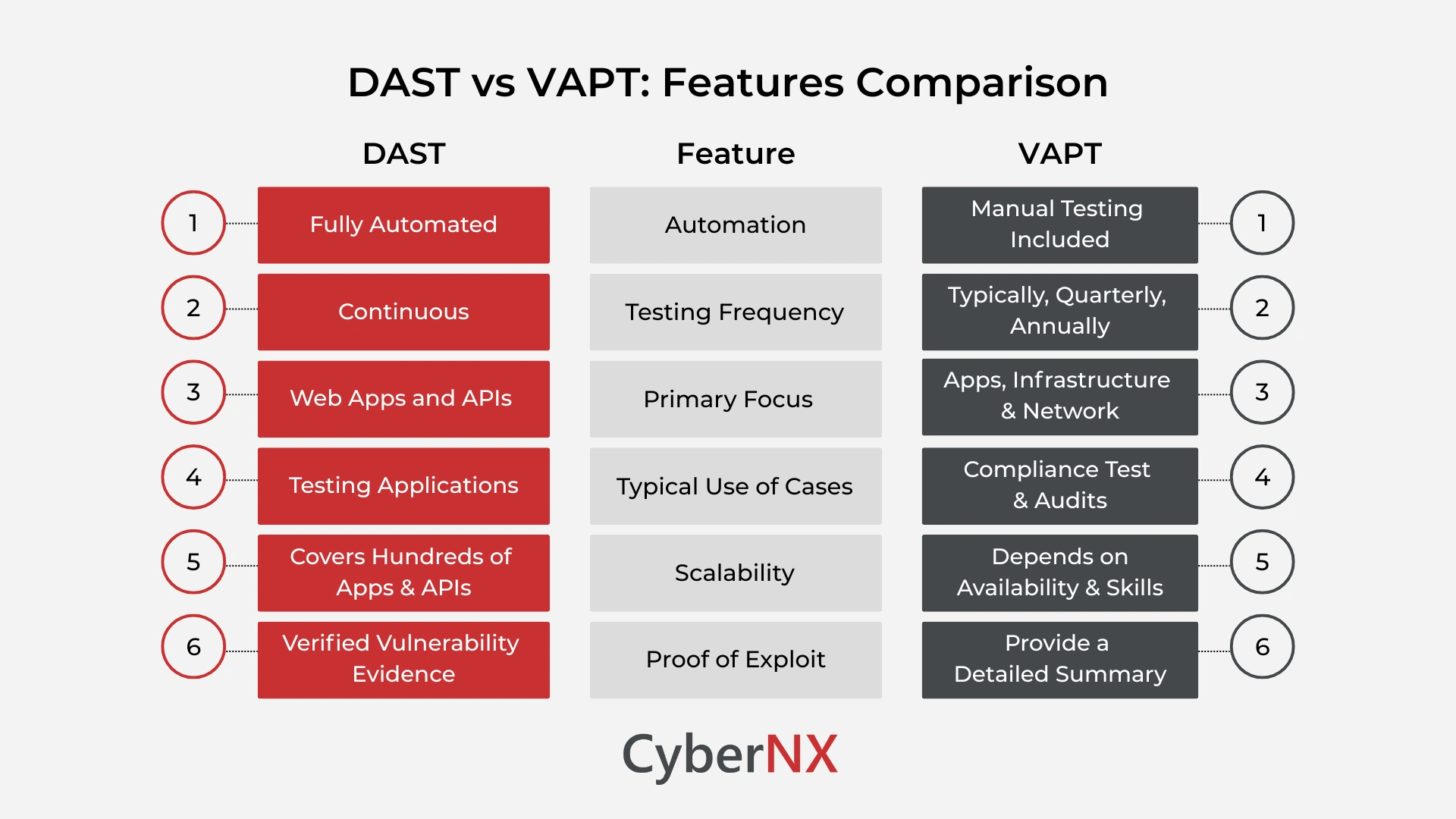
DAST and VAPT: Gaps and Benefits
Choosing between DAST and VAPT is rarely an either-or decision. While both are designed to improve application security, they solve different problems. DAST excels at continuous, automated testing of live applications, whereas VAPT provides the depth and human expertise needed to uncover complex attack paths. Understanding where each approach falls short helps determine when one should be prioritized—and why using both together delivers the strongest security posture.
Continuous security vs point-in-time assessments
Any new features, APIs or misconfigurations introduced after a VAPT assessment may remain undetected until the next engagement. DAST fills this gap by continuously scanning applications after every deployment, making it ideal for fast-paced DevSecOps environments.
Scalability vs depth of testing
Manual penetration testing is time-intensive which makes it difficult to scale across hundreds of applications. DAST automates testing which allows scanning large application networks with speed.
However, VAPT is required to uncover complex vulnerabilities in critical systems, as automation lacks the human reasoning to detect deep rooted issues.
Business logic and complex workflows
One of the DAST’s biggest limitations is that it cannot understand what an application is designed to deliver. While it easily detects technical vulnerabilities like SQL injection or cross-site scripting, it misses flaws in business logic, approval workflows, and transaction processes.
VAPT fills this gap by appointing ethical hackers who manually understand application functionality and test workflows by applying business context and extensive understanding.
Application Security vs Broader Infrastructure
DAST evaluates live web applications and APIs which limits visibility into networks, cloud infrastructure, servers, or active directory. However, VAPT evaluates the organization’s broader attack surface by maximising deeper visibility.
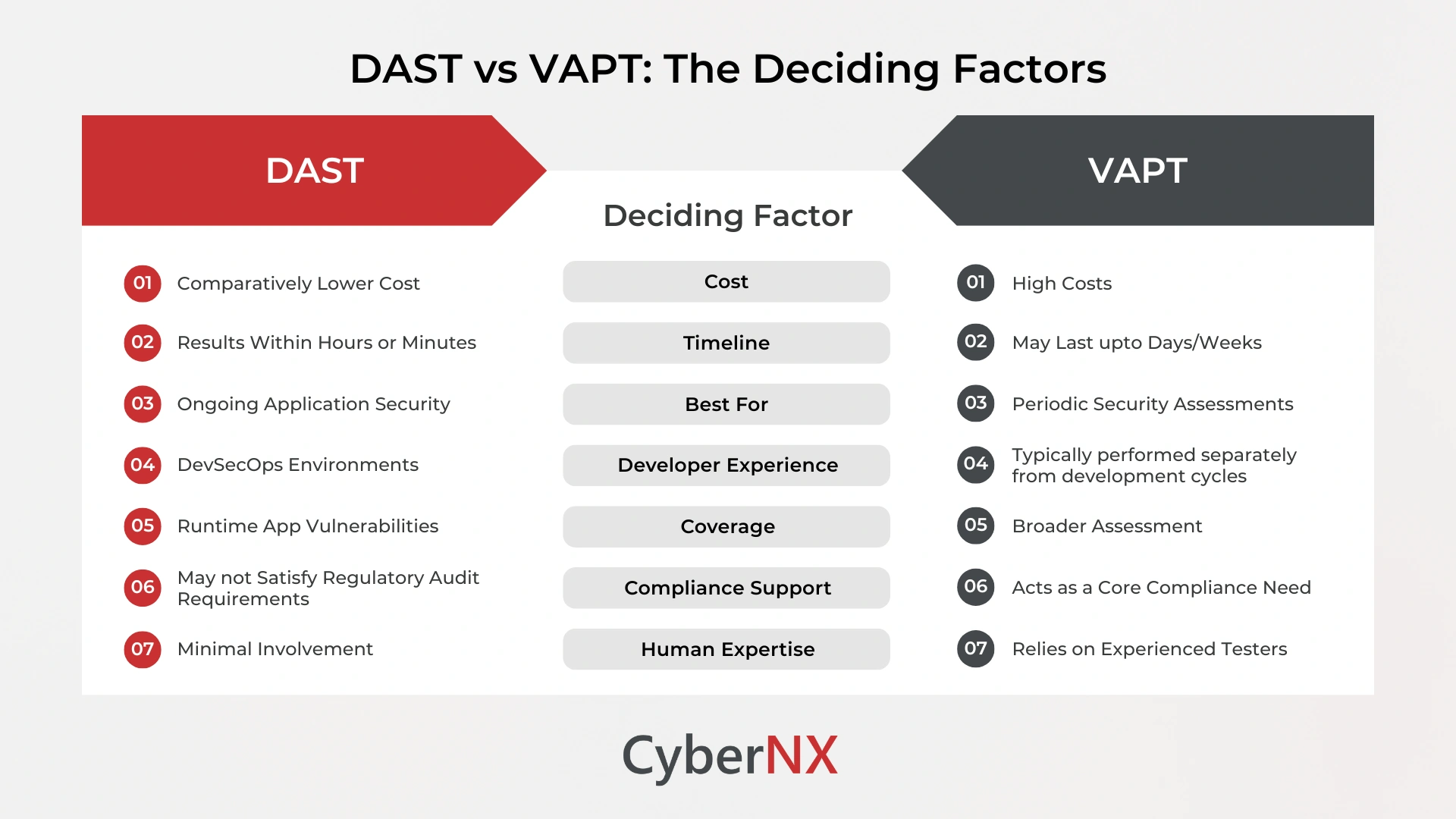
The Deciding Factors
Choosing the right approach also depends on operational requirements, budgets, and security objectives. Below are some more deciding factors to help you make the right choice:
Conclusion: Who Wins?
The answer is neither.
It’s the organization that uses both strategically.
DAST offers continuous and automated security testing, ideal for modern DevSecOps practices. It enables rapid detection of runtime vulnerabilities, integrates easily into CI/CD pipelines, and has the ability to scale across large applications.
VAPT delivers the depth that automation cannot support. Plus, skilled penetration testers can reveal business logic flaws, sophisticated attack pathways, authentication weaknesses and infrastructure risks that require inferring and interpreting context that tools fail to provide.
The strongest application security programs bring the best of both worlds together. Together, they provide both the speed needed for modern development and the depth required to defend against today’s increasingly sophisticated cyber threats.
At CyberNX, with our CERT-In empanelled VAPT services, we can help mitigate against system risks by identifying issues early and provide immediate remediation efforts backed by our expert-led team, which will save your organization from regulatory non-compliance, penalties and reputational damage.
FAQs
Can DAST replace VAPT?
No. DAST and VAPT serve different purposes. DAST provides continuous, automated testing of running applications, while VAPT includes manual penetration testing to identify complex vulnerabilities such as business logic flaws, authentication weaknesses, and chained attack scenarios. Organizations need both pace and depth for solid system security.
How often should an organization perform DAST and VAPT?
DAST should ideally run continuously or after every significant code deployment. VAPT should be conducted annually, quarterly, or before major product launches and compliance audits to validate security controls before it’s too late.
Which industries benefit the most from using both DAST and VAPT?
Organizations in banking, fintech, healthcare, e-commerce, SaaS, and government sectors benefit the most from combining DAST and VAPT. These industries acquire sensitive data daily. Such companies have stringent compliance requirements that demand both continuous security testing and periodic in-depth assessments.
Which should be implemented first: DAST or VAPT?
If your organization follows frequent release cycles, implementing DAST first helps establish continuous security testing within the development process. As applications develop or compliance requirements arise, VAPT should be conducted to validate security through expert-led assessments and real-world attack simulations.