Choose Language
Google Translate
Skip to content
Facebook X-twitter Instagram Linkedin Youtube
  • sales@cybernx.com
  • +91 90823 52813
CyberNX Logo
  • Home
  • About
    • About Us
    • CERT-In Empanelled Cybersecurity Auditor
    • Awards & Recognition
    • Our Customers
  • Services

    Peregrine

    • Managed Detection & Response
    • AI Managed SOC Services
    • Elastic Stack Consulting
    • CrowdStrike Consulting 
    • Threat Hunting Services
    • Digital Risk Protection Services
    • Threat Intelligence Services
    • Digital Forensics Services
    • Brand Risk & Dark Web Monitoring
    • Full Stack Observability

    Pinpoint

    • Red Teaming Services
    • Vulnerability Assessment
    • Penetration Testing Services
    • Secure Code Review Services
    • Cloud Security Assessment
    • Phishing Simulation Services
    • Breach and Attack Simulation Services

    nCompass

    • Cybersecurity Audit Services
    • Virtual CISO Services
    • DPDP Act Consulting
    • ISO 27001 Consulting
    • RBI Master Direction Compliance
    • SEBI CSCRF Framework Consulting
    • SEBI Cloud Framework Consulting
    • Security Awareness Training
    • Cybersecurity Staffing Services

    NXRadar

    • SBOM Solutions
    • CBOM Solutions
    • AIBOM Solutions
  • Industries
    • Banking
    • Financial Services
    • Insurance
  • Resources
    Blogs
    Case Studies
    Downloads
    Whitepapers
    Buyer’s Guide
    Research & Guides
    Data Sheets
  • Careers
  • English
Contact Us
CyberNX Logo
  • English
  • Home
  • About
    • About Us
    • CERT-In Empanelled Cybersecurity Auditor
    • Awards & Recognition
    • Our Customers
  • Services

    Peregrine

    • Managed Detection & Response
    • AI Managed SOC Services
    • Elastic Stack Consulting
    • CrowdStrike Consulting
    • Threat Hunting Services
    • Digital Risk Protection Services
    • Threat Intelligence Services
    • Digital Forensics Services
    • Brand Risk & Dark Web Monitoring
    • Full Stack Observability

    Pinpoint

    • Red Teaming Services
    • Vulnerability Assessment
    • Penetration Testing Services 
    • Secure Code Review Services
    • Cloud Security Assessment
    • Phishing Simulation Services
    • Breach and Attack Simulation Services

    nCompass

    • Cybersecurity Audit Services
    • Virtual CISO Services
    • DPDP Act Consulting
    • ISO 27001 Consulting
    • RBI Master Direction Compliance
    • SEBI CSCRF Framework Consulting
    • SEBI Cloud Framework Consulting
    • Security Awareness Training
    • Cybersecurity Staffing Services

    NXRadar

    • SBOM Solutions
    • CBOM Solutions
    • AIBOM Solutions
  • Industries
    • Banking
    • Financial Services
    • Insurance
  • Resources
    Blogs
    Case Studies
    Downloads
    Whitepapers
    Buyer’s Guide
    Research & Guides
    Data Sheets
  • Careers
  • Contact

Automated Vulnerability Management: A Guide for Modern Security Teams

4 min read
8 Views
  • VAPT

Every day, new security flaws keep showing up. In 2025 alone, teams tracked a record 48,185 of them, according to Edgescan’s 2026 Vulnerability Statistics Report. And the number will only keep climbing higher.

No team – no matter how efficient – can check this number of flaws manually. Spreadsheets and weekly reports slow things down. And by the time a fix reaches the top of the list, more flaws have joined it.

This is where automated vulnerability management steps in. It clears the backlog, ranks real risk first and helps Indian BFSI teams stay ahead of both attackers and regulators.

Table of Contents

What is automated vulnerability management?

It is the use of tools to run the full vulnerability lifecycle with minimal manual effort. This covers discovery, risk-based prioritisation, remediation tracking and compliance reporting, not just scanning.

Unlike a one-time vulnerability assessment, it runs continuously. New assets get scanned as they appear. New CVEs get matched against your systems as soon as they are published. Findings get ranked by real risk instead of a static severity score, and the resulting record becomes part of the ongoing audit trail rather than a point-in-time snapshot.

Why manual vulnerability management is falling behind

A few figures show why the shift to automation matters:

  • Edgescan’s 2026 Vulnerability Statistics Report found high and critical application and API vulnerabilities took an average of 54.81 days to close in 2025.
  • FIRST’s 2026 Vulnerability Forecast projects a median of roughly 59,400 CVEs this year, with a wide confidence range that itself signals how unpredictable the pace of disclosure has become.
  • IBM’s 2025 Cost of a Data Breach Report found companies using AI and automation for security operations saved around $1.9 million per breach and cut the breach lifecycle by 80 days compared to those depending on manual processes.

When put together, these numbers point to the same problem. Vulnerabilities are appearing faster than most teams can review them, let alone close them, and the gap tends to widen every year rather than close on its own.

The four stages of the process

A mature programme usually runs through four connected stages, each supported by automation.
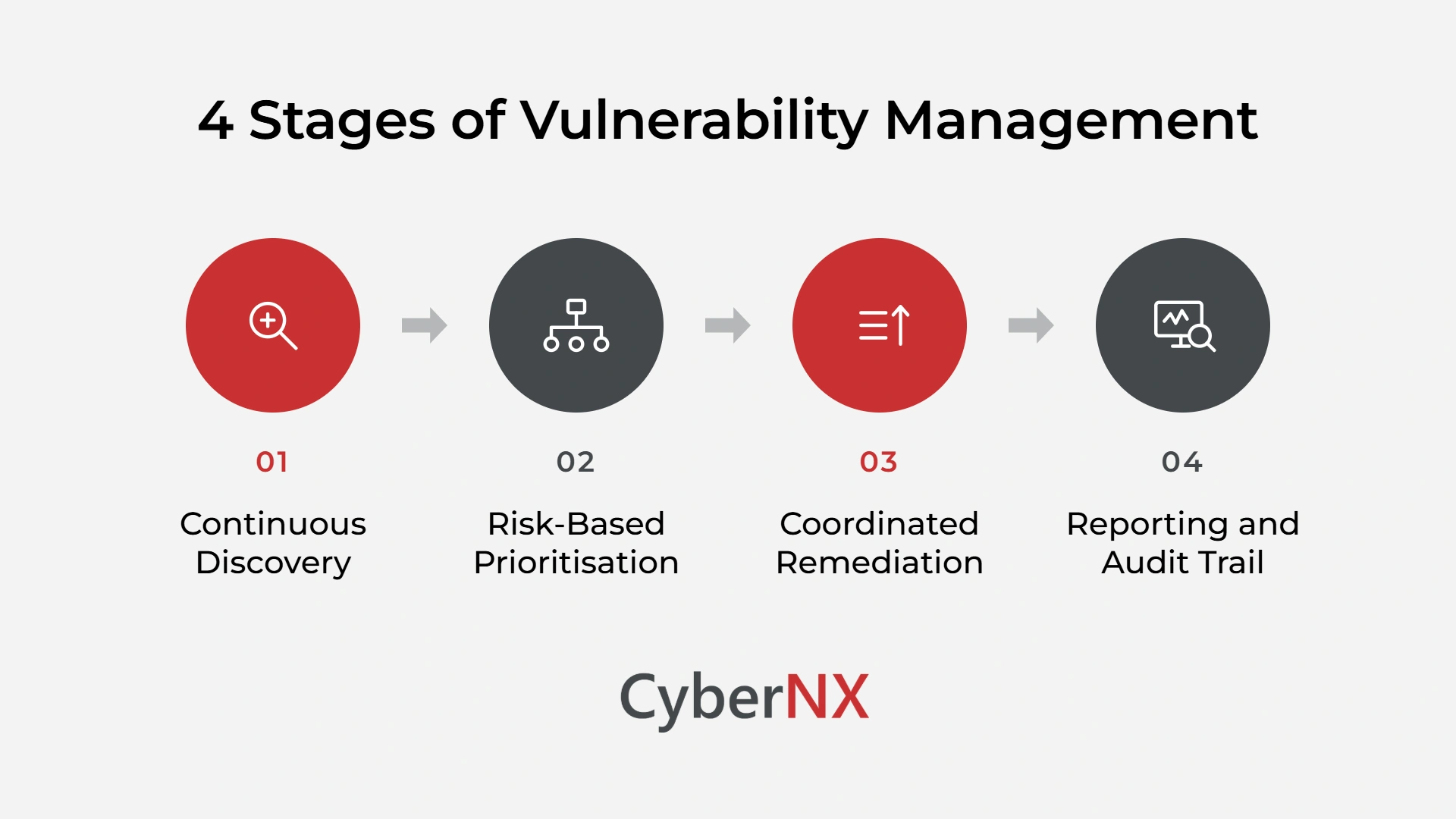
4 Stages of Vulnerability Management

  • Continuous discovery: Automated scanning and asset discovery tools keep an up-to-date map of servers, applications, cloud workloads and endpoints, so nothing goes unscanned.
  • Risk-based prioritisation: Instead of ranking findings by CVSS score alone, tools factor in exploitability, asset value and exposure to decide what needs attention first.
  • Coordinated remediation: Patches, configuration fixes and virtual patches get applied automatically for low-risk, high-volume findings, with tickets and approvals routed for anything higher-impact.
  • Reporting and audit trail: Every finding, fix and rescan gets logged automatically, building the audit record regulators expect without extra manual work.

Meeting SEBI CSCRF and CERT-In expectations

Indian regulators have been explicit about the pace expected from regulated entities:

  • SEBI’s CSCRF framework expects regulated entities to remediate vulnerabilities identified through VAPT within defined timelines and prioritise rapid remediation of high-risk findings.
  • CERT-In’s six-hour incident reporting requirement under Section 70B of the IT Act means any exploited vulnerability that leads to a breach needs fast, well-documented response, something automated tracking supports directly.

For BFSI firms managing branches, core banking systems and customer-facing apps at scale, this kind of continuous coverage is becoming less of an efficiency choice and more of a compliance necessity. Manual spreadsheets and quarterly reviews simply cannot produce the audit trail regulators now expect.

Choosing the right approach for your organisation

This works best when it is built around your specific environment, not a generic checklist. A few points worth weighing:

  • Map your assets first: Automation is only as good as the asset inventory feeding it. Unknown systems stay unmanaged and unscanned.
  • Keep humans in the loop for critical systems: Core banking platforms and customer-facing apps deserve a review step before any automated fix goes live.
  • Integrate with existing tools: A vulnerability management platform should feed your ticketing, SIEM and change management systems, not sit apart from them.
  • Test before you scale automation: Start with routine, low-risk fixes before automating anything touching production revenue systems.
  • Review the rules periodically: Risk scoring models and automation rules need regular tuning as your asset base and threat landscape change.

Conclusion

CVE counts keep rising and Indian regulators keep tightening expectations around how fast findings get closed. This approach gives security teams a way to keep up without adding headcount for every new disclosure, while building the audit trail regulators expect.

Building this the right way starts with knowing where the gaps are today. CyberNX provides resilient vulnerability assessment and penetration testing services, that helps BFSI organisations prioritise and close flaws within compliance timelines. Connect with our team of experts to build an automated vulnerability management workflow that keeps up with new threats.

Automated vulnerability management FAQs

What is automated vulnerability management?

It is the practice of using tools to handle the vulnerability lifecycle, discovery, prioritisation, remediation and reporting, on a continuous basis with minimal manual intervention.

How is this different from automated remediation?

Vulnerability management covers the entire lifecycle, from finding assets to closing findings and reporting on them. Remediation is one stage within that lifecycle, focused specifically on fixing the issue once it has been found and prioritised.

Does automation replace the need for VAPT?

No. VAPT provides deep, expert-led validation of exploitability and business impact. This approach handles the ongoing discovery and tracking work between assessments, not the assessment itself.

Is this approach suitable for smaller organisations?

Yes. Cloud-based platforms have made it accessible for smaller teams too, though the mix of automated and manual steps should scale with the size and risk profile of the environment.

Author
Bhowmik Shah
LinkedIn

Bhowmik is a seasoned security leader with hands-on experience operating large-scale SOC environments, leading offensive security teams, and performing cloud security assessments across AWS, Azure & Google Cloud. He has worked with enterprise CISOs across India & APAC to strengthen detection engineering, threat hunting & SIEM/SOAR effectiveness. Known for aligning red-team insights with SOC improvements, he brings practical, field-tested expertise in building resilient, high-performing security operations.

Share on

WhatsApp
LinkedIn
Facebook
X
Pinterest

For Customized Plans Tailored to Your Needs, Get in Touch Today!

Connect with us

RESOURCES

Related Blogs

Explore our resources section for insightful blogs, articles, infographics and case studies, covering everything in Cyber Security.
DAST vs VAPT: A Plain Comparison

DAST or VAPT: Which Security Assessment Exploits Your System Better

Companies today continue to release applications at a rapid pace, keeping up with their security has posed a significant challenge.

Automated Vulnerability Remediation: A Faster Patch Playbook

Automated Vulnerability Remediation: A Playbook for Faster Patch Closure

In May 2026, CERT-In gave organisations just 12 hours to stop a known attack on internet-facing systems. Ten years back,

Red Teaming vs VAPT: What These Tests Reveal About Security Maturity

Red Teaming vs VAPT: What These Tests Reveal About Security Maturity

Red Teaming vs VAPT is a conversation most cybersecurity leaders have encountered. CISOs, CXOs and IT heads hear these terms

RESOURCES

Cyber Security Knowledge Hub

Explore our resources section for insightful blogs, articles, infographics and case studies, covering everything in Cyber Security.

BLOGS

Stay informed with the latest cybersecurity trends, insights, and expert tips to keep your organization protected.

CASE STUDIES

Explore real-world examples of how CyberNX has successfully defended businesses and delivered measurable security improvements.

DOWNLOADS

Learn about our wide range of cybersecurity solutions designed to safeguard your business against evolving threats.
CyberNX Footer Logo
Book a Free Call

Peregrine

  • Managed Detection & Response
  • AI Managed SOC Services
  • Elastic Stack Consulting
  • CrowdStrike Consulting
  • Threat Hunting Services
  • Digital Risk Protection Services
  • Threat Intelligence Services
  • Digital Forensics Services
  • Brand Risk & Dark Web Monitoring
  • Full Stack Observability

Pinpoint

  • Red Teaming Services
  • Vulnerability Assessment
  • Penetration Testing Services
  • Secure Code Review Services
  • Cloud Security Assessment
  • Phishing Simulation Services
  • Breach and Attack Simulation Services

nCompass

  • Cybersecurity Audit Services
  • Virtual CISO Services
  • DPDP Act Consulting
  • ISO 27001 Consulting
  • RBI Master Direction Compliance
  • SEBI CSCRF Framework Consulting
  • SEBI Cloud Framework Consulting
  • Security Awareness Training
  • Cybersecurity Staffing Services

NXRadar

  • SBOM Solutions
  • CBOM Solutions
  • AIBOM Solutions
  • About
  • CERT-In
  • Awards
  • Careers
  • Sitemap
Facebook Twitter Instagram Youtube

Copyright © 2026 CyberNX | All Rights Reserved | Terms and Conditions | Privacy Policy

  • English
Copyright © 2026 CyberNX | All Rights Reserved | Terms and Conditions | Privacy Policy
Scroll to Top

WhatsApp us

Not Sure Where to Start with Cybersecurity?

We value your privacy. Your personal information is collected and used only for legitimate business purposes in accordance with our Privacy Policy.