In May 2017, a global ransomware worm called WannaCry hit the computers running Microsoft Windows. It locked user files and demanded Bitcoin payments and spread rapidly through a network exploit called EternalBlue. WannaCry didn’t need a zero-day to spread across the globe. It used a known flaw in Windows SMB – one that already had a patch sitting unapplied on thousands of systems. The exploit code was public. The fix was public too. The gap between the two is what let the ransomware move.
That gap between knowing about a weakness and actually closing it is where most security programs fail. It is also why two terms keep coming up in every security planning conversation: Vulnerability Management and Penetration Testing. Both deal with weaknesses in your systems, but they answer different questions, run on different timelines and serve different purposes in a security program.
This guide breaks down what each one does, how they differ and why a mature security system needs both working together.
What is vulnerability management?
Vulnerability management is an ongoing process. It scans your systems, networks and applications on a set schedule, flags known weaknesses and tracks them through to remediation.
The process includes:
- Discovery: Automated scanners identify assets and check them against known vulnerability databases
- Prioritisation: Findings are ranked by severity, exploitability and business impact
- Remediation: Patches, configuration changes or compensating controls close the gap
- Verification: A rescan confirms the fix worked
- Reporting: Stakeholders get visibility into open and closed items
Vulnerability management runs continuously or on a fixed cycle, such as weekly or monthly scans. It gives security teams an up-to-date map of where the weak points sit.
What is penetration testing?
Penetration testing is a point in time exercise. A tester acts like an attacker and tries to break into your systems using the same tools and techniques real attackers use.
Unlike automated scanning, penetration testing relies heavily on manual, human led techniques. Testers chain smaller weaknesses together, bypass controls and demonstrate what an attacker could actually achieve once inside. The output is proof of what happens when those flaws are exploited in sequence.
Penetration testing is usually scoped to a specific system, application or network segment and conducted periodically, such as annually or before a major release.
Vulnerability management vs. penetration testing: key differences
Both practices reduce risk, but they do it in different ways.
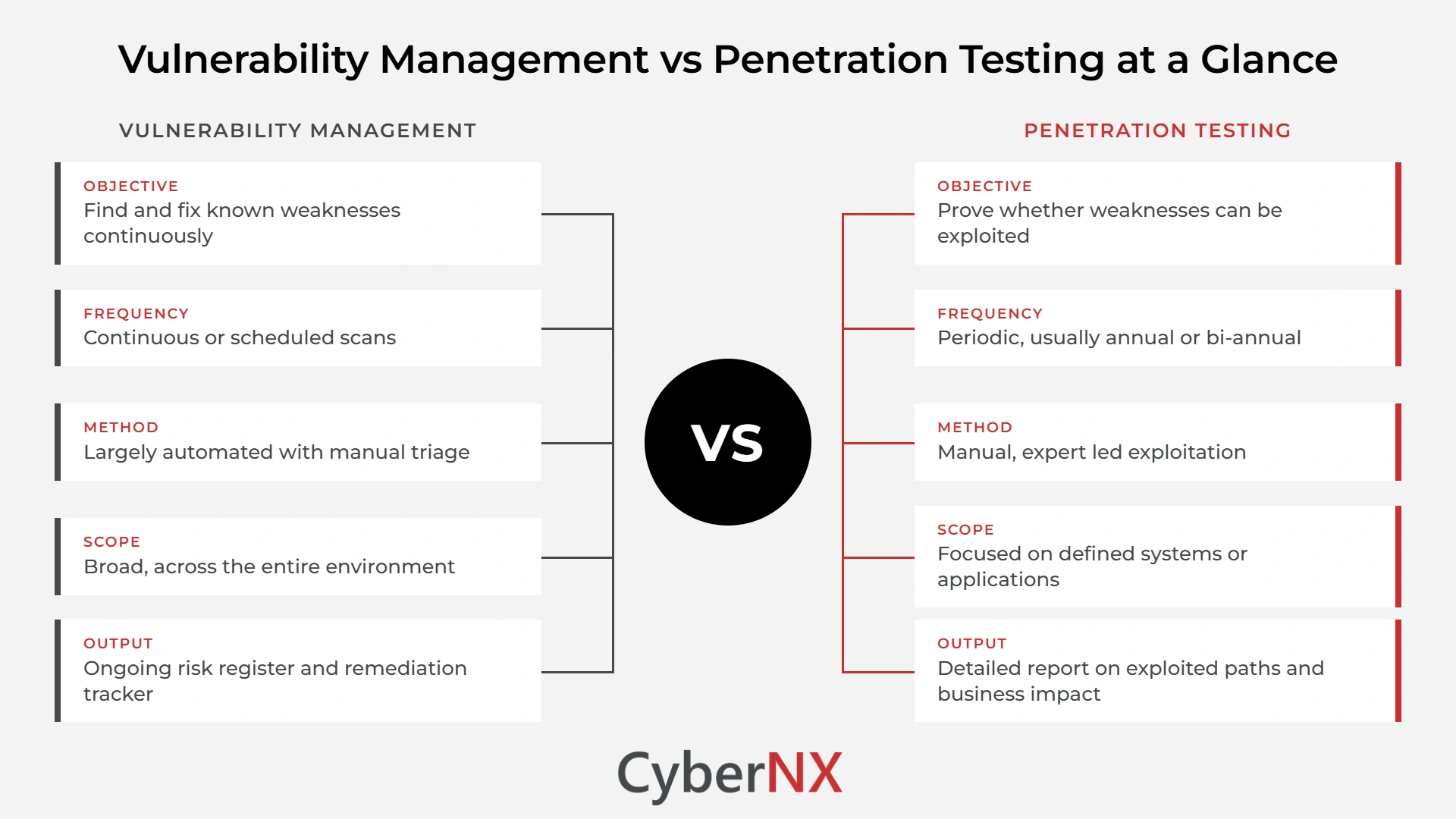
Vulnerability management tells you what is exposed. Penetration testing tells you what an attacker could do with that exposure. Neither replaces the other, and treating this as an either-or choice misses the point of both.
Why regulated Indian enterprises need both
The RBI Master Direction on IT governance requires regulated entities to perform periodic vulnerability assessments and annual penetration testing for critical systems, including internet-facing and DMZ environments, as well as before and after major changes.
SEBI CSCRF prescribes different VAPT frequencies depending on the regulated entity’s classification and risk tier. Critical market infrastructure entities generally require half-yearly assessments, while other regulated entities follow annual or risk-based schedules defined by the framework.
Underneath these mandates is a real, growing gap between disclosure and remediation. The Edgescan 2026 Vulnerability Statistics Report found threat actors weaponising new vulnerabilities within hours of disclosure, while the average time to close high and critical application vulnerabilities stretched to over 50 days across 2025. Meanwhile, CVE Program data shows the disclosure volume itself is climbing, with roughly 131 new vulnerabilities published every day in 2025. A vulnerability management program that only scans is not enough to keep pace. Periodic penetration testing is what confirms whether the gaps that remain open are actually dangerous.
How to combine vulnerability management and penetration testing effectively
A layered approach gets more value out of both practices than running them in isolation.
- Run continuous scanning first: Set up scheduled vulnerability scans across servers, endpoints, applications and cloud assets to build a live inventory of known weaknesses
- Prioritise by business context: Rank findings using severity, asset criticality and exposure, not just a generic score
- Remediate on a defined SLA: Assign closure timelines by severity, in line with RBI and SEBI CSCRF deadlines where applicable
- Schedule periodic penetration tests: Validate whether unresolved or newly introduced weaknesses are exploitable, and test critical systems before and after major changes
- Feed results back into the program: Use penetration testing findings to refine scanning rules, patch priorities and internal security awareness
- Report to leadership and auditors: Maintain a documented trail of VAPT reports, remediation status and IT Committee approvals for open items
Conclusion
Vulnerability management and penetration testing are not competing choices. Vulnerability management keeps a continuous, current view of exposure. Penetration testing proves what an attacker could actually do with that exposure. Regulated Indian firms need both to meet RBI and SEBI CSCRF timelines and to close the gap between disclosure and exploitation.
CyberNX’s Vulnerability management vs. penetration testing services are built to work together, giving BFSI organisations a program that covers both sides of vulnerability management vs. penetration testing. If you’re looking for reliable VAPT services for your firm, connect with our team to build a testing rhythm that fits your compliance timeline.
Vulnerability management vs. penetration testing FAQs
Is penetration testing part of vulnerability management?
No. Penetration testing is a separate, human led exercise that validates exploitability. Vulnerability management is the continuous process of finding and fixing known weaknesses. They work together but are not the same activity.
How often should a business run vulnerability assessment vs penetration testing?
Vulnerability scans should run continuously or at least monthly. Penetration testing is typically annual, though regulated BFSI entities under SEBI CSCRF or RBI Master Direction may need it every six months for critical systems.
Can a small business skip penetration testing and rely only on vulnerability management?
This is not recommended. Vulnerability scanning misses exploitable weaknesses that only surface through chained, manual attack paths, which is exactly what penetration testing is designed to uncover.