Endpoint security stopped being a single product a long time ago. The category split into prevention, detection and response, then extended into identity, cloud, email and network telemetry. Vendor naming has moved fast, which is why the CrowdStrike EDR vs XDR question shows up in almost every Falcon evaluation and renewal discussion.
The ambiguity is reasonable. CrowdStrike delivers endpoint detection and response (EDR) and extended detection and response (XDR) through the same module, the same sensor and the same console. So, the practical question is not which one to buy. It is what the platform already provides and what still needs design work before it produces audit-ready outcomes.
This post breaks down what Falcon delivers on each side of the EDR and XDR line, how Indian regulatory expectations change the calculation and where implementation choices decide whether a licence becomes real detection value.
What is the difference between EDR and XDR?
EDR monitors endpoints. It records process activity, file changes, registry edits and network connections on laptops or servers, then uses behavioural analytics to flag activity that antivirus signatures miss. The value sits in the recording, because it lets an analyst reconstruct exactly how an intrusion unfolded.
XDR keeps that endpoint foundation and adds correlated data from other domains. Gartner defines the category as a unified detection and response platform that automatically collects and correlates data from multiple security components. In CrowdStrike’s own framing of XDR, the model takes EDR capability and extends protection beyond the endpoint to networks, cloud workloads, servers and email.
The distinction matters operationally. EDR answers what happened on a machine. XDR answers what happened across an attack path that started with a stolen credential and ended in a cloud workload.
Is CrowdStrike Falcon an EDR or XDR?
Both. Falcon Insight XDR is a single module that covers endpoint detection and response and extends into cross-domain detection, which is why CrowdStrike lists it under EDR and XDR rather than as two products.
Three facts define what the licence actually includes:
- One sensor, no second deployment: extended coverage runs on the same lightweight agent already installed for endpoint protection
- Native XDR at no extra cost: CrowdStrike’s Falcon Insight XDR page states that native XDR is unlocked at no additional cost, with 10GB per day of free third-party data ingest in the same console
- Response and automation built in: Real Time Response gives direct system access, Falcon Fusion handles orchestration and Charlotte AI helps analysts with investigation and response workflows.
So, the CrowdStrike XDR vs EDR decision is not really a purchasing decision. It is a scoping and configuration decision about which data sources, identity signals and cloud workloads get connected.
CrowdStrike EDR vs XDR in daily SOC operations
Five things change when a team moves from endpoint-only detection to correlated detection.
1. Detection scope widens
Endpoint-only detection surfaces malicious processes. Correlated detection surfaces credential abuse, unusual cloud API activity and lateral movement that never triggers an endpoint alert on its own.
2. Investigation context arrives pre-assembled
Analysts stop pivoting between four consoles to build a timeline. Attack path context, adversary attribution and MITRE ATT&CK mapping sit inside one detection view.
3. Response actions extend past the host
Containment is no longer limited to isolating a machine. Workflows can disable an account, quarantine a session or trigger a third-party action through automation.
4. Data volume becomes a design decision
Every connector added increases ingest, retention and cost. Choosing which sources earn their place is where most XDR rollouts either succeed or stall.
5. Analyst workload shifts upstream
Less time goes to correlation and triage, more goes to hunting and tuning. That shift only materialises if detection logic is tuned for the environment rather than left at default.
Where Indian regulatory requirements change the calculation
For regulated enterprises, extended detection is not just a security upgrade. It is evidence generation.
The CERT-In Directions issued on 28 Apr 2022 require covered entities to enable logs across their ICT systems, maintain them for a rolling 180-day period within Indian jurisdiction and furnish them when a cyber incident is reported. Reportable incidents must reach CERT-In within six hours of detection.
That has direct consequences for Falcon deployments. Default retention windows, connector selection and where XDR data lands all become compliance variables rather than engineering preferences. SEBI regulated entities face a further layer, because CSCRF expects monitoring capability backed by documented proof.
Where consulting adds value
Falcon ships with strong defaults. Regulated environments don’t run on defaults. The work that turns licences into outcomes usually looks like this:
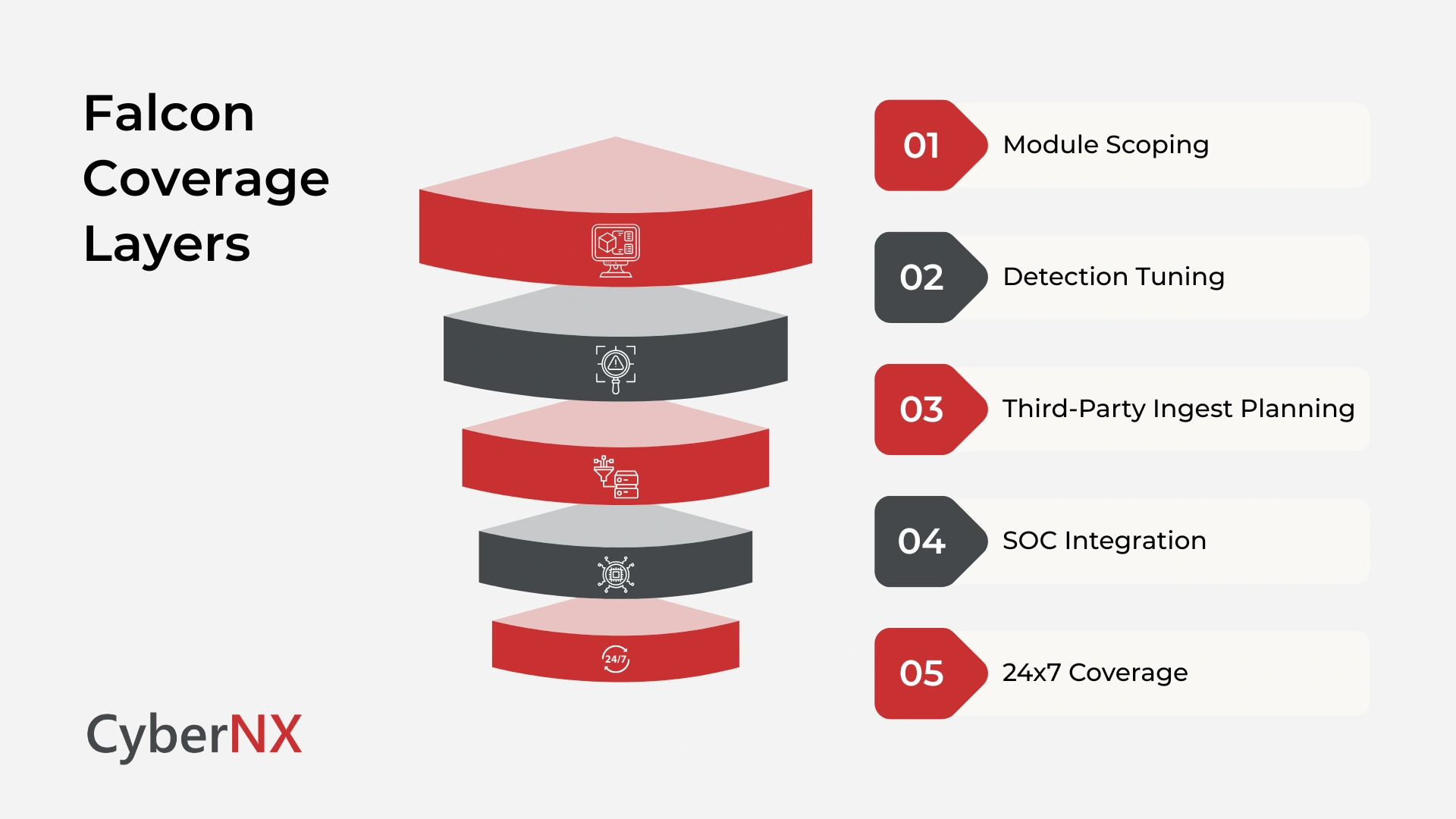
- Module scoping: mapping which Falcon modules and connectors match the actual attack surface and compliance scope
- Detection tuning: reducing false positives and building custom logic for the environment instead of accepting baseline rules
- Third-party ingest planning: deciding which sources belong inside the free ingest allowance and which justify additional cost
- SOC integration: aligning Falcon detections with existing runbooks, escalation paths and reporting timelines
- 24×7 coverage: pairing the platform with managed detection and response so detections get acted on at 3 AM, not at the next shift handover
Conclusion
The CrowdStrike EDR vs XDR comparison usually ends in the same place. Falcon already contains both capabilities, so value depends on scoping, tuning and integration rather than on buying another product. Extended detection closes the gaps that endpoint-only monitoring leaves open, and it produces the correlated evidence Indian regulators expect.
The CrowdStrike EDR vs XDR question rarely ends at the licence but at implementation. Falcon already contains both capabilities, so the real work is scoping which modules connect to your environment, tuning detection logic for your threat profile, and ensuring cross-domain telemetry is acted on around the clock.
At CyberNX, our CrowdStrike Consulting team covers module configuration, detection tuning, SOC integration and 24/7 managed detection and response. CrowdStrike brings the platform and the telemetry; we bring the operational expertise to turn it into connected evidence that meets your security and regulatory expectations.
Talk to our experts today to understand how CrowdStrike EDR vs XDR applies to your environment.
CrowdStrike EDR vs XDR FAQs
Is CrowdStrike Falcon an EDR or XDR?
Falcon is both. Falcon Insight XDR provides endpoint detection and response and extends the same detection engine across identity, cloud, mobile and third-party telemetry. There is no separate XDR agent to deploy.
Does CrowdStrike XDR vs EDR mean two separate licences?
No. CrowdStrike positions native XDR capability inside the Insight XDR module, including a daily allowance of free third-party data ingest. Costs rise with additional modules and ingest volume, not with switching from EDR to XDR.
Do you still need a SIEM alongside Falcon?
Often yes, particularly in India. Regulatory log retention obligations span systems that XDR does not monitor, so many enterprises run Falcon for detection and a log platform for retention and audit evidence.