There is a chance that you may assume that your security spend does double duty as privacy compliance. The fact of the matter is sometimes it does and often it does not. So, the gap only surfaces when an auditor asks for evidence.
This is where the relationship between CrowdStrike Falcon and DPDPA needs a straight answer.
We work on both sides of this problem: Falcon deployments and Digital Personal Data Protection Act readiness programmes. So here is the honest version. This blog walks through which obligations Falcon genuinely evidences, which ones it partly supports and which ones it won’t touch.
What the law asks of your security stack
First understand that before mapping any product, you need to know what you are mapping against. Two rules matter here.
Rule 6 and the seven minimum safeguards
Rule 6 of the DPDP Rules, 2025 is the technical backbone of the Act. It requires every Data Fiduciary to take reasonable security safeguards, and it lists seven minimums. These cover encryption and masking, access control, logging and monitoring, continuity, retention, processor contracts and organisational measures.
This is not guidance. Read alongside Section 8(5) of the Act, Rule 6 becomes an enforceable cybersecurity standard carrying penalties up to ₹250 crore for security failures.
The 72-hour clock in Rule 7
Rule 7 sets the reporting obligation. Every personal data breach triggers a dual notification, with no severity threshold below which reporting becomes optional. You inform the Data Protection Board without delay, then file a detailed report within 72 hours.
That detailed report needs specifics. Nature of the breach, extent, affected Data Principals, remediation. Remember this requirement. It becomes important later.
Where Falcon does the work
Falcon is strong on a narrow slice of Rule 6. That slice happens to be the slice most organisations are weakest on.
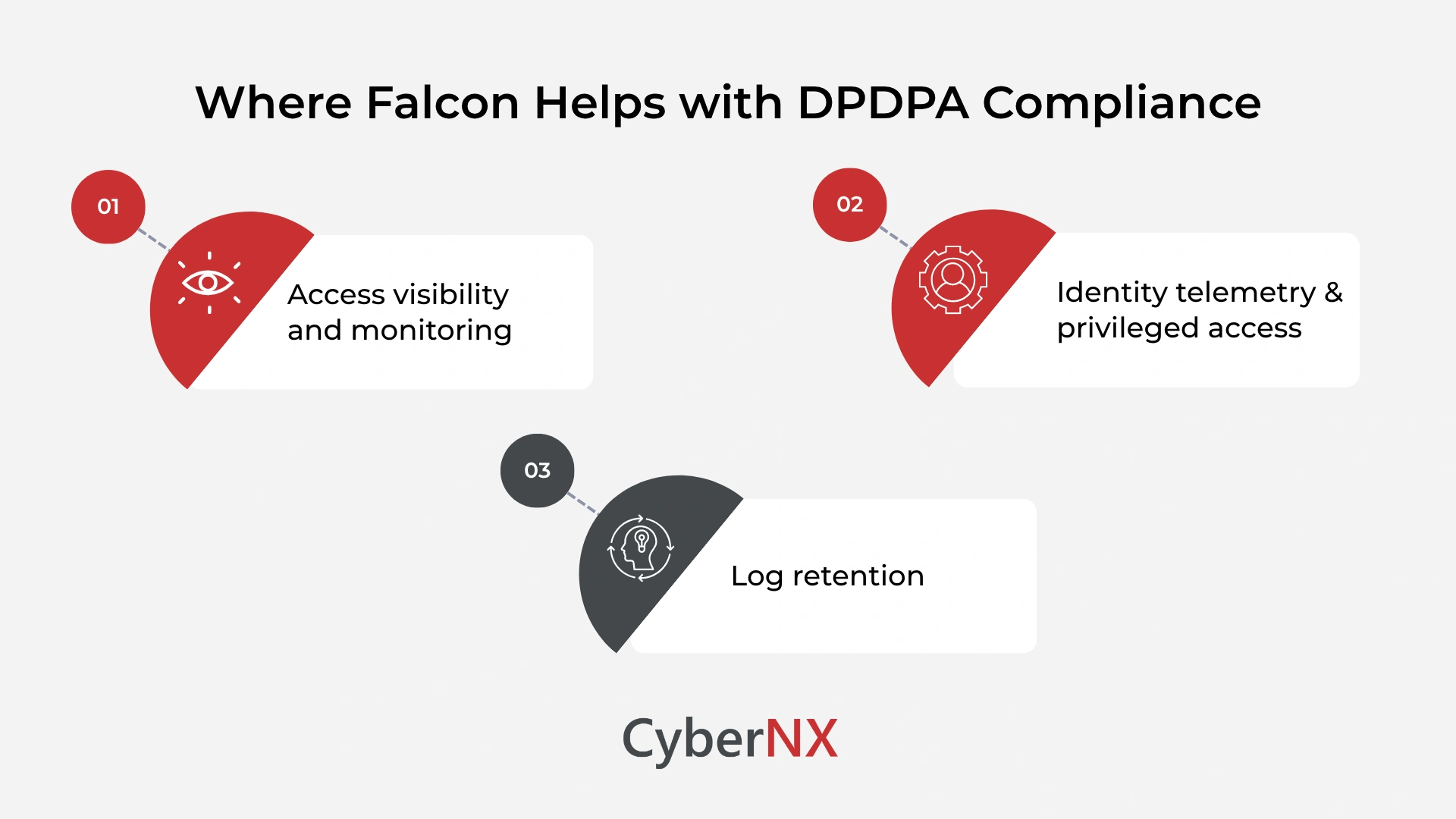
1. Access visibility and monitoring under Rule 6(c)
Rule 6(c) asks for visibility on the accessing of personal data through logs, monitoring and review. The stated purpose is detecting unauthorised access, then investigating and remediating it.
This is what an endpoint detection and response platform was built to do. Falcon captures process execution, file access and lateral movement across every instrumented endpoint. When someone touches a system they should not, the telemetry exists.
2. Identity telemetry and privileged access abuse
Rule 6(b) concerns control over computer resources. Falcon Identity Protection correlates authentication events with endpoint behaviour, which surfaces credential misuse and privilege escalation.
Shared admin credentials remain the most common failure we see in Indian enterprises. Identity telemetry makes that abuse visible and attributable, which matters when you must prove who accessed what.
3. Log retention against the one-year requirement
DPDPA expects access logs covering personal data to be retained for at least a year. Falcon Next-Gen SIEM supports scalable retention without the storage economics of legacy platforms.
We cover the architecture choices in detail in our guide to log retention and compliance using CrowdStrike NG-SIEM.
Where Falcon stops
Now it is important for you to know where Falcon cannot help as far as DPDPA readiness is concerned.
Encryption, masking and tokenisation
Rule 6(a) requires personal data to be secured through encryption, obfuscation, masking or virtual tokens. Falcon, which is mainly a detection and response platform, does not support this process.
Encryption lives in your database, storage and application tiers. No endpoint agent changes that.
Consent, notice and data principal rights
The substantive core of DPDPA sits entirely outside your security stack. Consent capture, privacy notices, purpose limitation, erasure on withdrawal, grievance redressal, nomination rights, Falcon touches none of them.
These obligations need consent management systems, data mapping and legal work. Treating a security platform as progress here is how programmes stall.
Processor contracts and governance evidence
Rule 6(f) requires security clauses in your Data Processor contracts. Rule 6(g) requires organisational measures proving observance. Both are governance artefacts. No product generates them.
The gap most Falcon customers miss
Even inside its strong rows, there is a subtlety worth understanding.
Threat detection is not personal data breach detection
Falcon tells you an endpoint was compromised and not whether personal data was in scope, whose data it was or how many Data Principals were affected.
Rule 7 asks for exactly those details, within 72 hours. A detection that says “ransomware on FIN-SRV-04” does not answer the Board’s questions. You still need to know what sat on that server.
What you need to add on top
Closing this gap means connecting security telemetry to data context. That usually involves three additions.
- Data discovery and classification: knowing which systems hold personal data before an incident, not during one
- Asset-to-data-flow mapping: so a compromised host resolves immediately to a data category and volume
- Detection logic scoped to personal data: rules tuned for unusual access patterns against those systems specifically
Without this layer, your detection stack is fast at answering security questions and slow at answering regulatory ones.
Conclusion
The relationship between your endpoint platform and India’s privacy law is narrower than vendor mapping suggests, and more valuable than compliance teams usually credit. Falcon does real work on access visibility, identity telemetry and retention. However, it does have limitation when it comes to encryption, consent or processor contracts.
With the substantive obligations arriving on 13 May 2027, the useful question is which Falcon modules you should configure now so the evidence exists when the Board asks.
At CyberNX, our CrowdStrike Consulting team can scope that with you – from module selection to detection tuning or retention design.
CyberNX works on both sides of this problem: Falcon deployments and Indian regulatory readiness programmes, including DPDPA, SEBI CSCRF, RBI and CERT-In. As a strategic CrowdStrike partner, CyberNX brings together detection engineering expertise and CrowdStrike’s AI-native unified platform to deliver security operations that produce the right evidence for the right obligation.
If you’re running Falcon and are unsure where your DPDPA gaps sit, then talk to our team today for a focused assessment.
CrowdStrike and DPDPA FAQs
Does DPDPA require EDR?
No. The Act is technology-neutral and names no product category. It requires reasonable security safeguards appropriate to your processing risk. Endpoint detection and response is one credible way to evidence the monitoring obligation in Rule 6(c), not a mandate.
Can CrowdStrike Falcon make us DPDPA compliant?
No single platform can. Falcon addresses roughly three of the seven Rule 6 safeguards and none of the consent, notice or rights obligations. It strengthens a compliance programme. It does not constitute one.
What is Rule 6(c) asking for?
Visibility on who accesses personal data, through logs, monitoring and review, sufficient to detect unauthorised access and investigate it. In practice this means centralised logging, retention of at least a year and detection capability that fires.