For years, endpoint security in Indian BFSI was settled at the initial procurement stage. You bought a recognised platform, pushed out the agent and the control was considered handled.
That era has closed. SEBI CSCRF and the RBI Master Direction moved the standard from ownership to proof. An auditor is no longer interested in just your Falcon licence. They want details like – the detection that fired on a specific machine in a specific month or the analyst who reviewed it and the responses that followed.
Many banks, NBFCs, brokers and insurers already run the CrowdStrike Falcon platform. But very few have mapped what it actually proves under those two frameworks, because nobody was asked that question until recently.
CrowdStrike consulting for BFSI closes that gap. It turns a licensed platform into deployed modules, tuned detections, retained evidence and a response process an auditor can follow end to end.
Here is what CrowdStrike consulting for BFSI covers, how Falcon capability maps to Indian regulatory expectations and what to check before your next cyber audit.
What CrowdStrike consulting for BFSI actually covers
CrowdStrike Falcon is a cloud-native platform. A licence gives you access to modules for endpoint protection, identity protection, cloud workload security, threat hunting and AI-driven SIEM. Buying it is simple but running it inside a regulated financial environment is a different matter entirely.
Strong CrowdStrike consulting services for a regulated entity cover four areas:
- Design and deployment: module selection, phased rollout across branches, data centres and cloud accounts, plus agent coverage validation
- Policy and detection tuning: prevention policies moved from monitor to block, exclusions documented, alert noise reduced
- Integration: Falcon telemetry streamed into your SOC, SIEM and ticketing system so alerts become tracked incidents
- Evidence and reporting: coverage reports, detection summaries and response timelines packaged the way Indian auditors ask for them
The last point is the one most BFSI teams underestimate. Regulators score evidence, not your licence.
Where SEBI CSCRF and RBI rules meet the Falcon platform
Two frameworks shape almost every endpoint security decision in Indian BFSI today. Both set outcomes that endpoint telemetry has to support, and translating one into the other is exactly where CrowdStrike consulting for BFSI earns its keep.
1. What SEBI CSCRF expects
The Cybersecurity and Cyber Resilience Framework, issued by SEBI in August 2024, applies to stock exchanges, depositories, brokers, mutual funds, RTAs, KRAs and other regulated entities. Obligations scale with entity category, but three themes touch endpoints directly:
- Functional SOC coverage, whether in-house, group-level or through a Market SOC
- Centralised logging from critical systems, including endpoints, with a defined retention policy
- Detection, containment and reporting of incidents inside fixed timelines
Falcon can supply the endpoint and identity signal for all three. It only counts if that data reaches your SOC, survives the retention window and links to a documented response.
2. What the RBI Master Direction expects
The Master Direction on IT Governance, Risk, Controls and Assurance Practices applies to banks, NBFCs, credit information companies and all-India financial institutions. It is a governance document, not a product list. It asks for a board-approved risk framework, documented controls, cyber incident response and an independent IS audit that tests whether those controls actually work.
For endpoint security, that reduces to three questions. Which assets are covered. Who reviewed the alerts. What happened after.
5 outcomes every CrowdStrike consulting for BFSI engagement should deliver
Speed is the reason this matters. The 2026 CrowdStrike Global Threat Report puts the average eCrime breakout time at 29 minutes, with the fastest observed breakout at 27 seconds. Tools alone cannot close a window that small. These five outcomes do.
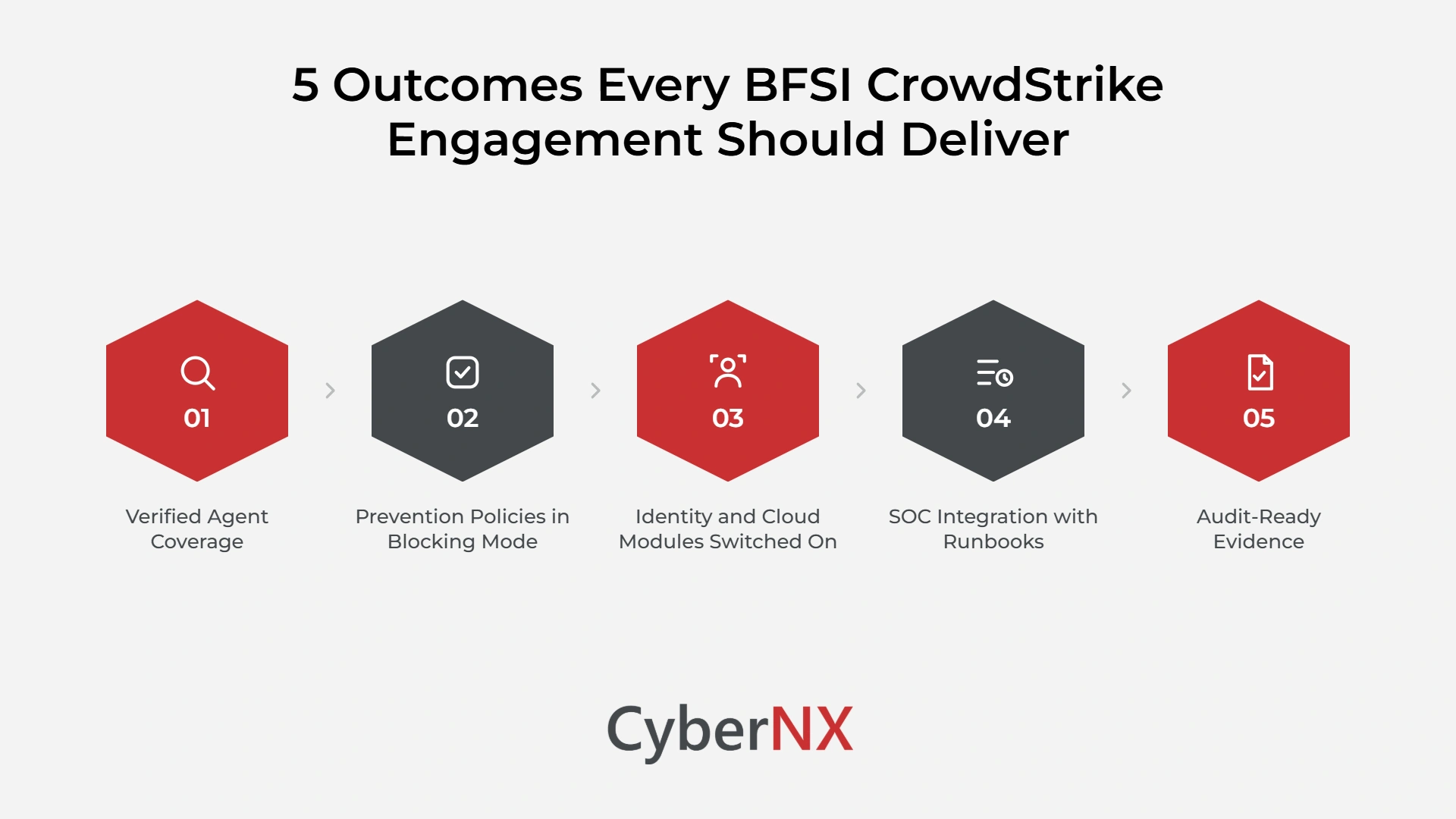
- Verified agent coverage: Every server, endpoint, branch device and cloud workload accounted for, with a documented exception list
- Prevention policies in blocking mode: Detection-only settings are a common audit finding in BFSI environments
- Identity and cloud modules switched on: Credential misuse and lateral movement rarely show up in endpoint logs alone
- SOC integration with runbooks: Named owners, escalation paths and response timelines that map to CERT-In and SEBI reporting clocks
- Audit-ready evidence: Retained detections, tuning change logs and review records you can produce on demand
Conclusion
Regulators are not interested in whether you bought a leading endpoint platform. They want to know if it is deployed across every asset, tuned to block, monitored around the clock and backed by proof your team can produce on demand. That is the real work behind SEBI CSCRF and RBI readiness, and it is what CrowdStrike consulting for BFSI is built to handle.
At CyberNX, our CrowdStrike consulting for BFSI helps banks, NBFCs, brokers and insurers deploy Falcon correctly, tune it for Indian regulatory expectations and back it with 24/7 MDR. As a CERT-In empanelled auditor, we also support SEBI CSCRF and RBI Master Direction readiness alongside the deployment.
CyberNX is a strategic CrowdStrike partner which helps us bring together our BFSI regulatory experience with CrowdStrike’s AI-native unified platform. For BFSI organisations, this combination is quite relevant: CyberNX’s background as a CERT-In empanelled auditor and its deep familiarity with SEBI CSCRF and RBI compliance obligations means your Falcon deployment is configured and evidenced to the standard Indian regulators actually test.
The partnership delivers visibility backed by 24/7 managed detection and response that reduces MTTD and MTTR and generates the audit trail. Talk to our experts today and turn your Falcon investment into proven, reliable protection.
CrowdStrike Consulting for BFSI FAQs
What is CrowdStrike consulting for BFSI?
It is advisory and implementation support that helps banks, NBFCs, brokers and insurers get full value from the CrowdStrike Falcon platform. The work covers module design, deployment, policy tuning, SOC integration and the evidence trail Indian regulators expect at audit time.
Does CrowdStrike Falcon make a BFSI entity SEBI CSCRF compliant?
No single product delivers compliance. CSCRF sets outcomes across governance, detection, response and audit evidence. Falcon supplies strong endpoint and identity telemetry that supports several of those outcomes, but only when it is fully deployed, integrated with a functional SOC and backed by documented processes. CrowdStrike consulting for BFSI closes that distance.
How does CrowdStrike consulting for BFSI support RBI Master Direction readiness
The RBI Master Direction expects documented controls, tested incident response and independent IS audit. Consulting turns Falcon data into that evidence: asset coverage reports, alert review records, containment timelines and change logs the IS auditor can verify.
Where is CrowdStrike Falcon data stored for Indian entities?
CrowdStrike announced in-country regional cloud deployments for India in January 2026, giving local data residency. Confirm your assigned cloud region and log retention settings during design, since CERT-In Directions require many organisations to securely retain ICT logs for at least 180 days.