CrowdStrike Falcon integrations are technically straightforward. The platform exposes well-documented APIs and streaming interfaces. But the difficulty is deciding what should flow where, and what should deliberately not flow at all.
This blog covers the integration types Falcon supports, the order to build them in, tool-by-tool notes for the systems most enterprises connect and the design mistakes that create duplicate work. If you are looking specifically at CrowdStrike’s own next-generation SIEM rather than third-party tools, our NG-SIEM architecture guide covers that separately.
What is CrowdStrike Falcon integration?
CrowdStrike Falcon integration is the practice of connecting the Falcon platform to your other security and operational tools so that detections, telemetry and response actions move between them. It works through Falcon’s REST APIs, its event streaming interface and pre-built connectors maintained by CrowdStrike and third-party vendors.
The four integration types worth distinguishing
Most confusion comes from treating all integrations as one thing. They serve different purposes and carry different risks.
- Streaming integrations: Detections and events flow continuously out of Falcon into a destination such as a SIEM. High volume, low latency.
- Query integrations: Another tool asks Falcon a question on demand, usually for enrichment during an investigation. Low volume, high value.
- Action integrations: An external system triggers a Falcon action, such as isolating a host. Low volume, high impact, needs the tightest controls.
- Enrichment integrations: Falcon pulls context from elsewhere, such as asset ownership from a configuration management database.
Why the direction of flow matters
Streaming data out of Falcon is easy and tempting. It is also where cost and noise problems originate, because ingestion pricing in most SIEM platforms scales with volume.
Query integrations often deliver more analyst value per rupee spent. An analyst who can pull Falcon process lineage into an open investigation gets more from that than from a full detection feed nobody reads.
The order to build integrations in
Sequence matters more than tooling choice. This is the order we use on engagements.
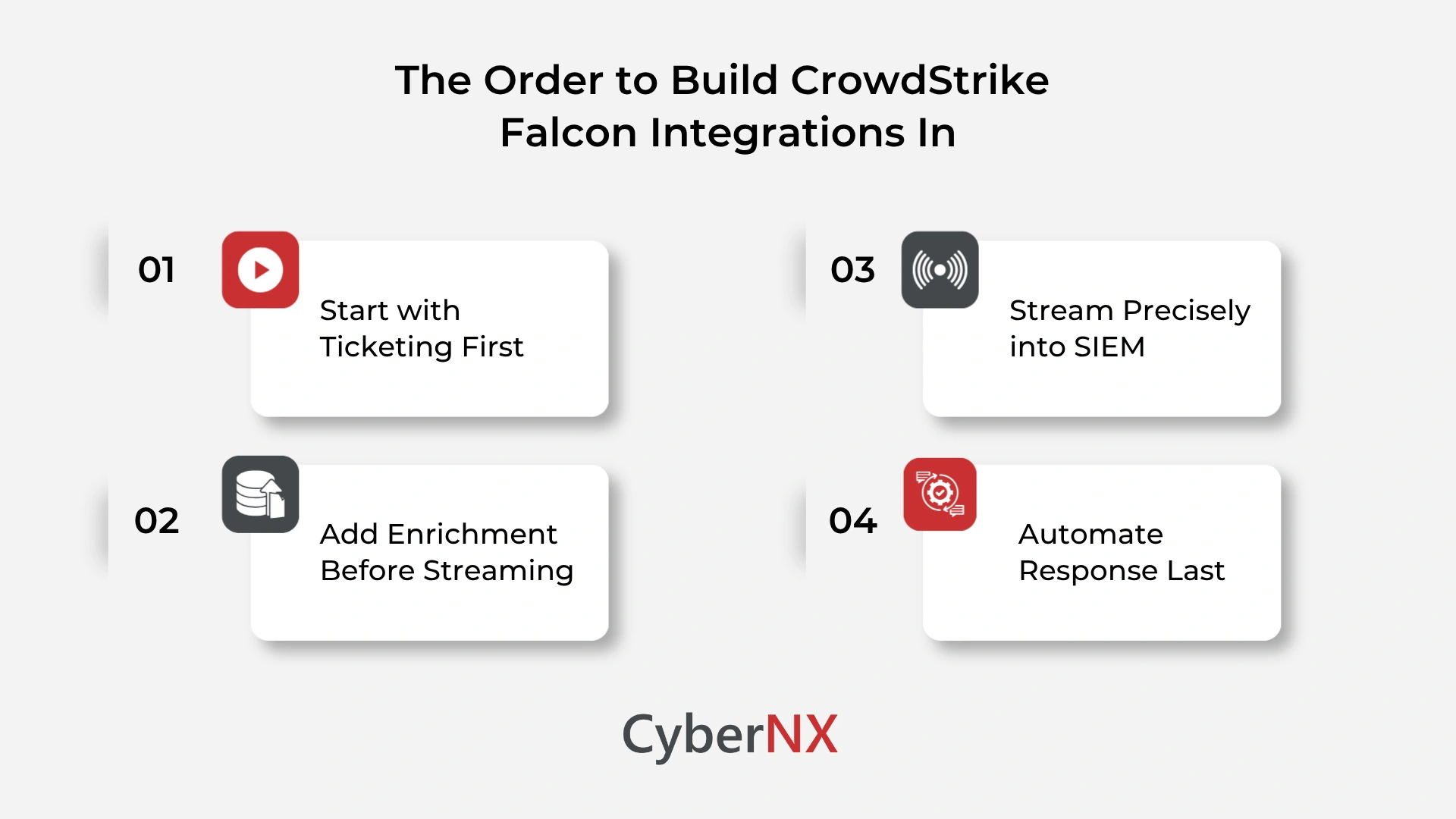
1. Start with ticketing, not SIEM
This is counterintuitive, and it is the single most useful piece of advice in this guide.
Ticketing integration forces you to answer the question every other integration depends on: who acts on a Falcon detection, and within what timeframe. Once that routing logic exists, your SIEM and SOAR integrations have somewhere sensible to point. Build them first and you will rebuild them later.
2. Add enrichment before streaming
Feeding asset ownership, business criticality and environment tags into Falcon costs almost nothing and improves every alert that follows.
An analyst seeing “production, payments, owner: platform team” attached to a detection makes better decisions than one seeing a hostname. Do this before you increase alert volume, not after.
3. Stream selectively into your SIEM
Now connect your SIEM, and be deliberate about scope. Send detections and audit events. Think hard before sending raw sensor telemetry, because volume is enormous and duplication with existing sources is likely.
Our post on common challenges during CrowdStrike implementation covers the API configuration and pipeline validation work this step requires.
4. Automate response last
Action integrations go live only after the previous three are stable and trusted. Automated containment built on top of noisy detection logic is how organisations isolate their own finance director during month-end close.
SOAR platforms and Falcon Fusion
You have two automation options, and they are not mutually exclusive.
Falcon Fusion is CrowdStrike’s built-in automation framework. It runs inside the platform, needs no external infrastructure and handles automated remediation workflows for defined conditions. For Falcon-native actions, it is the simpler choice.
External SOAR platforms such as Splunk SOAR, Palo Alto XSOAR or Torq make sense when your playbooks span multiple vendors. A playbook that isolates a host in Falcon, disables an account in your identity provider and opens a change record belongs in an external SOAR, because only one of those three steps is a Falcon action.
The practical rule: keep Falcon-only automation in Fusion, and put cross-vendor orchestration in your SOAR.
Ticketing and ITSM systems
ServiceNow and Jira are the common destinations, and both integrate reliably. The technical work is minor. The design work is not.
- Deduplication key: Decide what makes two detections the same incident. Host plus detection type is usually better than one ticket per detection.
- Severity mapping: Falcon severity and your operational priority scale are different things. Map them explicitly, with business context applied.
- Bidirectional status: Closing the ticket should reflect to Falcon where possible, or your console will show a permanently growing backlog of resolved issues.
- Assignment routing: Route by asset ownership from your enrichment integration, not by a single security queue.
The integration mistakes that create alert debt
These are the four patterns we see most often on assessment engagements.
1. Duplicate detection paths
The classic version: Falcon detections stream to the SIEM, the SIEM correlation rule generates its own alert, and the Falcon integration also opens a ticket directly. One event, two tickets, two owners, two half-investigations.
Fix this by defining a single authoritative path per detection type. Everything else is reference data, not an alert.
2. Integrating for completeness rather than use
Teams connect every available tool because the connector exists. Each integration then needs maintenance, credential rotation and validation after upgrades.
Every integration should have a named consumer and a stated purpose. If nobody can say who reads the output, switch it off.
3. Credentials nobody rotates
Falcon API clients are often created during a project, granted broad scope for convenience and never revisited. Scope each API client to the minimum needed, document the owner and put rotation on a schedule.
4. No validation after platform changes
Falcon evolves quickly, and so do the tools on the other end. An integration that worked at deployment can silently degrade after a version change on either side.
Build a simple monthly check: generate a test detection, confirm it appears in every downstream destination with correct fields. Ten minutes of work that catches problems your analysts would otherwise find during an incident.
Build fewer integrations, and build them in the right order
The teams who get most from CrowdStrike Falcon integrations are not the ones with the longest connector list. They are the ones who settled remediation routing before streaming any data, enriched detections with business context early and kept automated response until the foundation was trustworthy.
At CyberNX, our CrowdStrike Consulting services team works on exactly this layer – designing integration architecture, validating pipelines and tuning what reaches your analysts.
As a strategic CrowdStrike partner, CyberNX combines detection engineering expertise with CrowdStrike’s AI-native unified platform to deliver managed security operations. Integration architecture is where that cross-domain visibility is either built correctly or quietly undermined.
The four mistakes this blog names are exactly what CyberNX’s integration design is built to prevent. That is the work CyberNX does before the first SIEM connector goes live. If you’re dealing with integration debt already, talk to our CrowdStrike Consulting team today.
CrowdStrike Falcon Integrations FAQs
How many integrations does CrowdStrike Falcon support?
CrowdStrike maintains a marketplace of pre-built integrations spanning SIEM, SOAR, ticketing, identity, cloud and vulnerability management tools, alongside open REST APIs and event streaming that allow custom connections to almost anything. The practical limit is not what the platform supports but how many integrations your team can maintain properly. Most mature deployments run well on five to eight well-designed integrations.
Do you need a SIEM if you have CrowdStrike Falcon?
You need somewhere to correlate Falcon telemetry with logs from systems the Falcon sensor cannot reach, such as network appliances, legacy platforms and business applications. That destination can be a third-party SIEM or CrowdStrike’s own next-generation SIEM. What you should not do is run a SIEM purely to store Falcon detections that already live in the Falcon console.
Is Falcon Fusion a replacement for a SOAR platform?
For automation confined to Falcon actions, yes, and it removes infrastructure overhead. For playbooks that touch systems outside the Falcon platform, no. Most enterprises end up using both, with Fusion handling native response and an external SOAR orchestrating cross-vendor workflows.