Has brand risk monitoring really changed over the past few years? Do best practices for brand risk monitoring that worked in 2020 still work today?
The short answer is this. The fundamentals remain, but the execution has changed drastically.
Half a decade ago, many organisations focused on basic visibility. Spot fake domains, track phishing emails and respond when customers complained. That approach felt sufficient at the time. This was because attacks were fewer, channels were limited and brand abuse moved slower.
Fast forward to 2026, things have changed drastically. Attackers move at machine speed. Brand impersonation spans email, social platforms, mobile apps, search ads and the dark web at the same time. A delayed response now means lost revenue, regulatory scrutiny and reputational damage that spreads fast.
So yes, best practices for brand risk monitoring have evolved. Let us start with what still matters, before exploring what truly defines success today.
Core best practices that still matter in an era of sophisticated threats
Before we talk about what is new, it is important to acknowledge what has not changed. These practices remain essential. The difference lies in how consistently and intelligently they are applied.
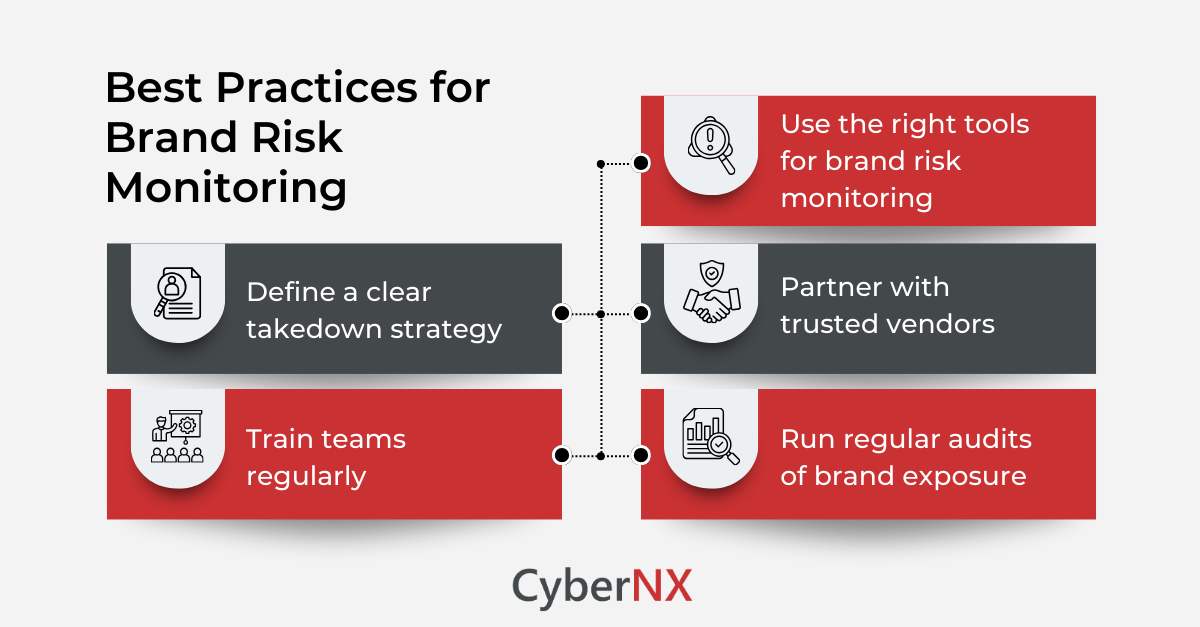
1. Use the right tools for brand risk monitoring
Every effective programme starts with the right tooling. Brand risk monitoring tools help identify phishing domains, fake websites, impersonation on social media, leaked credentials and unauthorised mobile apps.
However, in 2026, relying on narrow tools that cover only email or domain monitoring creates blind spots. Modern brand abuse rarely stays in one channel. We see campaigns move from email to social to messaging apps within hours.
The best tools today provide broad visibility across the open web, dark web and third party platforms. They also reduce noise by correlating signals rather than flooding teams with alerts.
Our experience shows that investing in capable tools early reduces downstream effort significantly.
2. Partner with trusted vendors
Technology alone is not enough. Trusted vendors play a critical role in successful brand risk monitoring programmes.
Brand risk monitoring vendors bring threat intelligence, takedown expertise and platform relationships that internal teams rarely have at scale. They also help organisations stay ahead of new abuse techniques that change every quarter.
The key is choosing partners who understand both security and brand protection. Vendors must speak the language of risk, not just indicators.
Strong partnerships free internal teams to focus on decisions rather than chasing takedown tickets all day.
3. Run regular audits of brand exposure
Regular audits remain a core practice. Organisations still need to review domains, subdomains, certificates, mobile apps and digital assets linked to their brand.
What has changed is the scope. In 2026, audits extend beyond owned assets to include third party exposure, partner misuse and abandoned infrastructure that attackers exploit.
Audits should not be one off exercises. They should feed directly into monitoring rules, response playbooks and leadership reporting.
When audits are treated as living inputs rather than static reports, they deliver real value.
4. Define a clear takedown strategy
Detection without response creates frustration. A clear takedown strategy remains non-negotiable.
This includes predefined processes for phishing sites, fake social profiles, malicious apps and fraudulent ads. It also means knowing when legal escalation is required and when rapid disruption is enough.
In 2026, speed matters more than perfection. The goal is to limit exposure quickly, then refine.
Teams that rehearse takedowns respond with confidence. Teams that improvise often lose critical time.
5. Train teams regularly
Human judgement still matters. Training helps teams recognise emerging brand abuse patterns and understand how attackers think.
Training should not be limited to security teams. Marketing, legal, customer support and fraud teams often see early signals of brand misuse.
When teams know what to look for and who to inform, response becomes faster and smoother.
The 2026 mandate: turning brand protection into a competitive advantage
While the practices above remain important, they are no longer enough on their own. The most effective organisations have evolved their approach in four key ways.
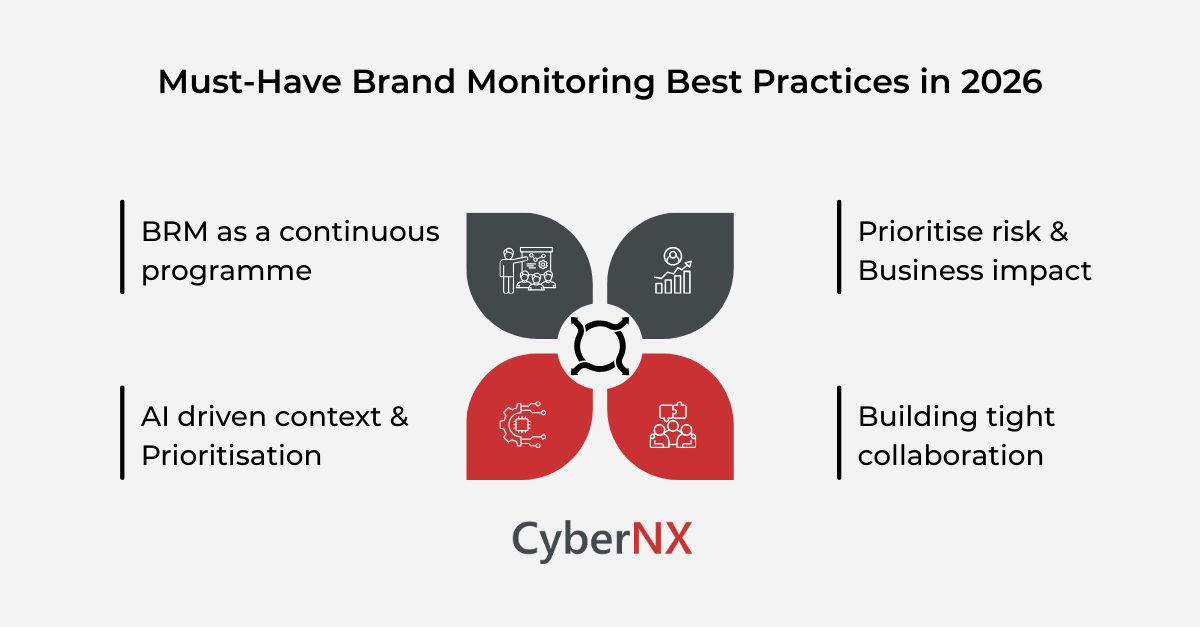
1. BRM as a continuous programme
One of the biggest shifts in best practices for brand risk monitoring is moving from projects to programmes.
In the past, monitoring was often reactive or periodic. Today, it must be continuous. Attacks do not wait for quarterly reviews.
A programme mindset means clear ownership, defined metrics and ongoing improvement. It also means integrating brand risk monitoring into daily security operations rather than treating it as a side task.
When monitoring runs continuously, teams catch abuse early. Early detection changes outcomes.
2. Prioritise risk & business impact
Another major change is how teams prioritise what they see.
In 2020, success often meant catching as many incidents as possible. In 2026, success means acting on the incidents that matter most.
Effective programmes link brand abuse to business impact. Is this phishing campaign targeting customers or internal users? Is executive impersonation involved? Is financial fraud already happening?
By scoring risk based on impact, teams avoid burnout and focus their energy where it protects trust and revenue.
Leadership also benefits from reporting that speaks in business terms rather than technical detail.
3. Building tight collaboration
Brand risk does not sit neatly within one team. This reality is now widely accepted.
The strongest programmes involve close collaboration between security, legal, marketing, fraud and communications teams. Each brings context that improves decision making.
Marketing teams validate brand misuse. Legal teams accelerate takedowns. Fraud teams assess financial impact. Security coordinates the response.
When collaboration is built into the programme, response becomes faster and less contentious.
4. AI driven context & prioritisation
AI has changed how brand risk monitoring scales.
Modern platforms use AI to correlate signals, identify coordinated campaigns and reduce false positives. More importantly, they provide context. Why this incident matters. How it connects to others. What action is recommended.
This does not replace human judgement. It supports it.
In 2026, teams that rely purely on manual analysis struggle to keep up. AI driven prioritisation allows smaller teams to manage larger attack surfaces with confidence.
Conclusion
So, have the best practices changed? Yes. And no.
The foundational best practices for brand risk monitoring remain relevant. Tools, vendors, audits, takedowns and training still matter deeply. What has changed is the mindset. Monitoring is now continuous. Decisions are driven by business impact. Collaboration is essential. AI supports scale and speed. Organisations that adapt to this reality protect more than their brand. They protect customer trust and long-term growth.
If you are still operating with a 2020 mindset, now is the right time to reassess. If you want to modernise your brand risk monitoring programme for 2026, speak with our experts. Our brand risk monitoring services help organisations move from reactive monitoring to proactive brand protection with clarity and confidence. We do Comprehensive mapping and monitoring of your organization’s digital presence across the internet. Plus, we identify and mitigate threats specifically targeting your brand and reputation.
Best practices for brand risk monitoring FAQs
How is brand risk monitoring different from threat intelligence?
Brand risk monitoring focuses specifically on abuse of brand assets such as domains, logos and identities, while threat intelligence covers a broader range of adversary activity.
Who should own brand risk monitoring in an organisation?
Ownership typically sits with security, but success depends on shared responsibility across legal, marketing and fraud teams.
How quickly should takedowns happen to be effective?
The first few hours matter most. Rapid disruption limits exposure even if full removal takes longer.
Can small security teams manage brand risk effectively?
Yes, with the right tools, prioritisation and vendor support, small teams can manage large digital footprints.