The Indian Computer Emergency Response Team (CERT-In) recently shared its latest figures with Parliament. Between January and June 2026, it detected 3,48,607 incidents in banking alone. Healthcare recorded 18,855 incidents in the same period, showing the threat extends beyond banking.
The financial impact is global and growing. The Federal Bureau of Investigation (FBI) released its Internet Crime Report in April 2026. It recorded $20.9 billion in reported losses, up 26% from the previous year. Not every loss originates in code, but many attacks exploit vulnerable applications. A missing authorisation control or an exposed API key can enable a breach.
A structured secure code review process helps you find these weaknesses before release. In this blog, we walk you through each stage of an expert-led review. You will also learn what to prepare and how to find the best review partner.
What a secure code review process covers
Secure code review is a structured examination of source code through an attacker’s lens. Standard code review asks whether the code works and reads well. A secure review asks how an attacker could exploit it. Reviewers trace how data enters, moves through and leaves your application.
Beyond functional code review
Functional review targets logic errors, readability and coding standards. Security review targets weaknesses such as injection paths and broken access control. It also covers hardcoded credentials, weak cryptography and insecure error handling. For the fundamentals, read our secure code review guide.
Where it fits alongside VAPT
Vulnerability Assessment and Penetration Testing (VAPT) tests your running application from outside. Secure code review works from the inside, one code path at a time. Each approach finds issues the other can miss. Together, they give you a far more complete view of application risk.
Why secure code review process is now a business priority
Two shifts have made code-level review far more urgent for development teams.
AI speeds up coding, not secure design
AI coding assistants now sit inside most development workflows. They produce working code quickly, but speed does not guarantee safe design. These assistants rarely understand your access model, data classification or regulatory obligations.
In security terms, code that only appears correct carries real risk. An AI-generated login handler may compile and pass every unit test. It may still omit rate limiting or trust a user-supplied role parameter. Only a reviewer who understands your business context will identify that gap.
Private Repositories Can Still Expose Secrets
Hardcoded credentials remain one of the easiest entry points for attackers. GitGuardian’s State of Secrets Sprawl 2026 report examined this closely. Internal repositories were six times likelier to contain hardcoded secrets than public ones. Commits co-authored by AI assistants also leaked secrets at twice the baseline rate.
Many teams assume private repositories are safe by default. That assumption leaves database passwords, cloud keys and payment gateway tokens exposed. Any insider or compromised developer account can then access them.
How the secure code review process works
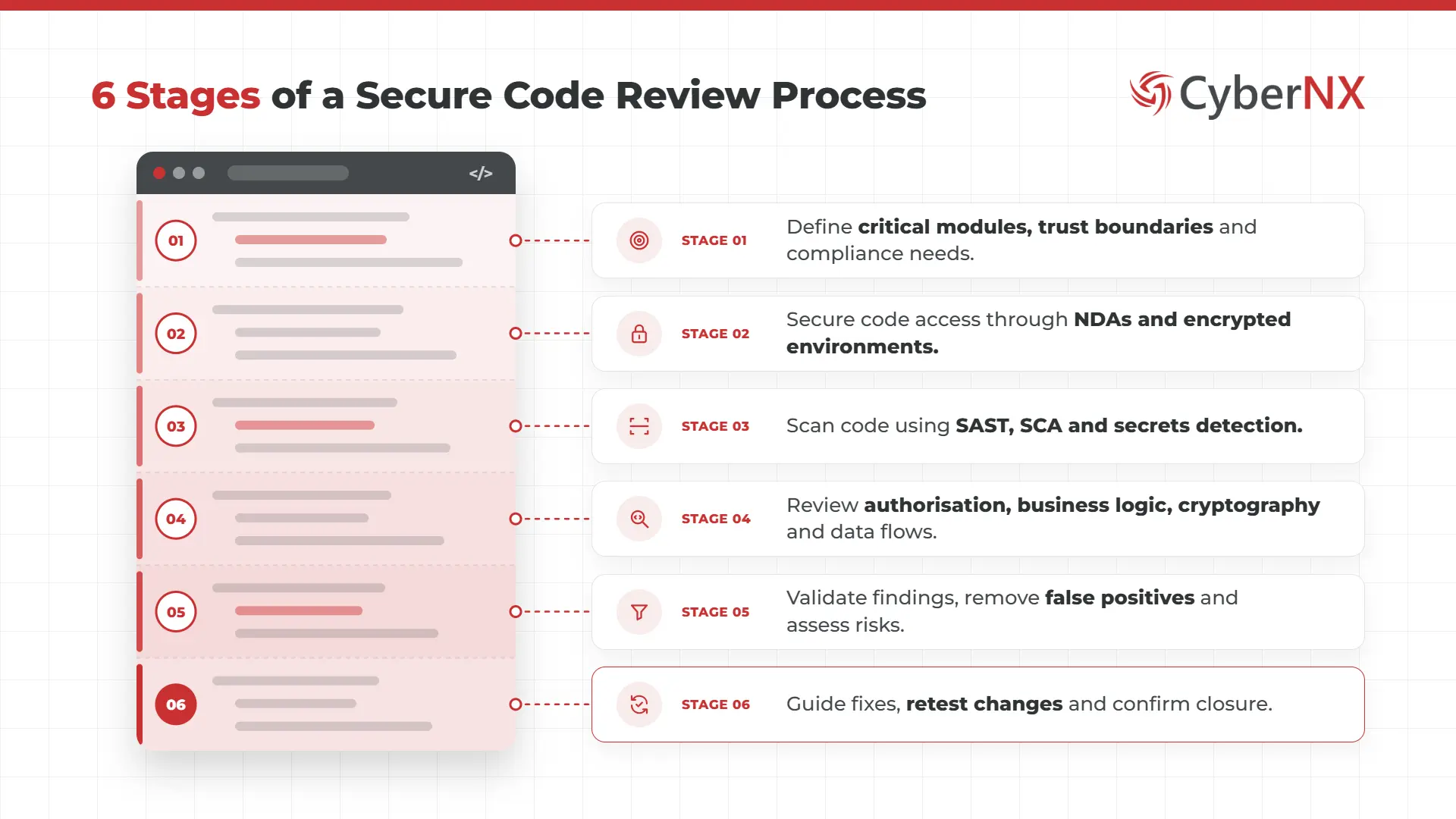
A mature secure code review process follows six connected stages. Each stage builds on the one before, so skipping steps weakens the outcome.
1. Scoping and threat context
Every secure code review process starts with clarity on what matters most. We identify critical modules such as authentication, payments and data export functions. We also map trust boundaries, user roles and third-party integrations. Requirements from the Reserve Bank of India (RBI) can further shape the scope. A short threat-modelling session then shows reviewers which components attackers will likely target.
2. Secure code access and handling
Your source code is valuable intellectual property, and reviewers must treat it that way. Expect a signed non-disclosure agreement before any code is shared. Access should run through isolated, encrypted environments with strict permissions. Your code should never reach public tools or third-party AI services. Once the engagement ends, the reviewer should confirm secure deletion of all copies.
3. Automated analysis
Next, reviewers run automated tools to cover the full codebase quickly. Static Application Security Testing (SAST) flags known insecure patterns across thousands of lines. Software Composition Analysis (SCA) identifies vulnerable open-source libraries and outdated dependencies. Secrets scanning finds exposed keys, tokens and passwords in code and commit history.
These tools work fast, but they cannot judge business context.
4. Manual expert review
This stage of secure code review process delivers the deepest value in the entire process. Experienced reviewers read high-risk code paths line by line. They focus on areas that automated tools routinely miss:
- Authorisation logic: Can a customer view another customer’s loan statement by changing an ID?
- Business logic: Can a user redeem the same reward points twice through parallel API requests?
- Cryptography: Are encryption keys stored safely and rotated on schedule?
- Data exposure: Do Aadhaar or Permanent Account Number (PAN) details appear in application logs?
- Service trust: Do internal microservices accept requests without verifying the caller?
5. Validation, risk rating and reporting
Every finding is validated to remove false positives before it reaches you. Each confirmed issue gets a severity rating based on exploitability and business impact. The report pinpoints the exact file, line and vulnerable code snippet. It also gives your developers clear, code-level remediation guidance. A good report serves your engineering team and your auditors equally well.
6. Remediation support and re-verification
Findings only reduce risk once your team fixes them. Reviewers should guide your developers through each critical and high-severity issue. After fixes are deployed, a focused retest confirms every vulnerability is closed. You then receive a closure report as evidence for audits and leadership.
What your team should prepare before the review
Proper preparation shortens timelines and improves the depth of findings. Before kick-off, keep these items ready for the review team:
- Repository access: Read-only access to the relevant branches and commit history.
- Architecture diagrams: Data flows, integrations and deployment views of the application.
- Build instructions: Steps to compile and run the application in a test environment.
- High-risk features list: Modules that handle money, identity or personal data.
- Previous reports: Earlier VAPT or audit findings, so reviewers can verify past fixes.
- Technical point of contact: A developer who can answer questions quickly.
Clear inputs let reviewers spend their time on analysis, not discovery.
How to evaluate a secure code review partner
Not every secure code review process delivers the same depth or value. Use these criteria when you compare providers.
Manual code review beyond automated scanning
Ask how much of the review is done manually. Unvalidated tool output increases your team’s workload instead of reducing risk. Request a sample report to judge quality before you sign.
CERT-In empanelment and audit-ready reporting
Regulated entities need evidence that stands up to scrutiny. A CERT-In empanelled partner adds recognised credibility to your audit file. Our post on secure code review best practices covers what auditors expect to see.
Stack coverage and retesting
Confirm the team has hands-on experience with your technology stack. That may include Java, .NET, Python, Node.js, Go or mobile frameworks. Also confirm that retesting is part of the scope, not an extra charge.
Automated scanning vs expert-led secure code review
This comparison shows why tools alone cannot replace an experienced reviewer.
| Factor | Automated scanning | Expert-led secure code review |
| Speed | Minutes to hours | Days to weeks, depending on scope |
| Business logic issues | Limited detection | Identifies issues using application context |
| False positives | May generate many false positives | Validates findings before reporting |
| Remediation guidance | General suggestions | Code-specific fixes and priorities |
| Audit value | Limited on its own | Detailed findings and closure reports |
| Application context | Limited understanding | Considers workflows, data flows and access controls |
| Human expertise | Relies on predefined rules and patterns | Applies security knowledge and attacker perspective |
Close the gap before attackers find it
Every line of code you ship either strengthens your defences or weakens them. Scanners flag patterns that look wrong, but attackers exploit what scanners miss. Broken authorisation, business logic gaps and hardcoded secrets rarely trigger an alert. They surface only when someone reads your code the way an attacker would.
That is the standard we hold ourselves to at CyberNX. Our CERT-In empanelled Secure Code Review process pairs automated analysis with expert manual review. We protect your code throughout and guide your developers through every fix. You get findings your engineers can act on and evidence your auditors accept.
Your next release is already in development. Book a secure code review with our experts and ship it with confidence.
Secure code review process FAQs
How much time it takes for secure code review process?
Timelines depend on code size, language and architecture. A focused review of a mid-sized application often takes two to four weeks. Large platforms with many microservices may need a phased engagement.
Can you review only the code changed since the last release?
Yes, a differential review targets only new or modified code. It suits teams releasing often through continuous integration and delivery (CI/CD) pipelines. Still, plan a full review at least once a year. Small changes can affect older code paths in unexpected ways.
Is a secure code review report accepted for regulatory audits?
In most cases, a well-documented report is accepted as audit evidence. Regulators such as RBI expect proof of secure development practices. A CERT-In empanelled auditor’s report, plus a closure report, usually meets that need. Still, confirm exact scope requirements with your compliance team.
How often should we schedule a secure code review?
Plan one before every major release and after significant architecture changes. Critical banking or healthcare applications benefit from quarterly reviews.