According to a 2025 Veracode State of Software Security Report, over 76% of applications contain at least one security flaw. Most of those flaws are introduced at the code level, long before testing or deployment begins. This is the reason why applications are now the primary attack surface.
Secure code review is the process of examining source code to find security vulnerabilities before they reach production. It is one of the most cost-effective security practices available, and one of the most skipped.
This guide covers what secure code review is, why it matters for Indian organisations, how to run one effectively and what to look for when you do.
What is secure code review?
Secure code review is a structured examination of application source code with the specific goal of identifying security vulnerabilities. It goes beyond checking whether code works as intended. The focus is on finding flaws that an attacker could exploit – before the code is deployed.
Reviewers look for issues like improper input handling, insecure authentication logic, hardcoded credentials and missing access controls. The goal is to catch these issues at the development stage, where fixing them costs a fraction of what it would post-deployment.
How it differs from standard code review
A standard code review checks for functionality, readability and adherence to coding standards. Secure code review does all of that, but adds a security lens. Reviewers actively look for vulnerabilities, not just bugs.
A developer reviewing a login function might confirm it works correctly. A secure code reviewer would also ask: Is the session token generated securely? Is brute-force protection in place? Is the password stored as a salted hash? These are different questions, and they require a different mindset.
Where it fits in your SDLC
Secure code review belongs inside your Software Development Life Cycle (SDLC), not after it. The earlier you review code for security issues, the cheaper and faster those issues are to fix.
The NIST Secure Software Development Framework recommends integrating security reviews at every phase of development – from design to deployment. For most teams, this means building code review checkpoints into pull request workflows, not treating it as a one-time pre-launch activity.
Secure code review and Indian entities
Security vulnerabilities discovered in production are expensive to fix and difficult to contain. The IBM Cost of a Data Breach Report 2024 puts the average cost of a data breach in India at Rs. 19.5 crore, a figure that has risen steadily over the past four years. The organisations most exposed are those that treat security as a final checkpoint rather than a development practice.
The cost of finding vulnerabilities late
Fixing a vulnerability during development costs roughly 10 to 15 times less than fixing it after deployment. Once a flaw reaches production, the costs multiply fast. You are dealing with emergency patches, potential data exposure, regulatory notifications and reputational damage — all at the same time. Secure code review moves that discovery point earlier. It reduces your exposure window and gives your team time to fix issues properly, rather than under pressure.
RBI, CERT-In & SEBI CSCRF compliance requirements
Regulatory pressure is a strong driver for secure code review in India. Several frameworks now explicitly require secure development practices.
The Reserve Bank of India’s (RBI) guidelines on IT and cybersecurity for banks and NBFCs require organisations to maintain secure application development standards. This includes code-level security reviews as part of application lifecycle management.
CERT-In’s cybersecurity framework and incident reporting guidelines expect organisations to have controls in place that prevent vulnerabilities from entering production systems. Secure code review is one of the most direct ways to demonstrate that control.
SEBI Cyber Security and Cyber Resilience Framework (CSCRF) requires regulated entities to conduct security testing of applications as part of their resilience programme. For market intermediaries, this now includes application-level reviews tied to change management.
ISO 27001 and secure development obligations
ISO 27001 Annex A, Control 8.28 requires organisations to follow secure coding principles. This includes reviewing code for security vulnerabilities before release. For organisations pursuing or maintaining ISO 27001 certification, secure code review is not optional. It is a documented requirement that auditors will check.
Types of secure code review
There is no single method that works for every team or codebase. Most mature security programmes use a combination of approaches based on the size of the codebase, the risk level of the application and the resources available.
Manual code review
Manual code review involves a security expert reading through the source code line by line, looking for vulnerabilities that automated tools may miss. It is particularly effective for catching business logic flaws, insecure design patterns and context-dependent issues.
Manual review is time-intensive but thorough. It works best for high-risk applications, critical modules or codebases where the business logic is complex. A reviewer who understands both the code and the threat model can find issues that no tool will flag.
Automated code review with SAST tools
Static Application Security Testing (SAST) tools scan source code automatically, flagging patterns that match known vulnerability signatures. Tools like Checkmarx, Semgrep and SonarQube can scan thousands of lines of code in minutes and integrate directly into your CI/CD pipeline.
Automated review is fast and scalable. It is good at catching common vulnerability classes like injection flaws, hardcoded secrets and insecure function calls. The trade-off is a higher rate of false positives and an inability to understand business context. Read Secure Code Review Tools blog to know more.
Hybrid approach
The most effective approach combines both methods. You use SAST tools to catch common, high-volume issues early in the pipeline. You then apply manual review to the highest-risk components, the findings that need context and the areas your tools consistently miss. This hybrid model gives you speed and depth. It also makes your security review process defensible to auditors, because you can demonstrate both automated coverage and human oversight.
How to conduct a secure code review
A secure code review follows a structured process. Skipping steps – or treating it as informal feedback, reduces its value significantly.
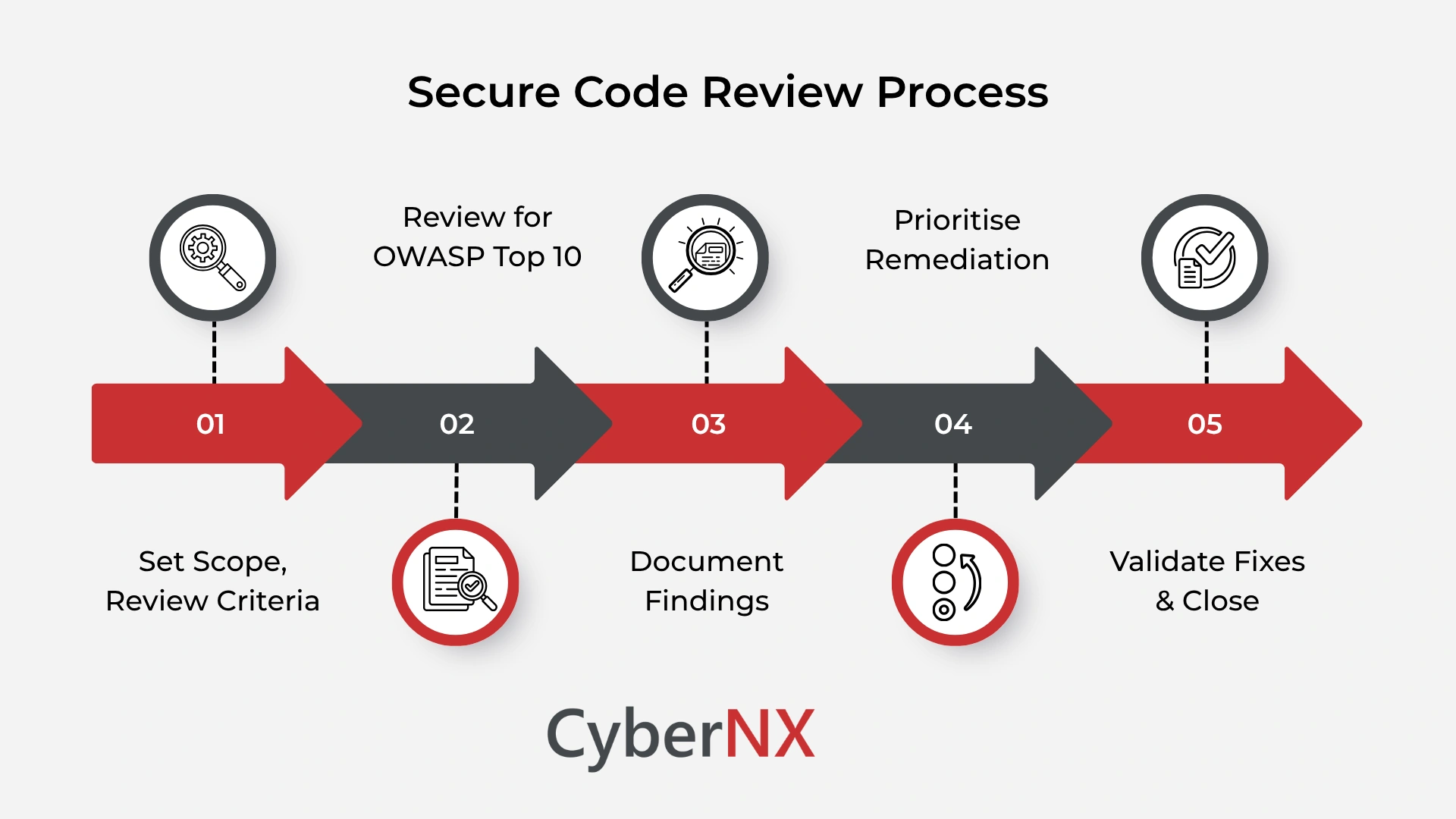
Define scope and set review criteria
Before you begin, define what you are reviewing and why. Is this a full-codebase review or a targeted review of a new feature? What is the risk classification of this application? What compliance requirements apply?
Set your review criteria upfront. This includes the vulnerability classes you will check for, the coding standards your team follows and the severity thresholds that will block a release. Without defined criteria, reviews become inconsistent and difficult to track over time.
Review for OWASP Top 10 vulnerability patterns
The OWASP Code Review Guide is the most widely used reference for secure code review. The OWASP Top 10 gives you a prioritised list of the most critical application security risks. These include:
- Injection flaws: SQL, command and LDAP injection
- Broken access control: users accessing resources they should not
- Cryptographic failures: weak encryption, improper key management
- Security misconfigurations: default credentials, open cloud storage, verbose error messages
- Vulnerable components: outdated libraries with known CVEs
Reviewing against the OWASP Top 10 gives your team a consistent, risk-based starting point for every review.
Document findings and prioritise remediation
Every finding should be documented with the file path, line number, vulnerability class, severity rating and a clear description of the risk. Generic findings like “this function is insecure” are not actionable. Specific findings with context and recommended fixes are.
Prioritise remediation based on severity and exploitability. A critical injection flaw in an externally facing API takes precedence over a low-severity information disclosure in an internal tool. Your team needs a clear order of work, not a flat list.
Validate fixes and close the loop
Once developers remediate findings, the findings need to be verified. Re-run your SAST scan. Have the reviewer confirm the fix addresses the root cause, not just the symptom. A patch that removes the flagged line but introduces a new vulnerability in the same function is not a fix.
Close the loop in your tracking system. This gives you a clear audit trail – which matters for compliance reviews, incident investigations and measuring your programme’s effectiveness over time.
What to look for during a secure code review
Knowing which vulnerability classes to prioritise is half the battle. Here are the areas that consistently produce the most critical findings.
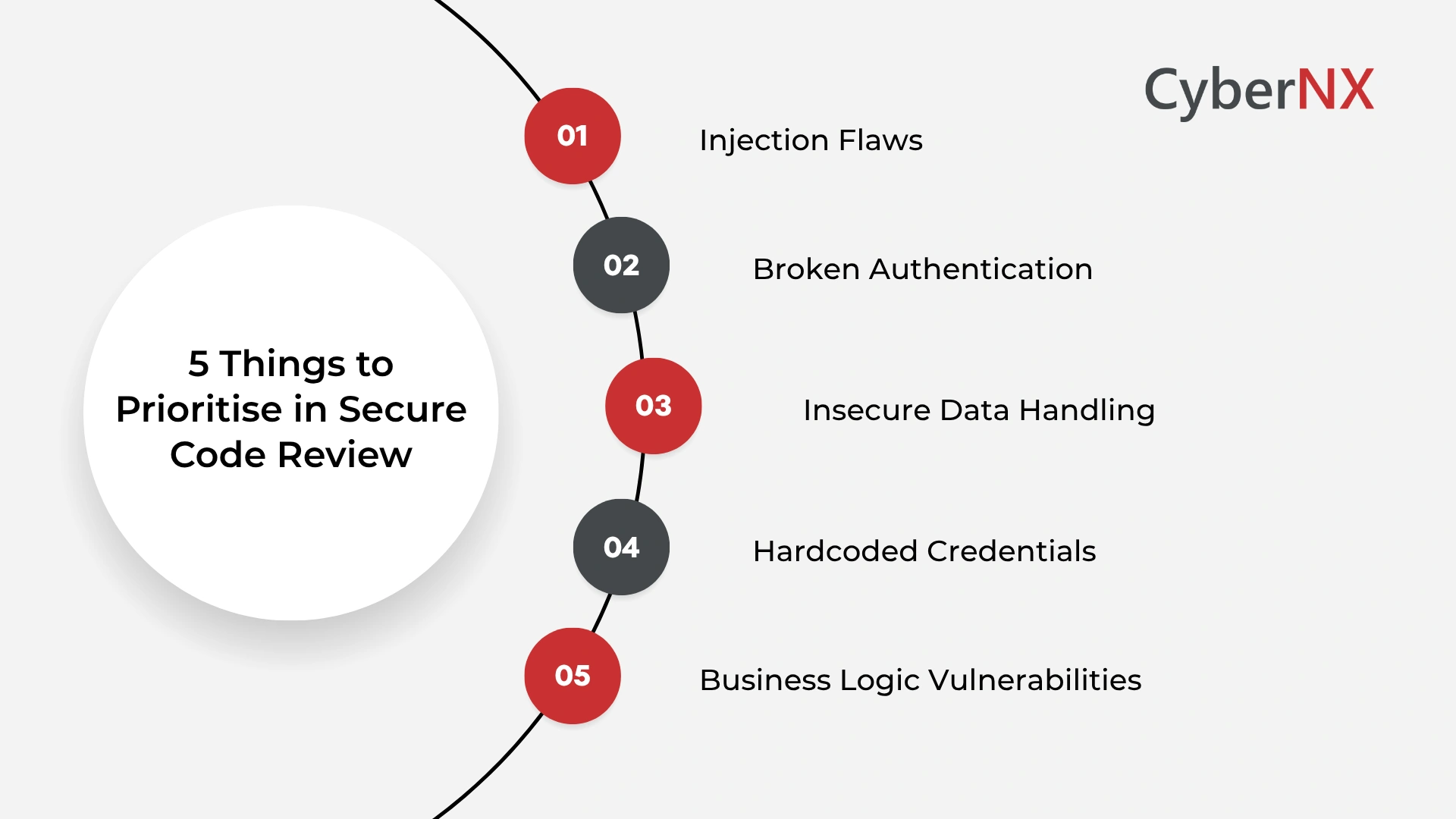
Injection flaws (SQL, command, LDAP)
Injection flaws occur when untrusted data is sent to an interpreter as part of a command or query. SQL injection remains one of the most exploited vulnerability classes globally. During review, check that all user input is validated, sanitised and handled through parameterised queries or prepared statements. Never trust input from external sources.
Broken authentication and session management
Authentication flaws give attackers direct access to user accounts. Look for weak password policies, missing account lockout mechanisms and session tokens that do not expire or rotate after login. Check that sensitive actions require re-authentication. Verify that tokens are generated using a cryptographically secure source.
Insecure data handling and hardcoded credentials
Sensitive data – passwords, API keys, connection strings and personally identifiable information — should never appear in source code. During review, scan for hardcoded credentials and check that sensitive data is encrypted at rest and in transit. Look for logging statements that may inadvertently capture sensitive values.
Business logic vulnerabilities
These are the flaws that automated tools almost never catch. Business logic vulnerabilities occur when the application behaves in ways the developers did not intend – such as a user skipping a payment step, applying a discount multiple times or accessing another user’s records by changing a URL parameter.
Finding these requires a reviewer who understands how the application is supposed to work and can think through how it could be abused.
Common challenges in secure code review
Even well-intentioned teams run into obstacles. Here is what gets in the way most often and how to address it.
Developer resistance and security silos
When security reviews are seen as a blocker rather than a safeguard, developers work around them. This usually happens when reviews are slow, findings are poorly communicated or the security team operates separately from the development team. The fix is cultural and structural. Involve developers in defining review criteria. Give clear, actionable feedback rather than vague warnings. Embed security champions within development teams so that security knowledge is distributed, not centralised.
Scaling reviews across large codebases
Manual review does not scale to millions of lines of code. Teams that rely solely on manual review end up covering only a fraction of their codebase, usually the parts they already know well. The answer is to use SAST tools to cover the full codebase automatically and reserve manual review for high-risk components, new features and areas flagged by automated scans. Triage carefully. Not everything needs the same depth of review.
Managing false positives from automated tools
SAST tools produce false positives. A finding that looks like a vulnerability may be a legitimate code pattern that the tool does not understand. If your team spends significant time investigating false positives, they will lose confidence in the tool and start ignoring its output.
Tune your tools. Suppress confirmed false positives with documented justification. Review tool configuration at regular intervals to keep the signal-to-noise ratio manageable.
Conclusion
Secure code review is one of the most direct ways to reduce your application security risk. It moves vulnerability discovery to the earliest possible point in your development process, where fixes are fast, cheap and contained. With the right combination of automated scanning and targeted manual review, you can maintain coverage without slowing your team down.
For Indian organisations operating under RBI, SEBI CSCRF, CERT-In or ISO 27001 requirements, a documented secure code review process is also a compliance necessity. The question is not whether to do it. The question is whether your current process is thorough enough to withstand scrutiny.
At CyberNX, our Secure Code Review services include expert-led application security reviews that go beyond automated scanning. Our team reviews your code against OWASP standards, maps findings to your specific compliance requirements and works alongside your developers to remediate issues effectively.
Want to know where your applications stand? Talk to our team and get a security assessment tailored to your environment.
Secure code review FAQs
How long does a secure code review take?
It depends on the size and complexity of the codebase and the type of review. An automated SAST scan can complete in minutes for most codebases. A manual review of a single critical module may take a few hours to a day. A full manual review of a large application can take several days to weeks. Most organisations use automated scanning continuously and schedule targeted manual reviews for new releases or high-risk components.
What is the difference between secure code review and penetration testing?
Secure code review examines the source code directly to find vulnerabilities before the application is deployed. Penetration testing simulates an attacker against a running application to find vulnerabilities from the outside. Both are valuable. Code review catches issues earlier and is generally more cost-effective. Penetration testing validates your defences in a real-world scenario and can find issues that only appear at runtime. For most organisations, the two practices complement each other.
What tools are used in a secure code review?
Common SAST tools include Checkmarx, Semgrep, SonarQube, Veracode and Fortify. For secrets detection, tools like GitLeaks and TruffleHog are widely used. For dependency scanning, OWASP Dependency-Check and Snyk cover known vulnerabilities in third-party libraries. Manual review is typically supported by IDEs, code search tools and a structured checklist based on the OWASP Code Review Guide.
When should you do a secure code review?
The short answer is: regularly and early. Integrate automated scanning into your CI/CD pipeline so every commit is checked. Schedule manual reviews for new features, major releases and any code that handles sensitive data or authentication. For regulated industries in India – banking, NBFCs, healthcare and capital markets – periodic code reviews are often a compliance requirement, not just a best practice.