Your Non-Banking Financial Company (NBFC) doesn’t close at 7 PM. Does it? Loan repayments arrive overnight through e-mandates. Therea are apps that approve small loans even on a holiday and then there are partner integrations that keep calling unknown times. In short, the business never stops.
But in many NBFCs, it is possible that security team go home at night. And cybercriminals have special knack to attack these systems after office hours when no one is watching. A Sophos report recently found that 88% of the ransomware attacks it investigated were launched outside business hours.
So, what should NBFCs do? You might be already running firewalls, endpoint protection and a Security Information and Event Management (SIEM) platform. But the problem here is the coverage. Someone dedicatedly must watch those tools, decide which alert matters and act before the damage spreads. That someone can’t just work a day shift alone.
In this blog, you’ll see:
- Where the after-hours gap sits
- What the Reserve Bank of India (RBI) now expects and
- how a managed Security Operations Centre (SOC) closes the gap without asking you to build a night shift
24/7 lending needs 24/7 security: Is your NBFC covered?
Digital lending changed how NBFCs work. Customers expect instant answers at any hour, and your systems deliver them. At the same time, your risk now runs on the same clock.
When attackers choose to strike
Cybercriminals select the hours when you’re least likely to notice. The 2026 Sophos Active Adversary Report found that 79% of data theft activity also took place outside the working day, alongside those ransomware attacks. So, what does that tell us exactly? It indicates that fewer eyes on screens means more time for encryption or data transfer to finish without interruption.
Why the clock matters
Speed makes this worse. The same report found attackers reached Active Directory in a median of 3.4 hours after getting in. [Help Net Security] Once they control identity, they control everything connected to it. So, an alert that fires at midnight and gets read the next morning is a record of what already happened.
What’s exposed in an NBFC
Think about what runs overnight in your environment. An attacker will look for these systems first:
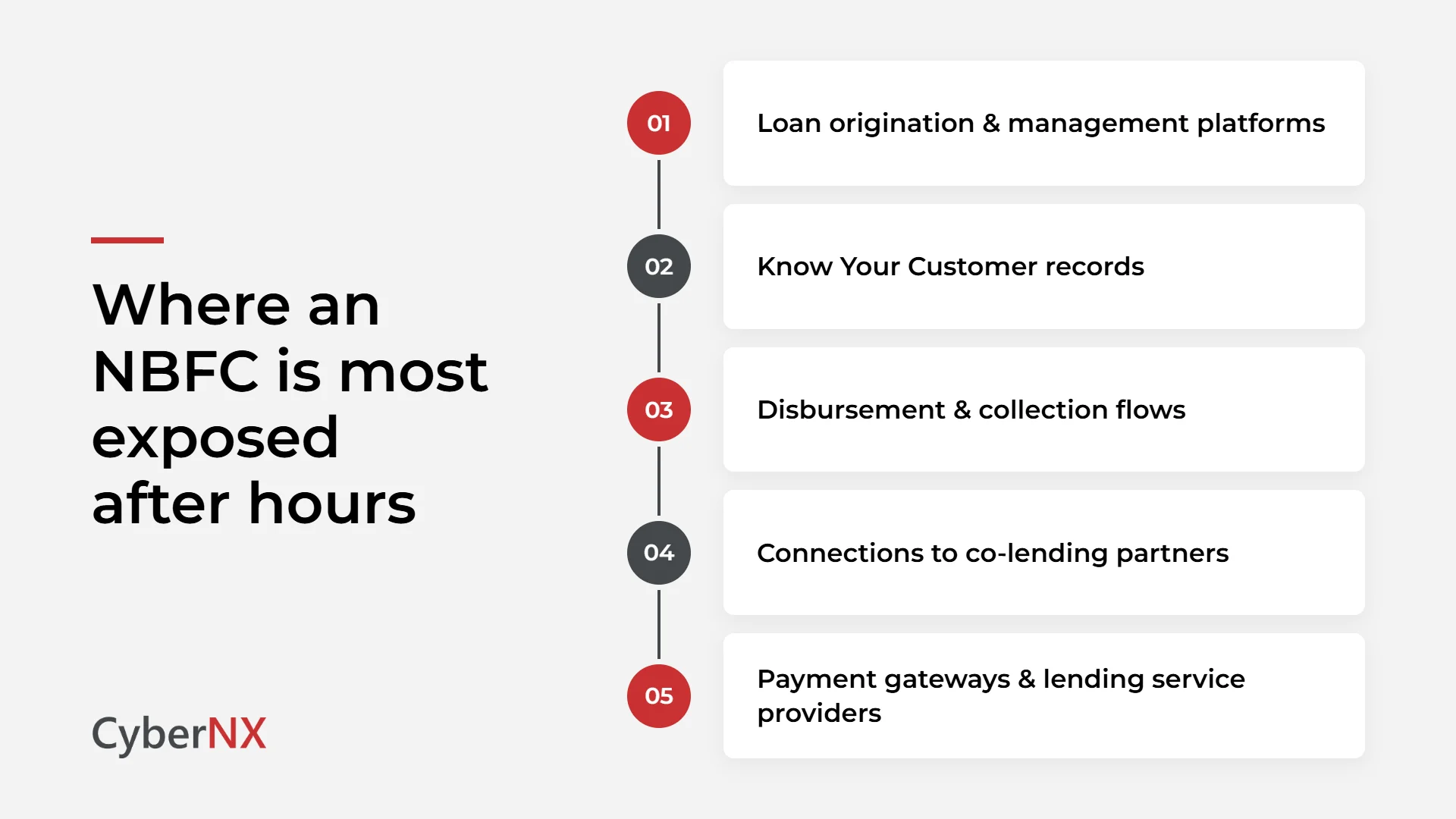
- Loan origination & management platforms that hold borrower records
- Know Your Customer records, which are valuable on their own
- Disbursement & collection flows that move money
- Connections to co-lending partners
- Payment gateways & lending service providers
A breach in any of these hits your customers, partners and associates. That’s why the hours nobody is watching matter most.
The coverage gap nobody budgets for
Tools can detect an attack, but only people can act on it. Watching them around the clock takes staff on duty every hour of the week.
The real cost of watching every hour
Look at this example:
A week has 168 hours. Let’s suppose, one analyst works about 45 of them. Covering a single seat 24/7 takes four people before you count leave, training and resignations. In practice, it comes to five or six.
And one seat doesn’t make a SOC. You still need someone to investigate, tune detections and someone with seniority to make the call during an incident. That’s a lot for a team of three.
The analyst you can’t hire
Even with budget, hiring is hard. In ISC2’s 2025 workforce study, 97% of Indian security professionals reported at least one skills need in their organisation. Nearly three in four rated those needs critical or significant.
NBFCs compete for talent with banks, IT services firms and global capability centres. Mid-size lenders rarely win on salary.

See why alert fatigue, burnout and budget pressure keep landing on security leaders, and what helps: Alert Fatigue, Burnout, and Budget Battles: The Real SOC Challenges
Tools without people
A SIEM collects events well, but it doesn’t have the capability to which one matters at a given point of time. Without an analyst behind the desk analysing, the tool logs what went wrong for someone to read later. It is important to know that a SIEM can flag an event but eventually it takes an analyst to decide whether it’s an attack.
What RBI now expects after dark
RBI’s cybersecurity directions for NBFCs, issued in July 2026, make after-hours coverage harder to ignore. Three requirements stand out.
1. The six-hour reporting clock
NBFCs must report cyber incidents to RBI on the DAKSH platform within six hours of detection. The clock doesn’t pause for weekends or holidays.
Six hours is tight even during office hours. You need to confirm what happened, assess the impact and brief leadership. If nobody is watching overnight, most of that window is gone before anyone knows. Keep a reporting runbook ready before you need it.
2. Watching logs, not just keeping them
For Middle Layer NBFCs and above, the directions call for regular monitoring of audit trails and system logs to catch unauthorised activity. They also make the office of the Chief Information Security Officer (CISO) responsible for managing and monitoring a SOC. [RBI]
Storing logs for an auditor no longer meets the bar. Someone must read them. Our RBI Master Directions gap assessment checklist for NBFCs covers the wider set of controls.
3. You can outsource the SOC and keep the accountability
RBI allows NBFCs to outsource SOC operations. Under its outsourcing directions, you must still own and oversee detection rules, logs and analytics. The provider’s escalation process must plug into your incident response. Incidents must also reach you fast enough to meet the six-hour deadline. In plain terms, a good partner works inside your governance.
How a managed SOC extends your team
A managed SOC gives you round-the-clock security operations without building them in-house. It extends your team. You keep strategy, policy and decisions. The SOC handles the watching that a small team can’t sustain.
Read how SOC as a Service delivers 24/7 monitoring and response without an in-house build: SOC as a Service Explained: The Smarter Way to Stay Secure
Monitoring that doesn’t clock out
Analysts watch your critical systems through every shift, weekend and holiday. Servers, endpoints, cloud workloads and identity systems feed into one view. Nothing waits for Monday.
Investigation that turns alerts into answers
Alerts aren’t incidents. A managed SOC triages each one, filters the noise and investigates what’s real. Your team hears only about what needs attention, with the context attached. That cuts alert fatigue and frees your team for work only they can do.
Response that fits your crisis plan
When something real happens, the SOC moves fast to contain it. That means isolating affected systems, blocking malicious access and escalating through your agreed matrix. Your Cyber Crisis Management Plan stays in charge. Your people keep the final say.
Evidence your board can use
Your CISO reports on cyber risk to the board every quarter. A managed SOC gives you metrics, incident records and trends that make those reviews easier to prepare and harder to question.
Questions to ask any SOC partner
Not every managed SOC suits a regulated lender. Before you sign, ask these four questions. The answers show whether a provider understands RBI’s expectations or is just selling monitoring hours.
1. Who owns the rules and logs?
You should. The contract must give you ownership of the detection rules, log data and analytics built for your NBFC.
2. Can they support your six-hour window?
Ask how fast they escalate a confirmed incident. Then test that promise in a drill. A partner who can’t answer clearly isn’t ready for a regulated lender.
3. How do they connect to your escalation process?
Their runbooks should map to your incident response plan and your named contacts.
4. Can auditors and RBI get access?
RBI expects access to records held by service providers. Confirm this in writing before you sign.
Use our 14-point checklist to compare SOC providers on coverage, response and compliance fit before you commit: SOC Service Provider Evaluation Checklist: 14 Key Criteria
Conclusion
NBFCs run around the clock, and that puts your systems at risk all the time. That’s because attackers plan around the hours your team is offline. RBI’s six-hour reporting rule gives those hours regulatory weight. Closing the gap takes people watching every hour, with tools behind them.
You don’t need to build a night shift. Instead, our Managed SOC Services can help you. We monitor, investigate and respond 24/7, while you keep ownership of every decision. Your business runs all night and your security will too. Talk to our SOC team and see what round-the-clock coverage looks like for your NBFC.
FAQs
Does RBI require NBFCs to have a SOC?
For Middle Layer NBFCs and above, RBI’s 2026 directions make the CISO’s office responsible for managing and monitoring a SOC. Base Layer NBFCs with assets of ₹500 crore and above face lighter rules. They still need processes to detect, analyse and respond to incidents.
Can an NBFC outsource its SOC?
Yes. RBI permits it, provided you keep ownership of rules and logs, review how alerts are handled and connect the provider to your incident response. Accountability stays with your board.
What is the difference between a managed SOC and MDR?
A managed SOC focuses on monitoring, triage and escalation. Managed Detection and Response (MDR) adds hands-on containment and threat hunting. Many providers, including CyberNX, offer both together.