Your customers apply for loans, pay monthly instalments and complete Know Your Customer (KYC) checks online. So, when a message says their loan is approved, they click. A fake site that looks like yours feels routine to them. Attackers understand this reality and look to exploit your customers.
How do they achieve this? By registering a lookalike domain, collecting logins and personal data, and running loan and payment fraud under your name. And if the attacks succeed, your customers lose money and you lose their trust.
Given the rising cyberattacks and methods of execution, Non-Banking Financial Companies (NBFCs) should not treat this as a brand or fraud problem that ends with a takedown. Instead, you should align it with your security team or Security Operations Centre (SOC). It will help to know if the fake site touched your own staff, systems or logins.
In this blog, we explore:
- How Brand Risk Monitoring and platforms like CrowdStrike-powered security operations can work as one workflow.
- You’ll also get practical steps to protect your customers and your brand.
How fake domains impersonate NBFCs and target customers
Attackers can hurt your customers without touching your systems. A convincing lookalike is enough.

For the wider tactics attackers use to borrow your credibility, read 5 Ways How Attackers Exploit Brand Trust and How to Stop Them.
The lookalikes attackers register
Most fake domains follow a few familiar patterns:
- A swapped or missing letter in your brand name
- Lookalike characters, such as a zero in place of the letter O
- Your real name on a different extension
- Words like “loan”, “kyc” or “support” added to your brand
What attackers are after
The goal is money or data. Fake sites collect login credentials, one-time passwords (OTPs) and KYC documents. Many also ask for an upfront processing fee of a few thousand rupees to release a loan that never arrives.
Why NBFC customers are easy targets
Many of your customers are first-time borrowers. They are used to paying small fees during an application. So a request for one more small payment rarely raises alarm.
Why a BRM-powered takedown alone is not a response
A takedown removes the website. It does not remove what the website already collected.
Three teams, three separate lanes
In most NBFCs, the brand team owns impersonation, the fraud team owns customer losses and the SOC owns the internal environment. Each team sees one piece. The handoff between them is where hours turn into days.
What a fake domain tells you
A lookalike domain shows intent. It tells you who is targeting you, what infrastructure they use and what they plan next. That is useful intelligence for your SOC.
The six-hour clock
The Indian Computer Emergency Response Team (CERT-In) issued directions in 2022 that list phishing attacks and fake mobile apps among incidents to report within six hours. If discovery and response sit in separate lanes, that clock runs out fast.
How Brand Risk Monitoring discovers and tracks external threats
Brand Risk Monitoring is your early warning outside the perimeter. The earlier it spots a fake domain, the less time attackers have to use it.
What it watches
CyberNX Brand Risk Monitoring tracks the places where impersonation starts:
- Newly registered domains that resemble yours.
- New security certificates and mail records on those domains.
- Cloned pages that use your logo or content.
- Fake mobile apps and social media profiles.
Mail records on a lookalike domain are a strong warning. They often mean phishing emails are about to go out.
If you’re setting up or reviewing your monitoring scope, see How Brand Risk Monitoring Detects Phishing and Fake Domains for the signals that expose fake domains early.
Also Read:
Fake apps run alongside fake domains in the same campaign. Our blog Detecting Fake Mobile Apps Using Brand Risk Monitoring shows how to find them before your customers do.
Validated findings only
Not every similar domain is malicious. Our analysts validate each finding and score it by risk. Your team hears only about what deserves attention.
Tracking the campaign behind each URL
Take down one site and another often appears. We map the hosting, registrant patterns and related domains behind each finding. That lets you block the whole campaign instead of a single page.
How can SOC investigate with CrowdStrike-powered security operations
This is where most impersonation responses stop. With CyberNX and CrowdStrike, it’s where the real investigation begins.
Every validated finding becomes a set of indicators: the domain, its IP addresses, its hosting and its related domains. Our SOC analysts enrich these with CrowdStrike threat intelligence. That shows whether the infrastructure links to a known campaign or threat actor.
Then we search your CrowdStrike endpoint, identity and network telemetry for three things:
- Employees who visited the domain or received email from it.
- Signs of credential use from attacker infrastructure.
- Unusual login or account activity.
1. Endpoint telemetry shows who went there
Using CrowdStrike Falcon endpoint telemetry, we search your environment for any device that contacted the domain. If an employee clicked a link or downloaded a file, you see the device, the user and what ran next.
2. Identity telemetry shows credential misuse
CrowdStrike Falcon identity protection surfaces unusual logins, failed attempts from unfamiliar locations and logins from attacker infrastructure. If staff credentials were captured, you spot misuse before it spreads.
3. Network signals show the wider campaign
Domain name system, proxy and email logs show whether other domains in the same campaign reached your network. They also show who received email from the fake domain. We correlate these with endpoint and identity data, so you get one picture instead of three partial ones.
4. What your telemetry can and cannot see
One boundary matters. Your customers’ devices sit outside your telemetry, and CrowdStrike does not see their side. The internal investigation covers your staff, systems and login infrastructure. Customer protection comes from takedowns, warnings and fraud monitoring. That is why the next step needs every team involved.
How to coordinate validation, escalation, containment and takedown
Discovery and investigation only pay off when they feed one coordinated response. Here is how CyberNX runs it with CrowdStrike. Each finding moves through the same five stages:
1. Validate
Our Brand Risk Monitoring analysts confirm the domain is malicious and score its risk. CrowdStrike intelligence adds context on the infrastructure behind it.
2. Escalate
High-risk findings go straight to our SOC as an incident, with the indicators attached. Nobody waits for a forwarded email.
3. Contain
Using CrowdStrike Falcon, we block the domain and related IP addresses, isolate affected devices and force password resets for exposed accounts. Falcon Fusion workflows automate the repeatable steps, so containment doesn’t wait on manual work.
4. Take down
We start takedowns with registrars and hosting providers. In parallel, we give your fraud and communications teams what they need to warn customers.
5. Monitor
Brand Risk Monitoring watches for re-registrations and new variants. CrowdStrike detections stay tuned to the campaign’s infrastructure.
Automation does much of the heavy lifting in step 3. Incident Response Automation Tools for Modern Security Operations explains how it shortens the gap between detection and response.
Who owns what
Clear handoffs matter more than a new team. Our SOC leads the investigation and containment. Your fraud team handles customer accounts. Your communications team handles customer warnings. Your compliance team handles CERT-In reporting, using the incident timeline we provide.
Closing the loop
Every incident teaches the system something. Patterns found by the SOC go back into Brand Risk Monitoring watchlists. Domains found outside become detections inside. Each campaign makes the next one easier to catch.
This matters because attacks that blend into normal activity often slip past SOCs. Exploring the Quiet Detection Gap Inside Modern SOCs shows why external signals sharpen internal detection.
This process closes the gap between “we found a fake site” and “we know whether it touched us.” That speed limits customer losses and protects brand trust.
Practical steps NBFCs can take to reduce customer exposure
You can make impersonation harder and your response faster, starting this quarter.
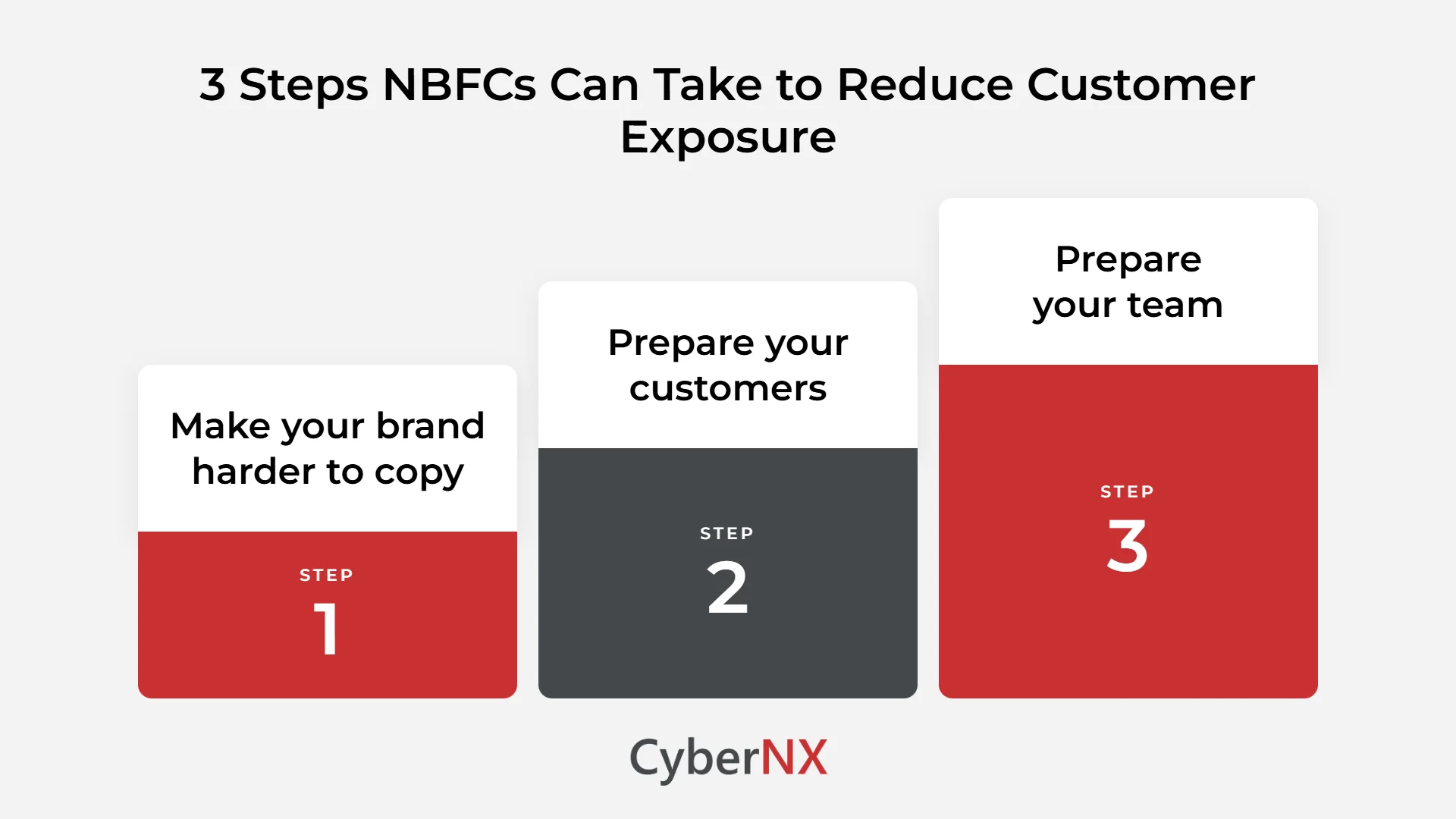
Make your brand harder to copy
Set up email authentication standards such as DMARC, SPF and DKIM so attackers can’t send email as your real domain. Register the most obvious lookalikes of your domain yourself. Publish one official page listing your genuine websites, apps and contact numbers.
Prepare your customers
Tell customers clearly what you will never ask for, such as OTPs or upfront loan fees. Repeat it in loan applications, SMS and app notifications. Give them a simple way to report a suspicious site.
Prepare your team
Write an impersonation playbook before you need it. Agree on owners, escalation paths and CERT-In reporting steps now, so the six-hour clock never catches you off guard.
Conclusion
Finding a fake domain is a good start. But the key is to find out what it has already touched, and only your security operations can answer that. When external discovery feeds internal investigation, you contain faster, protect customers sooner and meet your reporting obligations on time.
CyberNX brings both halves together. Brand Risk Monitoring services help you find and track impersonation outside your perimeter. Our CrowdStrike-powered security operations investigate and contain what it reaches inside.
Attackers are already copying trusted brands. Don’t wait for a customer complaint to find out yours is next. Protect Your Brand from Online Impersonation and talk to our team today.
FAQs
What is brand impersonation in cybersecurity?
Brand impersonation is when attackers copy your name, logo or website to deceive people. Common forms include lookalike domains, cloned login pages, fake apps and fake social profiles. The aim is usually to steal credentials, data or money.
Do NBFCs need to report phishing websites to CERT-In?
CERT-In’s 2022 directions list identity theft, spoofing and phishing attacks among incidents to report within six hours of noticing them. Confirm the exact obligations for your organisation with your compliance team.
Can a SOC tell whether customers were affected by a fake site?
Not directly, because customer devices sit outside your telemetry. Your SOC can see whether staff, systems or login infrastructure were touched. Customer impact is tracked through fraud monitoring and customer reports.