Security teams everywhere are under a lot of stress. Systems change quickly and new vulnerabilities appear without warning. Attackers are constantly coming up with new ways to attack. Most companies already run VAPT exercises, but the results don’t always seem to be the same. Some assessments lead to real improvements, while others just feel like checking off boxes.
We have seen the difference firsthand. Mature teams see VAPT as a cycle that keeps going and is based on intelligence, not as a one-time event. They use planning, collaboration, validation, and measurement to make VAPT a strategic advantage instead of just a requirement for compliance.
This guide shows you some of the lesser-known VAPT process secrets that the best cybersecurity teams use to keep their security strong consistently.
Why the VAPT process often fails in growing organisations
Before looking into best practices, it’s important to understand where the process usually goes wrong. These breakdowns silently sabotage security and reduce the value of VAPT efforts.
Here are the most common problems we observe:
- Testing starts too late, usually just before audits or after major issues.
- Scope is unclear, which causes gaps, confusion and missed assets.
- Reports lack clarity regarding actions and thus cause delays in remediation.
- There is no retest cycle, so fixes remain unverified.
- It’s hard to set priorities when business and engineering teams work separately and lack proper communication.
When these problems build up, VAPT stops being a useful security tool and becomes just a checkbox.
What top cybersecurity teams do differently in the VAPT process
High-performing teams see VAPT as a cycle that includes preparation, testing, validation and improvement. Here is how they improve each step of the process.
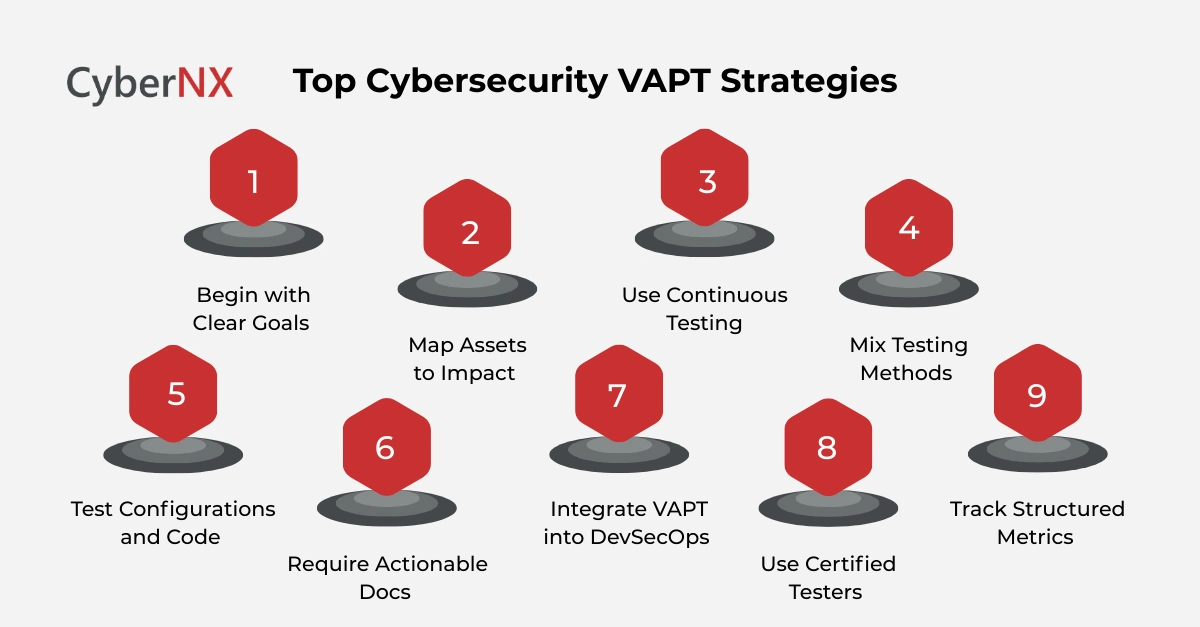
1. Begin with clear goals
Clarity is the first step in a good VAPT process. Top teams set clear goals with discipline, so they don’t get off track later.
The scope usually includes:
- Important assets and environments
- Testing depth and method
- Requirements for compliance
- Out-of-scope areas
- Timelines and limits on business
Clear scoping prevents unexpected surprises, saves money and makes the findings more accurate.
2. Map assets to impact
Mature teams know that not all assets have the same amount of risk. Risk alignment is always the first step in their VAPT process.
Usually, high-priority systems include:
- Systems for identity and authentication
- Platforms for payments or transactions
- Customer data stores
- Remote access components
- Cloud workloads that run sensitive tasks
This makes sure that the testing effort matches real-world exposure.
3. Use continuous testing
It’s not realistic to wait for yearly evaluations anymore. Leading teams use VAPT in their regular engineering cycles.
Strong programs usually have:
- Testing during development
- VAPT before major updates are released
- Quarterly full-scope assessments
- Frequent lightweight scans
- Scheduled retests
Regular testing fills in risk gaps before they grow.
4. Mix testing methods
Different methods reveal different types of vulnerabilities. Top teams try to avoid one-size-fits-all methods.
- Black box mimics external attackers.
- Grey box reveals deeper logical weaknesses.
- White box exposes configuration problems that might’ve not been obvious before.
Using multiple perspectives gives you a more complete picture.
5. Test configurations and code
A lot of breaches happen because of misconfigurations and not because of flaws in the application. Strong VAPT processes look beyond code.
Some common areas of focus are:
- IAM rules and role assignments
- Network segmentation and firewall rules
- Permissions for cloud storage
- Setting up logging and monitoring
- Dependencies that are outdated or services that haven’t been patched
This stops attackers from taking advantage of simple errors.
6. Require actionable docs
The best teams use VAPT report to help them make decisions, not just to keep track of technical issues.
A good report has:
- Clear vulnerability descriptions
- Evidence of proof of concept
- Risk ratings with reasons
- Business impact explanation
- Prioritised remediation steps
- Expected fix complexity
Clarity accelerates remediation and makes it easier to work with engineering teams.
7. Integrate VAPT into DevSecOps
To reduce repeated findings, teams with a lot of experience build security into development.
Effective integrations include:
- Automated SAST/DAST
- Secure code reviews
- Pre-deployment checks
- Pipelines for scanning dependencies
- Unit tests for security
This way, VAPT is not the first line of defence; it is a validation layer.
8. Use certified testers
Skilled practitioners are better at interpreting the results accurately, simulating real world attackers, and finding tiny problems that tools might miss.
Teams usually depend on:
- CERT-In certified auditors
- Experts who have worked with multiple architectures
- External testers for fair evaluations
This mix makes sure that the results are deep, objective, and of high quality.
9. Track structured metrics
High-performing teams see VAPT as a program for ongoing improvement with results that can be measured.
Some useful metrics are:
- Time taken to fix security gaps
- Number of repeating vulnerabilities
- Retest pass rate
- Decrease in critical findings per quarter
- Change in exposure levels after configuration updates
Tracking these improvement changes VAPT from an event to a strategy.
Conclusion
A mature VAPT process isn’t about how many tests you run. It’s about how well you plan, execute and improve each cycle. When businesses apply the methods used by the top cybersecurity teams, testing becomes more predictable. Fixing issues happen faster and risks reduce steadily. Most importantly, teams get more clarity and confidence about their security posture.
If you’re looking for a reliable and efficient VAPT service, we can help you out. We work closely with organisations to create structured VAPT programs that fit your needs and priorities. Speak with us to plan a strategic VAPT approach that is tailored to your organisation’s needs.
VAPT process FAQs
How often should organisations run VAPT?
Quarterly or semi-annual cycles work best for most environments. Fast-moving teams may need more frequent testing.
Why is scoping so critical in the VAPT process?
Poor scoping leads to missed systems, wasted effort and inaccurate results. Strong scoping saves time and improves coverage.
Does VAPT change in cloud-native environments?
Yes. Cloud configurations, IAM rules and container security require additional focus and specialised testing techniques.
Is automation enough for a complete VAPT process?
No. Tools identify known weaknesses, but manual testing exposes logic flaws, chained exploits and contextual risks.