For businesses in India, compliance has always been on the top of the priority list. Conducting VAPT exercise equalled meeting compliance. In recent years, regulatory demands have evolved, putting Indian enterprises under constant pressure to stay ahead of cyber risks.
Many teams now feel stretched as threats rise faster than internal capabilities. VAPT compliance now plays a central role in reducing blind spots and proving that systems are tested with care. This shift is driven by Indian regulators like SEBI, RBI, CERT-In and the recent DPDP Act which expect stronger controls and continuous verification.
Organisations want clarity, practical guidance and a reliable partner who understands their environment. We see this need across sectors as teams aim to reduce risk without slowing the business.
The modern mandate of VAPT compliance
VAPT, short for Vulnerability Assessment and Penetration Testing, aims to help organisations find and fix vulnerabilities in networks, web and mobile apps, IoT devices, cloud and other digital systems.
VAPT compliance in cybersecurity shows that an organisation assesses its systems for weaknesses and proves that it has acted on the findings. It offers structure and gives leaders confidence that they have checked critical assets. The pressure to validate controls has increased due to more frequent cyber incidents and the rise of interconnected systems across banking, fintech, healthcare, telecom and manufacturing.
Why Indian regulators emphasise VAPT
India’s regulatory landscape has matured quickly. Authorities now expect companies to prove that systems have gone through detailed security checks. This is no longer seen as an annual exercise but as an ongoing duty led by business leaders.
Regulatory push: RBI, SEBI, CERT-In and DPDPA
Indian regulators have raised expectations, especially for sectors that hold critical or sensitive data. Businesses now treat VAPT compliance as a key requirement rather than a checkbox.
1. RBI expectations
RBI’s cybersecurity frameworks require banks, NBFCs, payment companies and UPI stakeholders to conduct periodic VAPT and remediate gaps promptly. These checks must also cover mobile apps, digital payment products and internet banking systems. Many teams struggle with frequency and depth, which makes a strong audit partner essential.
2. SEBI’s cybersecurity circulars
SEBI mandates VAPT for market intermediaries, stockbrokers, depositories, mutual fund houses and other regulated entities. Reports must come from CERT-In empanelled auditors and be shared with the Cyber Security and Cyber Resilience division. SEBI views this as a vital step to prevent data leakage, fraud and system disruptions.
3. CERT-In directives
CERT-In expects organisations that handle large user bases or critical operations to undergo structured audits. Its guidelines highlight the need for expert-led testing and timely reporting. Since CERT-In sets national standards, enterprises trust empanelled auditors to interpret the framework with clarity and provide practical guidance.
4. DPDPA Act and mandatory audits
India’s Digital Personal Data Protection Act (DPDPA) focuses strongly on accountability. The Act calls for regular security assessments for data fiduciaries and data processors. High-risk companies or those handling large volumes of personal data must demonstrate they have identified and reduced threats across systems. VAPT compliance in cybersecurity becomes a foundation because it verifies that personal data is protected from misuse, breaches or unauthorised access.
The risks Indian enterprises face without VAPT compliance
Indian organisations see a rapid expansion of digital services, yet their environments often grow faster than security teams. This creates blind spots. Without proper assessments, attackers exploit small gaps which can quickly escalate into financial loss, service downtime and reputational impact.
- CERT-In report noted that India recorded over 1.3 million cybersecurity incidents in 2023, showing how attackers frequently test enterprise defences.
- PwC’s 2024 Global Digital Trust Insights survey also highlighted that 46% of Indian businesses expect more disruption from cyber-attacks this year. These numbers show the pressure leaders feel as they work to stay resilient.
Why CERT-In empanelment is gold standard for Indian cyber audits
Decision-makers often ask what difference an empanelled auditor makes. The answer is simple. Empanelment indicates that the auditor’s skills, processes and reporting quality have been vetted by the government. It also means reports are accepted by regulators without additional scrutiny.
Key advantages of working with CERT-In empanelled VAPT auditors:
- They understand Indian regulatory expectations with precision.
- They follow national standards for methodology, reporting and data handling.
- Their reports carry higher credibility during audits, assessments or compliance reviews.
- They help organisations prioritise fixes based on real-world attack paths rather than theoretical gaps.
VAPT compliance as a strategic asset
VAPT compliance is more than a security requirement. It gives decision-makers clarity on where to invest, what to fix and how to build confidence across customers, partners and regulators.
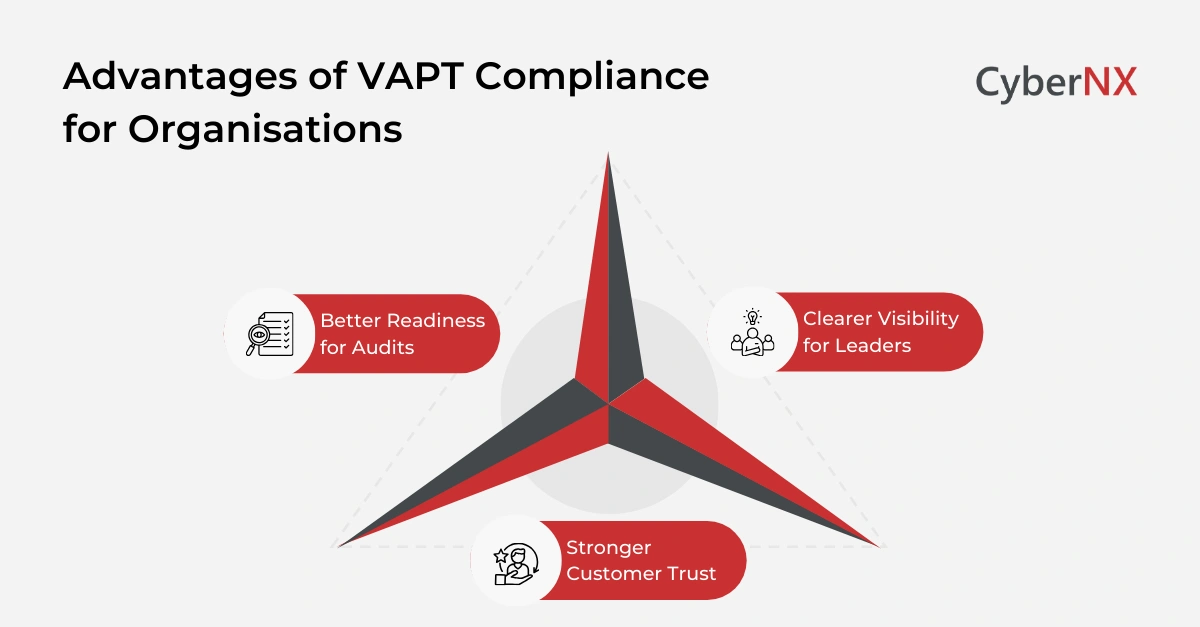
1. Clearer visibility for leaders
Executives gain a direct view of risks that could impact operations. This helps them prioritise budgets and projects with better accuracy.
2. Stronger customer trust
Organisations demonstrate that they take security seriously. This reassurance is especially important for fintechs, SaaS providers, e-commerce platforms and healthcare operators dealing with sensitive data every day.
3. Better readiness for audits
When teams maintain VAPT compliance regularly, regulatory audits become smoother. There are fewer surprises and less back-and-forth when presenting evidence.
Trends that are elevating VAPT to the boardroom in India
India’s shift to cloud-first systems has accelerated testing cycles. Teams now want continuous or quarterly assessments rather than annual exercises. Security validation is becoming a routine part of release pipelines and DevSecOps practices.
We also see growing interest in API testing, configuration assessments, mobile security reviews and cloud posture checks. These areas carry more risk due to rapid business expansion and complex integrations.
A Gartner note from 2024 highlighted that:
- Over 60% of cloud breaches arise from misconfigurations. This shows why teams in India place higher importance on cloud VAPT and configuration reviews.
Why CyberNX is a strong partner for VAPT compliance
Organisations want a partner who speaks their language, understands Indian regulations and brings practical solutions. We fit this need with our structured approach, deep sector experience and CERT-In empanelled auditors.
What sets us apart:
- Clear, actionable reporting that gives teams clarity, not confusion.
- CERT-In empanelled auditors follow national standards that regulators recognise.
- Work closely with your IT and security teams to help them close gaps quickly.
- Tailor assessments for BFSI, fintech, SaaS, healthcare, manufacturing and telecom environments.
- Offer continuous VAPT support for organisations that need ongoing compliance, especially under RBI, SEBI and DPDPA.
We also integrate VAPT with secure configuration reviews, cloud posture assessments and incident readiness checks. This helps teams build a consistent line of defence across systems.
Conclusion
VAPT compliance has become a priority for Indian enterprises as regulations evolve and risk exposure grows. It gives leaders confidence, reduces uncertainty and prepares organisations for the demands of RBI, SEBI, CERT-In and DPDPA. The right partner can simplify the process and make security improvements more predictable.
We, at CyberNX, supports enterprises through each step. We help teams find gaps, fix issues and maintain trust with customers and regulators. Are you ready to strengthen your security posture? Speak with our experts to understand our VAPT services and to schedule your VAPT compliance assessment.
FAQs on VAPT compliance
How often should Indian companies conduct VAPT?
Most regulated sectors expect quarterly or half-yearly assessments, especially in BFSI and capital markets. The goal is to keep pace with rapid technology changes so risks are not left undetected for long.
Does DPDPA mandate VAPT?
DPDPA focuses on accountability and expects organisations to prove they protect personal data with care. VAPT is the clearest way to demonstrate that systems storing personal information are regularly tested and secured.
Are CERT-In empanelled auditors mandatory for SEBI entities?
Yes. SEBI requires all VAPT reports to come from CERT-In empanelled auditors to ensure consistency, reliability and government-approved testing standards. This also helps organisations avoid delays during regulatory audits.
Does VAPT cover cloud environments?
Absolutely. Cloud VAPT reviews configurations, identity controls, exposed services and architectural gaps across platforms like AWS, Azure and GCP. It helps teams catch misconfigurations early before they lead to costly breaches.