
Security teams carry heavy responsibilities today. New vulnerabilities appear quickly, and systems change every week. Attackers look for easy gaps to disrupt operations. Many organisations run VAPT exercises to stay ahead of modern attackers and fix vulnerabilities before they could be exploited. But the value often falls short because the testing process is irregular, rushed or disconnected from business risks.
We see this often. A test is done once a year. Reports stack up. Fixes get delayed. Vulnerabilities return. The cycle continues.
This guide shares VAPT best practices that help teams build a predictable, objective and continuous testing rhythm. These practices are practical and work well for growing organisations that want clarity and control over their security posture.
Why VAPT still fails in many organisations
Even with strong intentions, testing fails to deliver insights when common issues occur.
- Testing happens too late: Many teams conduct VAPT after release or just before an audit. Issues enter production. Fixes become expensive.
- Reports lack meaningful guidance: Some reports list issues without clear remediation. Engineering teams struggle to understand the impact.
- Remediation moves slowly: Backlogs grow fast. Without clear priorities, critical vulnerabilities remain open.
- No retest is conducted: Fixes remain unverified. Problems may still be exploitable. These issues weaken security silently. The right approach can reverse this.
VAPT best practices that make testing effective
Many organisations run VAPT, but the outcomes vary widely. The real difference comes from how the testing is planned, executed and validated. When teams combine strong preparation with disciplined follow-through, VAPT becomes a continuous improvement cycle rather than a one-time activity.
These best practices help teams create a stable rhythm, improve collaboration and close vulnerabilities faster.
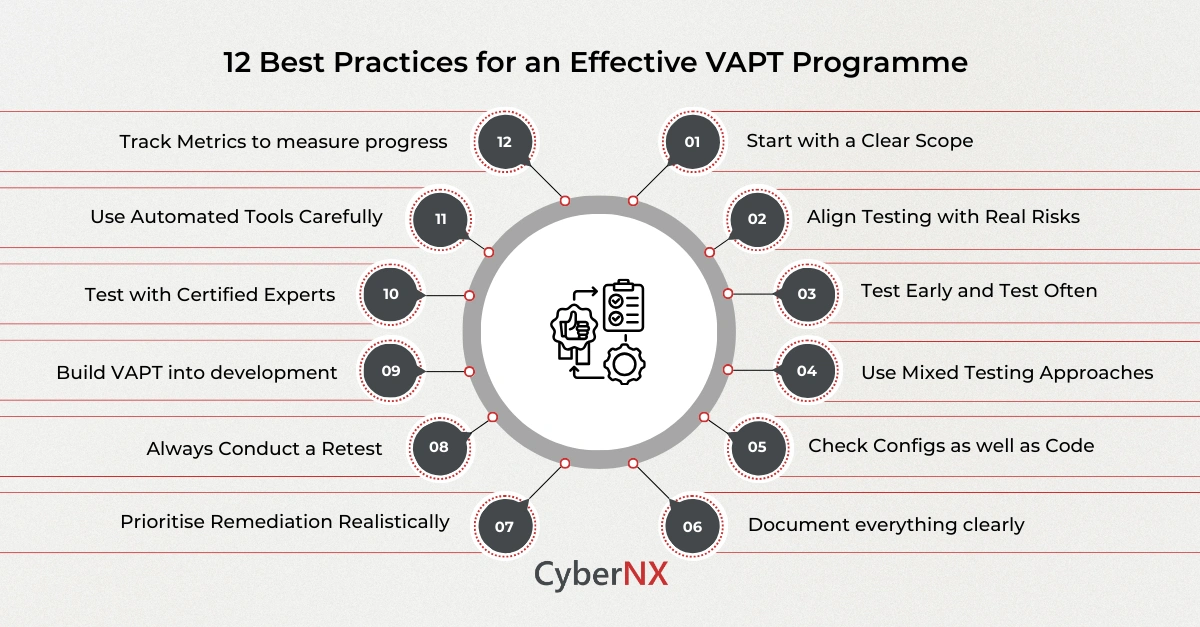
1. Start with a clear scope
A strong scope sets the direction for the entire exercise. It aligns expectations and avoids miscommunication.
A good scope covers:
- Assets and environments
- Testing depth
- Out-of-scope systems
- Timelines and objectives
Clear scoping saves time and improves the quality of findings.
2. Align testing with real business risks
Some assets deserve extra attention. These include:
- Payment systems
- Identity systems
- Customer data platforms
- Remote access modules
Testing efforts must match business impact. This ensures time and budget go where they matter.
3. Test early and test often
Annual testing is no longer enough. Systems change too fast.
Teams benefit from:
- VAPT during development
- Security tests for every major release
- Regular retests
- Quarterly or biannual full-scope testing
Frequent testing reduces surprises and improves overall resilience.
4. Use mixed testing approaches
Different methods uncover different issues.
Black box shows outsider attack behaviour. Grey box gives deeper insight with partial knowledge while White box reveals hidden internal flaws. Together, they offer strong coverage.
5. Validate configurations, not just code
Many breaches occur due to misconfigurations, not coding errors.
Key areas include:
- IAM policies
- Cloud storage settings
- Network rules
- Logging configurations
- Outdated dependencies
A complete VAPT checks both code and environment.
6. Document everything clearly
Reports need to be practical and actionable. A good VAPT report offers:
- Clear descriptions
- Risk levels
- Proof-of-concept
- Business impact
- Priorities for fixes
- Remediation guidance
Clear documentation helps teams resolve issues faster.
7. Prioritise remediation realistically
Not every issue is urgent. Teams need structure.
Use:
- CVSS
- Exploitability
- Business impact
- Fix complexity
- Exposure level
Priorities bring order to remediation queues.
8. Always conduct a retest
This is one of the most important VAPT best practices. Retesting:
- Confirms patches
- Validates fix quality
- Ensures stability
- Prevents recurring issues
No VAPT cycle is complete without it.
9. Integrate VAPT into the development lifecycle
Security improves when testing becomes part of the development process.
Useful integrations include:
- Code reviews
- Static analysis
- Pre-release tests
- Automated checks
Teams discover fewer issues over time, saving effort and cost.
10. Conduct testing through certified professionals
CERT-In certified VAPT auditors are recognized by the government to carry out audits across India. In addition, experienced testers bring deeper insights. They understand attack patterns and emerging threats. Internal teams do well, but external specialists add objectivity and broader perspective. A hybrid model works best.
11. Use automated tools carefully
Automation improves speed. But it cannot replace human judgement. Use VAPT tools for:
- Scanning
- Recon
- Dependency checks
Use manual methods for:
- Logic flaws
- Authentication bypass
- Chained exploits
- Context-driven issues
Balanced testing gives better results.
12. Track metrics to measure progress
Metrics show real improvement.
Track:
- Time to remediate
- Recurring vulnerabilities
- Retest success
- Risk reduction per quarter
Metrics help security leaders justify investment and show real progress.
Common mistakes to avoid during VAPT
Most security leaders understand the importance of testing. But small missteps reduce the impact. Avoiding these mistakes lifts testing quality immediately.
1. Focusing only on visible systems
Teams tend to test public-facing systems and skip internal ones. Yet internal systems often contain outdated configurations and identity gaps. Real attackers move laterally. Testing must reflect that.
2. Running VAPT only before audits
Compliance-driven testing creates a rushed cycle. It offers little long-term value. Regular, scheduled assessments build stronger resilience and reduce pressure on engineering teams.
3. Assuming automated tools are enough
Scanners find known issues. They cannot detect chained attacks or subtle logic flaws. Overreliance on automation leaves major gaps unnoticed.
4. Not aligning testing with business priorities
Every system does not carry the same weight. Testing everything equally wastes both effort and budget. Priority must follow business impact.
5. Skipping retests after fixes
One of the most damaging mistakes. Without retesting, fixes remain assumptions. They may fail silently in production.
Poor communication between testers and engineering teams
If findings are unclear, remediation slows down. Collaborative discussions shorten timelines and improve implementation quality.
1. Not tracking recurring vulnerabilities
When issues return repeatedly, they point to deeper process or training gaps. Tracking trends reveals where teams need support.
2. Ignoring third-party integrations and APIs
Modern systems rely heavily on external services. Weaknesses in APIs or integrations can expose the entire environment.
3. Overlooking environment drift
Infrastructure evolves weekly. When testing does not align with these changes, insights become outdated quickly. Continuous visibility prevents drift.
Conclusion
A strong approach to VAPT best practices helps organisations make real progress. Testing becomes predictable. Remediation becomes faster. Risks reduce steadily. Most importantly, teams gain clarity and confidence in their security posture.
We work closely with growing businesses to build structured VAPT programmes that support your pace and priorities. Our guidance is clear. Our support is consistent. And our focus remains on giving teams the confidence they need to operate securely.
Ready to strengthen your VAPT programme? Connect with us today for VAPT services and let’s build a stronger testing strategy together.
VAPT best practices FAQs
How often should organisations run VAPT?
Quarterly or semi-annual assessments work well for most teams. Fast-changing environments may need more frequent testing.
Is VAPT necessary for compliance?
Several standards recommend or require periodic testing. This ensures that controls function the way they should.
Why do vulnerabilities reappear after fixes?
This often happens due to incomplete fixes, configuration drift or reverting changes during deployments. Retesting prevents this.
How long does a VAPT exercise take?
Simple assessments take a few days. Larger environments may take a few weeks. Scope and technology influence timelines.