“71% of SOC analysts report burnout and 64% are considering leaving their roles within a year.” – Tines Voice of the SOC Analyst Report.
That number should alarm every CISO. And not just because hiring is hard. This data should be taken seriously because it signals something deeper: the traditional SOC model is breaking under its own weight.
Most security operations centres today run on the assumption that more tools and more alerts equal more security. The reality is sometimes the opposite. Analysts are drowning in noise, detection gaps go unvalidated for months and the question “are our controls actually working?” fails to get a confident answer. That is the modernization problem. And SOC modernization with Breach and Attack Simulation (BAS) is one of the few approaches that directly addresses it.
The SOC crisis
The scale of the problem is well-documented. SOC teams often find it difficult to keep pace with alert volumes. False positive rates in enterprise SOCs keep increasing and analysts spend a lot of time on alerts that lead nowhere.
This is not a staffing shortfall you can hire your way out of. It’s an architectural failure. The SOC was built to react, not to constantly validate whether it can even detect what it’s reacting to. That is where breach and attack simulation changes the equation.
What is breach and attack simulation?
Breach and attack simulation is a constant, automated testing approach that mimics real adversary tactics, techniques and procedures (TTPs) against your live environment. Unlike a point-in-time penetration test, BAS runs 24/7, simulating everything from phishing and lateral movement to data exfiltration – and reporting exactly how well your existing controls responded. The output is that we get a direct answer to the question: “If an attacker did this today, would we catch it?”
How SOC modernization with breach and attack simulation works
The five steps below show how BAS integrates into your existing SOC workflow:
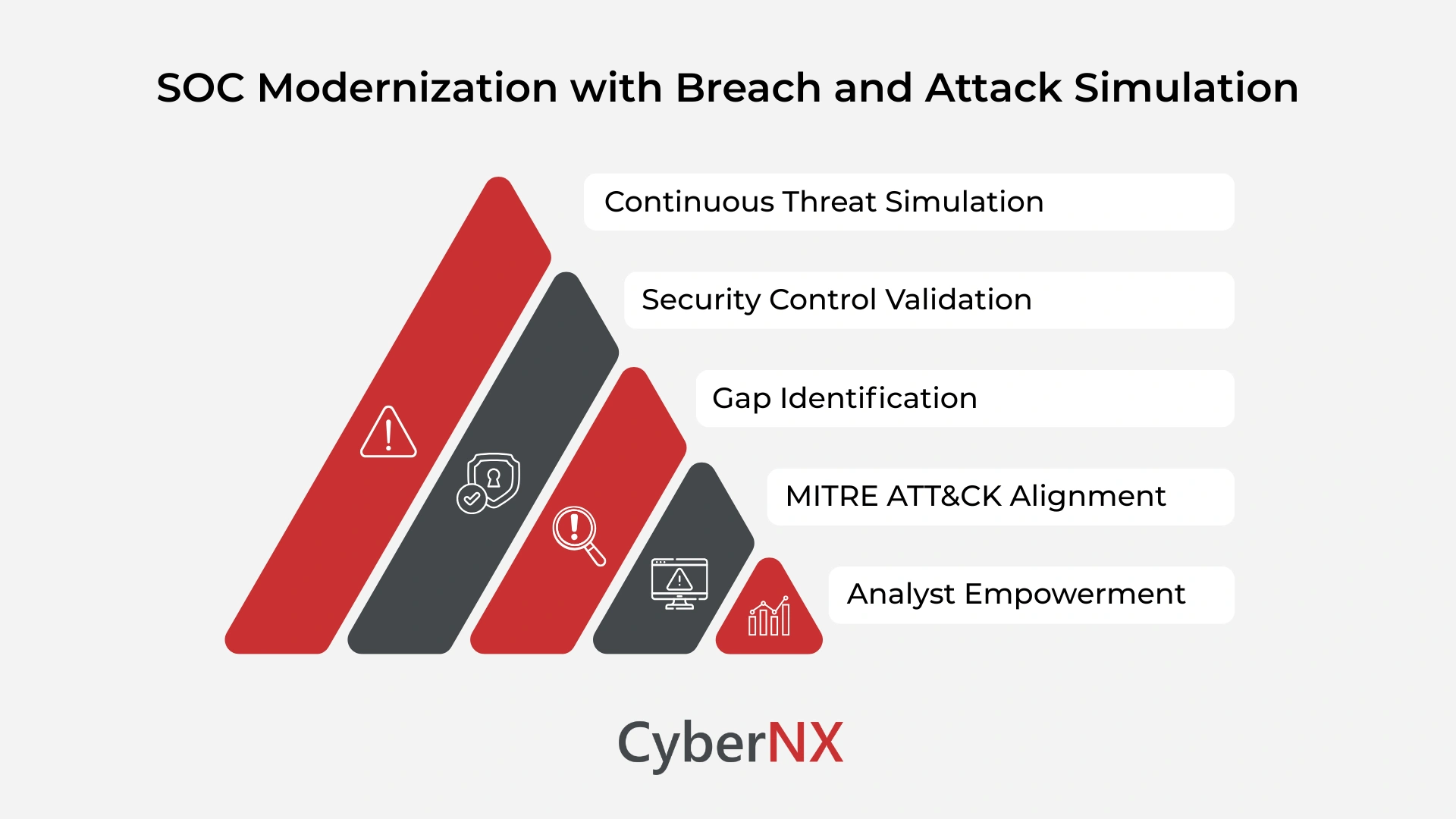
Continuous threat simulation
BAS platforms run real-world attack scenarios around the clock and eliminate the gaps between annual red team exercises. Zero-day exploits with a public proof-of-concept are added to the simulation library within 24 hours.
Security control validation
Every simulation tests whether your SIEM rules, EDR, firewall and SOAR playbooks actually fire as configured. Many organisations discover that rules that look correct in theory fail silently in production.
Gap identification
BAS surfaces detection blind spots and misconfigured controls before adversaries find them, giving your team a head start on remediation.
MITRE ATT&CK alignment
Findings are mapped to MITRE ATT&CK TTPs, allowing analysts to prioritise fixes based on the actual techniques used by threat actors targeting your industry.
Analyst empowerment
By automating repetitive testing cycles, BAS frees analysts to focus on detection engineering, threat hunting and high-value incident response rather than manual validation work.
What BAS actually changes for your SOC team
The operational impact of BAS goes beyond coverage metrics. Here is what changes in practice:
- Alert quality improves: When detection rules are continuously validated, the signal-to-noise ratio improves. Analysts investigate fewer false positives.
- MTTD and MTTR reduce: Organisations using continuous security validation consistently report faster detection and response times because gaps are identified before incidents occur.
- Compliance evidence becomes easier to produce: BAS generates structured reports suitable for auditors, executives and regulators, showing not just what you tested, but also what your controls did or didn’t do.
- SOC burnout is addressed structurally: Offloading repetitive validation removes one of the primary drivers of analyst fatigue.
The BAS market reflects this growing urgency. The global Automated BAS market is projected to grow from USD 0.72 billion in 2024 to USD 2.40 billion by 2029, registering a CAGR of 27% – driven largely by companies looking for continuous, proactive security validation over reactive monitoring.
Conclusion
A SOC that only reacts has already fallen behind. The threat landscape moves too fast and the cost of undetected gaps is too high to rely on manual, periodic testing alone.
SOC modernization with breach and attack simulation gives your team continuous visibility into whether your controls actually work, not just in theory, but against the adversary TTPs that matter right now.
At CyberNX, our breach and attack simulation services help companies test and validate their security posture. We identify control gaps, map findings to MITRE ATT&CK and give your SOC the intelligence it needs to stay ahead of evolving threats. If you are looking to modernise your SOC, reach out to our experts.
SOC modernization with breach and attack simulation FAQs
What is the difference between BAS and penetration testing?
Penetration testing is a point-in-time exercise performed by human testers to exploit vulnerabilities. BAS is an automated, continuous process that mimics adversary TTPs daily to validate whether your security controls detect and block attacks.
How does BAS help with SOC analyst burnout?
BAS removes a significant portion of low-value alert triage from analysts’ workloads by automating control validation and reducing false positive rates. This directly addresses alert fatigue – one of the leading drivers of the 71% burnout rate reported among SOC analysts.
Does BAS work with existing SIEM and EDR tools?
Yes. BAS platforms are designed to integrate with your existing security stack – SIEM, EDR, SOAR and firewalls. The simulation output directly tests whether those tools respond correctly to attack scenarios.
How often should BAS simulations run?
Best-in-class BAS platforms run continuously. At minimum, organisations should run weekly simulations covering their high-risk attack surfaces, with new threat scenarios – including zero-days with available PoCs – added within 24 hours of public disclosure.