The Securities and Exchange Board of India’s Cyber Security and Cyber Resilience Framework (CSCRF) hold regulated entities to a higher standard. It’s not enough to have a Security Operations Centre (SOC). Your SOC must meet specific monitoring, detection, response and reporting requirements defined by the regulator.
If your SOC wasn’t built with CSCRF in mind, you may already have compliance gaps. In this blog, we break down what SEBI CSCRF compliant SOC services actually require, where most organisations fall short and what to look for when evaluating a managed SOC provider.
Why your existing SOC may not be CSCRF-ready
Many organisations have a SOC in place, but being CSCRF-compliant is a different bar entirely. Most traditional SOC deployments were built for general threat detection, not regulatory compliance. Here are the common gaps we see most often:
- Inadequate log coverage: Logs from all critical assets (endpoints, network devices, cloud systems) may not be collected or retained for the required duration
- No formal incident classification: CSCRF requires incidents to be classified by severity, but many SOCs lack a structured taxonomy
- Slow response timelines: SEBI expects incidents to be reported within defined windows; legacy SOCs may lack the automation to meet these SLAs
- Missing threat intelligence integration: Proactive threat feeds are expected under CSCRF; many SOCs operate reactively
- Weak documentation trails: Auditors look for evidence: detection logs, response runbooks, post-incident reports. Gaps here create compliance risk
What SEBI auditors actually check
During a CSCRF audit, assessors look for operational evidence – logs showing you detected an anomaly, records showing how quickly you responded, proof that your incident response playbooks were followed. If your SOC can’t produce this evidence on demand, you’re exposed.
What SEBI CSCRF compliant SOC services must include
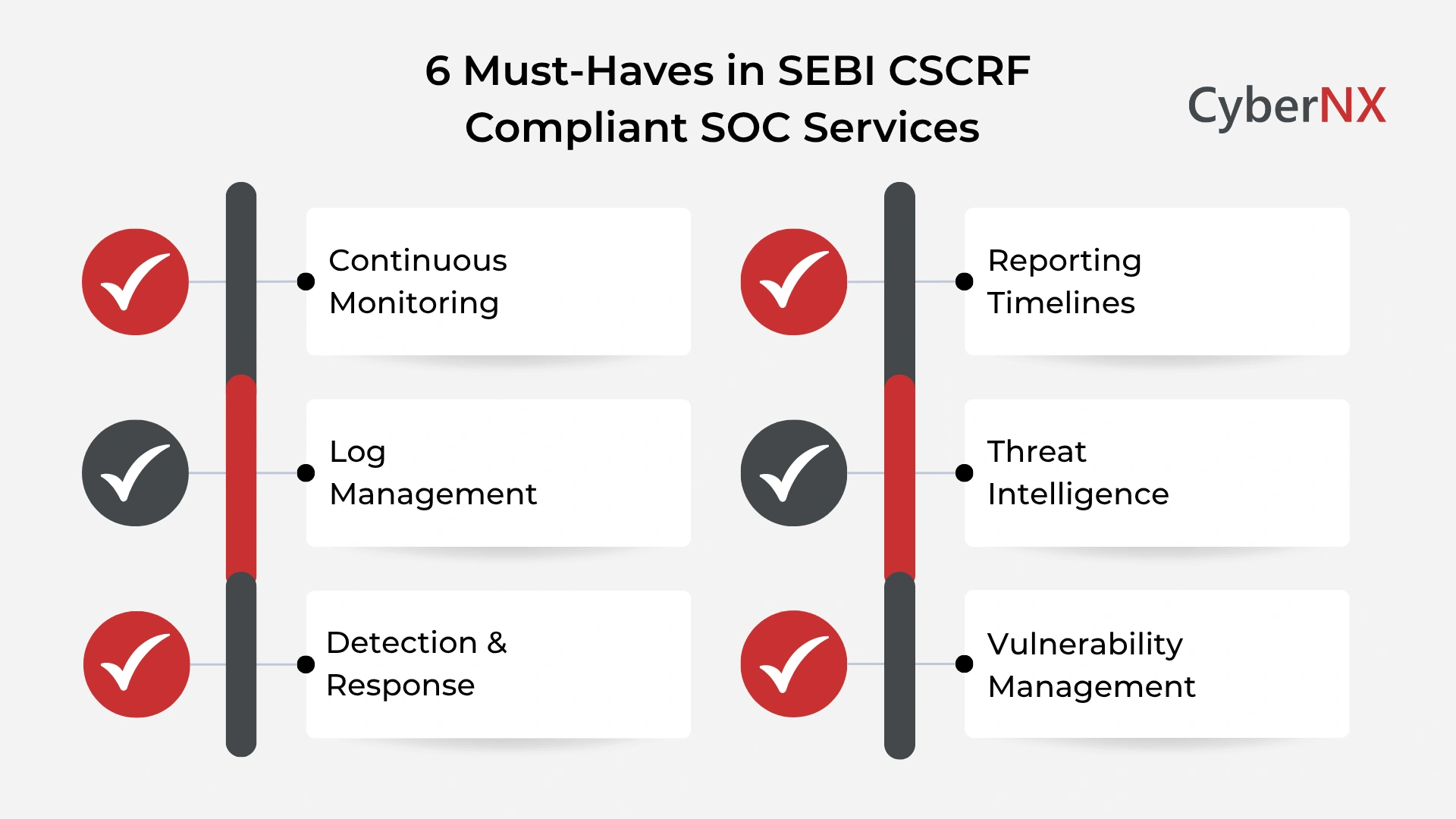
A SOC built for CSCRF compliance isn’t just a monitoring tool. It’s a compliance engine. Here’s what it needs to deliver.
Continuous monitoring and log management
CSCRF requires 24/7 monitoring of your IT environment. This means:
- Real-time ingestion of logs from all critical systems – servers, firewalls, endpoints, cloud workloads and applications
- Log retention for a minimum period as mandated (typically 1–2 years depending on entity category)
- Correlation rules tuned for financial sector threat patterns, not generic use cases
Incident detection, response and reporting timelines
Speed matters under CSCRF. Your SOC must be able to detect, triage and escalate incidents within defined timeframes. Key requirements include:
- Detecting anomalies and generating alerts within agreed SLAs
- Classifying incidents by severity (critical, high, medium, low)
- Escalating critical incidents to your CISO and relevant stakeholders promptly
- Reporting cyber incidents to SEBI and CERT-In within the prescribed timelines – typically within 6 hours for critical incidents
Your SOC must have documented runbooks for each incident type so response is consistent and auditable.
Threat intelligence and vulnerability management
CSCRF expects your organisation to stay ahead of threats – not just react to them. Your SOC should integrate:
- Threat intelligence feeds relevant to the BFSI (Banking, Financial Services and Insurance) sector
- Vulnerability management workflows that track open vulnerabilities, prioritise remediation and close the loop
- Threat hunting capabilities for proactive identification of indicators of compromise (IOCs)
How to evaluate a managed SOC for CSCRF compliance
Choosing a managed SOC provider is a high-stakes decision for any regulated entity. Here’s how to evaluate them rigorously.
Questions to ask your SOC provider
Before signing a contract, ask these directly:
- Do you have experience supporting SEBI-regulated entities under CSCRF?
- Can you demonstrate log coverage across our entire asset landscape?
- What are your incident detection and escalation SLAs?
- How do you support SEBI and CERT-In reporting obligations?
- Can you provide sample audit evidence packages from past engagements?
- How do you handle changes in CSCRF guidelines or new SEBI circulars?
A provider who struggles to answer these questions clearly is not ready for CSCRF compliance engagements.
Key certifications and capabilities to look for
A credible SEBI CSCRF compliant SOC provider should demonstrate:
- ISO 27001 certification information security management maturity
- SOC 2 Type II operational controls and service reliability
- BFSI sector experience to assess understanding of the threat landscape, regulatory context and reporting expectations
- Dedicated compliance support who could help in preparing audit documentation, evidence packages and regulatory submissions
Conclusion
SEBI CSCRF compliance isn’t a one-time audit pass. It’s an ongoing operational commitment and your SOC is the engine that keeps you compliant every day.
The framework has real teeth. Entities that can’t demonstrate operational evidence of detection, response and reporting face regulatory action. The question isn’t whether you need a CSCRF-aligned SOC. It’s whether the one you have can actually prove compliance when it matters.
CyberNX’s managed SOC services are built for exactly this challenge. We understand what SEBI auditors look for, how to structure evidence packages and how to keep your compliance posture strong between audits. Contact us today to know more.
SEBI CSCRF compliant SOC services FAQs
What is SEBI CSCRF?
SEBI CSCRF stands for Cyber Security and Cyber Resilience Framework. It is a regulatory mandate issued by the Securities and Exchange Board of India that defines minimum cybersecurity standards for entities operating in India’s securities market. It covers governance, monitoring, incident response, recovery and more.
Is a managed SOC sufficient for SEBI CSCRF compliance?
A managed SOC is central to CSCRF compliance – but only if it’s specifically designed to meet the framework’s requirements. A generic SOC may cover basic monitoring but fall short on log retention, incident reporting timelines, documentation and BFSI-specific threat intelligence. Always verify that your SOC provider has CSCRF experience.
What are the reporting timelines under SEBI CSCRF?
CSCRF mandates that regulated entities report critical cyber incidents to SEBI and CERT-In within 6 hours of detection. Less critical incidents have longer reporting windows. Your SOC must be configured to detect, classify and escalate incidents quickly enough to meet these deadlines.
How does CyberNX help with CSCRF-aligned SOC services?
CyberNX offers managed SOC services purpose-built for SEBI-regulated entities. We align our monitoring, detection and response workflows to CSCRF requirements – from 24/7 log management and threat intelligence to incident reporting support and audit documentation. We work alongside your compliance team so you’re always audit-ready.