India is a global software exporter and a digital-first nation today. What it means is that software now underpins nearly every critical business in India. From banking platforms, payment systems to government portals and cloud services – all rely on complex software stacks assembled from thousands of components. When one of those components carries a vulnerability, it is critical to find it fast and take concrete actions.
That is the operational problem Software Bill of Materials (SBOM) management solves. An SBOM is a machine-readable inventory of every component inside an application – its name, version, licence and supplier. SBOM management is the programme that keeps that inventory accurate, linked to vulnerability data and built into your engineering and procurement workflows.
We have covered the foundations in our SBOM guide. This blog focuses on what managing SBOMs involves in reality – the process, the roles, the friction points and how Indian organisations can align it with CERT-In, RBI and SEBI regulatory expectations.
A brief history: why supply-chain opacity became a security crisis
In 2020, the SolarWinds compromise exposed how opaque software dependencies could be weaponised at scale. Attackers modified a trusted vendor’s build and distributed a malicious update across thousands of organisations. Neither buyers nor security teams had visibility into what was inside the software they were running.
That single incident accelerated a global policy response. The US issued Executive Order 14028 in May 2021, directing agencies to adopt minimum SBOM elements. India followed. CERT-In, under MeitY, published SBOM Technical Guidelines Version 2.0 in July 2025, mandating SBOM adoption across government, public and essential services organisations and covering 21 mandatory fields for component identity, supplier data, licence information, integrity hashes and dependency relationships. SEBI’s Cybersecurity and Cyber Resilience Framework (CSCRF) made third-party software risk management an explicit expectation for capital markets participants – and the August 2025 compliance deadline has passed, making SBOM an active audit obligation today.
The shift from optional transparency to expected practice happened quickly. What was once an engineering concern is now a compliance and governance obligation.
What SBOM management involves
Knowing you need an SBOM is not the same as knowing how to manage one. SBOM management is a continuous process.
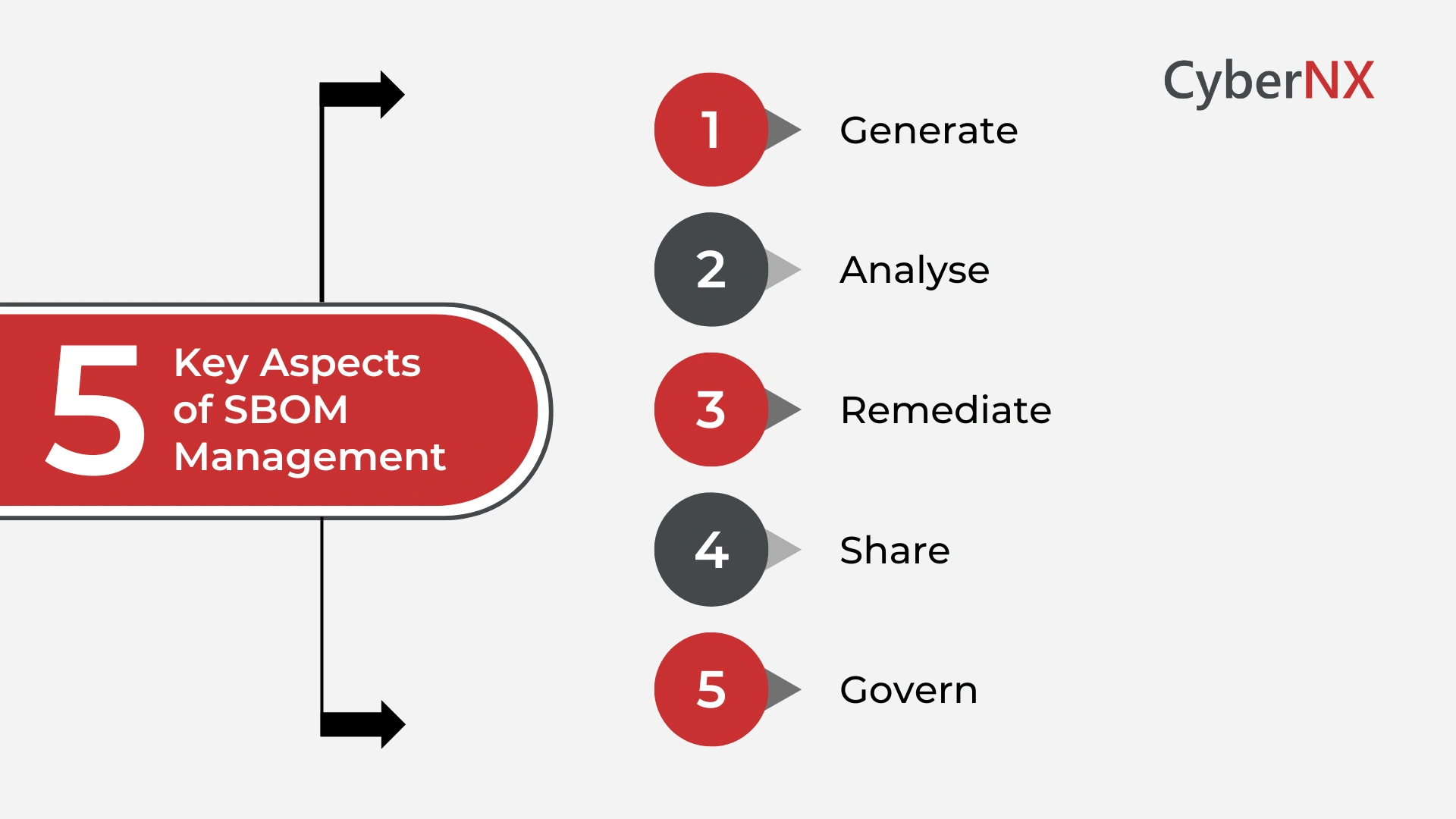
1. Generate
SBOMs are produced in machine-readable formats – primarily SPDX (Software Package Data Exchange) and CycloneDX. Generation can be triggered at build time inside your CI/CD pipeline, at release, or via analysis of existing binaries. Automated generation is the only approach that scales across multiple applications and release cycles.
2. Analyse
A static SBOM file has limited value. The operational benefit comes when you correlate component data against live vulnerability feeds – CVE databases, vendor advisories and the National Vulnerability Database (NVD). This correlation tells you which of your applications are affected when a new vulnerability is disclosed, and how urgently.
3. Remediate
Correlation turns into action when your security and development teams can see which systems carry an affected component, who owns that system and what the remediation path is. A well-managed SBOM shortens this path from weeks to hours.
4. Share
Increasingly, buyers and regulators expect you to provide SBOMs as part of procurement and audit processes. Machine-readable SBOMs that are signed and version-controlled are becoming a standard deliverable for Indian software exporters and financial sector suppliers.
5. Govern
Governance is where most organisations stall. SBOMs go stale when they are treated as point-in-time records. A governance layer sets the cadence for SBOM updates, defines how new suppliers are onboarded, and maps your SBOM fields to regulatory requirements – CERT-In’s 21 mandatory fields and SEBI CSCRF’s 9 fields are the benchmarks for Indian organisations.
SBOM Management vs Generation
There is a chance that organisations may conflate the two. Generating an SBOM produces a file. Managing one turns that file into a continuously updated programme, linked to vulnerability feeds, governed under defined ownership, and aligned to regulatory field requirements. The table below shows where generation ends and management begins.
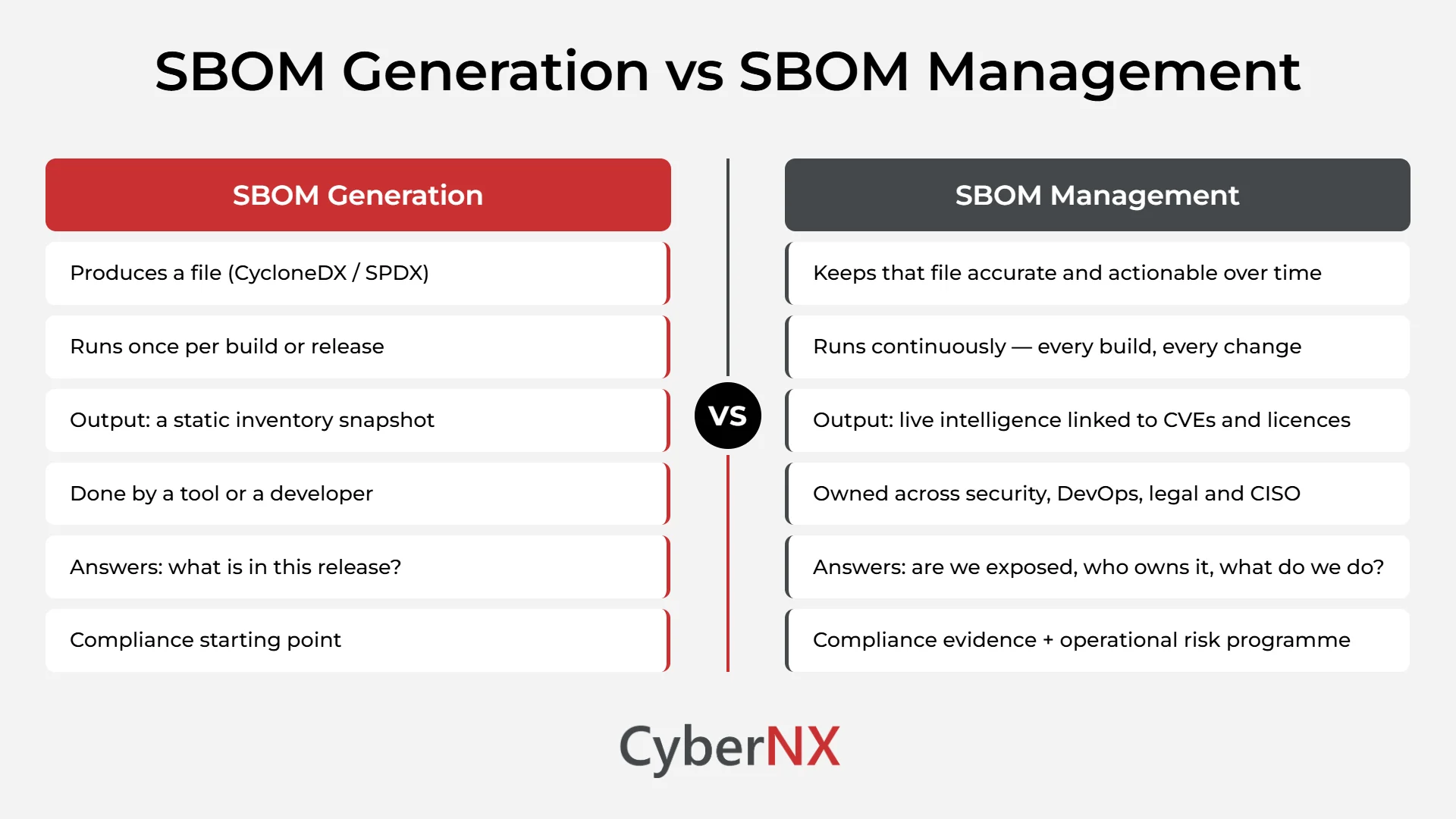
Who owns SBOM management
SBOM management spans teams. Ambiguity about ownership is one of the most common reasons programmes stall. The breakdown is practical, not theoretical.
- Security team: Owns vulnerability correlation and CVE triage. They set the risk threshold for patch prioritisation and feed SBOM data into incident playbooks.
- DevOps and engineering: Own generation. SBOM creation must be embedded in CI/CD pipelines as a standard build output, not added manually after release.
- Legal and procurement: Own vendor SBOM intake. They request machine-readable SBOMs from suppliers, review licence obligations and include SBOM attestation requirements in contract language.
- CISO: owns governance. The CISO ensures SBOM coverage across critical applications, tracks regulatory field alignment and reports programme maturity to the board.
Without this clarity, SBOM management becomes everyone’s responsibility in theory and no one’s in practice.
The regulatory alignment Indian organisations need
CERT-In, SEBI and RBI have all moved SBOM management from a future expectation to a present-day obligation.
- CERT-In’s July 2025 technical guidelines specify 21 mandatory SBOM fields – including component name, version, supplier, licence, hash value and dependency relationships. These fields are not aspirational. They define what a defensible SBOM looks like in an audit or incident investigation.

For a complete field-by-field breakdown of what each regulator requires and how they differ, see our reference guide on required SBOM fields under SEBI, RBI and CERT-In
- SEBI’s CSCRF requires capital markets firms – stock brokers, depositories, asset management companies and market infrastructure institutions – to manage third-party software risk explicitly. SBOM management is the mechanism that makes that requirement operational.
- RBI’s 31 July 2026 Cybersecurity Directions make vendor due diligence, supply-chain risk management and audit rights legally binding. Is auditors are required to verify these controls as part of their standard programme. For RBI-regulated entities, a current and complete SBOM programme is the most direct way to demonstrate compliance during an inspection.
Organisations that align their SBOM fields to these frameworks from the outset convert a compliance burden into a structured programme. Those who treat it as a checkbox will find themselves rebuilding it under pressure.
For Indian software exporters, SBOM readiness also shortens procurement cycles with international buyers who operate under US or EU supply chain security expectations.
Beyond SBOM: CBOM and Post-Quantum Cryptography Readiness
SBOM management covers software components. But modern applications also depend on cryptographic assets like algorithms, keys, certificates, and protocols that carry their own category of risk.
A Cryptographic Bill of Materials (CBOM) inventories these assets and assesses each against current and post-quantum standards. NIST finalised its post-quantum cryptography (PQC) standards in 2024, setting a firm expectation to migrate away from RSA and elliptic-curve cryptography.
Organisations without a cryptographic inventory cannot credibly plan that migration. CERT-In’s July 2025 guidelines explicitly cover CBOM alongside SBOM, making both part of the same compliance programme for Indian regulated entities.
Read our PQC readiness guide to understand what a cryptographic inventory involves and how to start.
Friction points and how to address them
SBOM adoption is not straightforward. The challenges are real, and generic advice does not help. Here is what Indian organisations typically encounter and what to do about it.
- Legacy systems without provenance: Many critical applications were assembled before SBOM practices existed. Start with asset discovery and manual SBOM creation for your top 10 to 20 business-critical applications. Automate from there.
- Inconsistent formats from vendors: Suppliers may deliver SBOMs in different formats, versions or levels of completeness. Include minimum SBOM format requirements – SPDX 2.3 or CycloneDX 1.5 – in your procurement contracts and supplier onboarding templates.
Our SBOM formats and field mapping guide for RBI, SEBI and CERT-In compliance shows exactly which fields each regulator expects and how to map them across CycloneDX and SPDX, so you can validate vendor submissions against a defined standard.
- Skills shortages in software composition analysis: SBOM generation and CVE correlation require tooling and expertise that many internal teams do not yet have. National skilling initiatives under MeitY are expanding the talent pipeline, but in the near term, managed tooling or external advisory support bridges the gap.
- SBOMs going stale: The most common failure mode is treating an SBOM as a deliverable rather than a live record. Build update triggers into your release process. An SBOM that is not updated at each build is a false assurance.
Three priorities for SBOM management leaders
Indian organisations that move beyond compliance will get the most from their SBOM programme. Three priorities make the difference.

Not sure where your organisation sits today? Our SBOM maturity model guide maps out five stages from first-generation to continuous governance, so you can identify your current position and prioritise the right next steps.
1. Embed SBOM management in your product lifecycle
This is not a security project with a start and end date. Procurement contracts, CI/CD pipelines and incident response playbooks should all reference SBOM requirements. When SBOM generation is a default build output, it stops being a burden.
2. Invest in automation
Manual SBOM creation does not scale for organisations with more than a handful of applications. Automated generation, signing and vulnerability correlation turn SBOMs from static files into live operational intelligence. The ROI shows up in reduced mean time to remediate and faster procurement approvals.
3. Use SBOMs to improve vendor risk management
Request machine-readable SBOMs in supplier onboarding. Require attestation for critical components. Ask vendors directly whether their SBOM output is aligned to CERT-In’s 21 fields and SEBI’s 9 fields – most suppliers are not asked, and most will have to check.If your team is not sure how to have that conversation with suppliers, our guide on how to get an SBOM from your third-party software vendor covers the request process, contract language, and what to do when a vendor pushes back.
Conclusion
SBOM management is now an operational requirement for Indian organisations across software, financial services and critical infrastructure. The regulatory frameworks are in place. The supply-chain risk is real and documented. The gap between knowing you need an SBOM programme and running one that works is where the exposure lives.
Organisations that treat SBOM management as a product lifecycle capability – rather than a compliance exercise – reduce remediation time, improve vendor accountability and build the kind of supply-chain transparency that wins enterprise customers and satisfies regulators.
At CyberNX, our SBOM solutions automate generation, vulnerability correlation and regulatory field mapping across CERT-In, RBI and SEBI CSCRF requirements.
The frameworks are in place and the audits are running. If you are ready to create an operational SBOM management programme, contact us and talk to our experts for a proper assessment, and find out exactly where your gaps are before an auditor does.
The first step is an honest inventory. Start there.
SBOM management FAQs
What does SBOM management involve beyond creating an SBOM file?
An SBOM file is the starting point, not the end goal. Management involves continuously correlating that inventory against live CVE feeds, updating it at each build or release, sharing it with buyers and regulators in a machine-readable format and governing it under a defined ownership structure. A static SBOM that is not maintained actively gives you false assurance.
How does SBOM management differ from basic software inventory tracking?
Standard inventory tracking records what software you have deployed. SBOM management goes further – it ties every component to its provenance, version, licence terms and current vulnerability status. When a new CVE is published, an SBOM management programme tells you exactly which applications are affected and what to do next. A software inventory cannot do that.
What do CERT-In and SEBI actually require from Indian organisations?
CERT-In’s July 2025 guidelines specify 21 mandatory SBOM fields covering component identity, supplier details, licence data, hash values and dependency relationships. SEBI’s CSCRF requires capital markets participants to manage third-party software risk explicitly – SBOM management is the most direct operational response. The RBI’s 31 July 2026 Cybersecurity Directions add a further layer for regulated financial entities, making vendor audit rights and supply-chain risk management legally binding across all entity classes. Organisations in scope for both frameworks should align their SBOM output to all required fields from the outset.
Can SBOM management help with open-source licence compliance?
Yes. A machine-readable SBOM surfaces licence data at the component level – GPL, MIT, Apache and others. This gives your legal and procurement teams visibility into licence obligations before a product ships, rather than discovering conflicts during an audit. It also supports supplier contract review when third-party components carry restrictive licence terms.