Applications today rely heavily on open-source libraries, third party frameworks and vendor supplied components. This creates speed and scale but also creates blind spots.
This is why regulators now expect organisations to show precise visibility into what their software contains. This requirement is formalised through SBOM or Software Bill of Materials guidance referenced by CERT-In, Reserve Bank of India, and Securities and Exchange Board of India.
This guide outlines a clear SBOM generation checklist as per RBI, SEBI and CERT-In guidelines and expectations. It also explains how organisations can operationalise SBOMs without slowing delivery teams.
Regulatory context and why SBOMs are mandatory
Indian regulators approach SBOMs from slightly different angles. Together, they set a clear baseline.
1. CERT-In expectations
CERT-In has issued detailed technical guidelines that define 21 mandatory SBOM fields. These fields focus on deep technical visibility. They cover component identity, dependency relationships, vulnerabilities, integrity and lifecycle data.
For most regulated entities, this guidance forms the technical backbone of SBOM compliance.
2. RBI expectations
RBI, through CSITE advisories, directs all regulated entities to follow CERT-In SBOM guidelines. RBI also expects organisations to obtain SBOMs from internal development teams and third-party vendors.
For RBI regulated environments, the 21 field SBOM is the baseline. There are no shortcuts.
3. SEBI expectations
SEBI’s Cybersecurity and Cyber Resilience Framework define 9 minimum SBOM fields. The emphasis here is governance. Licensing clarity, encryption, dependency mapping, update frequency and access controls matter as much as technical detail.
The result is clear. SBOMs are now a mandatory security and compliance artefact.
Building a regulator aligned SBOM programme
Regulators expect a structured and repeatable approach that defines scope, ownership, data accuracy and governance from the outset. Without this foundation, SBOMs often remain fragmented and difficult to defend during audits.
The steps below outline a practical, end to end approach to SBOM generation and management, helping organisations move from ad hoc efforts to a controlled and audit ready SBOM operating model.
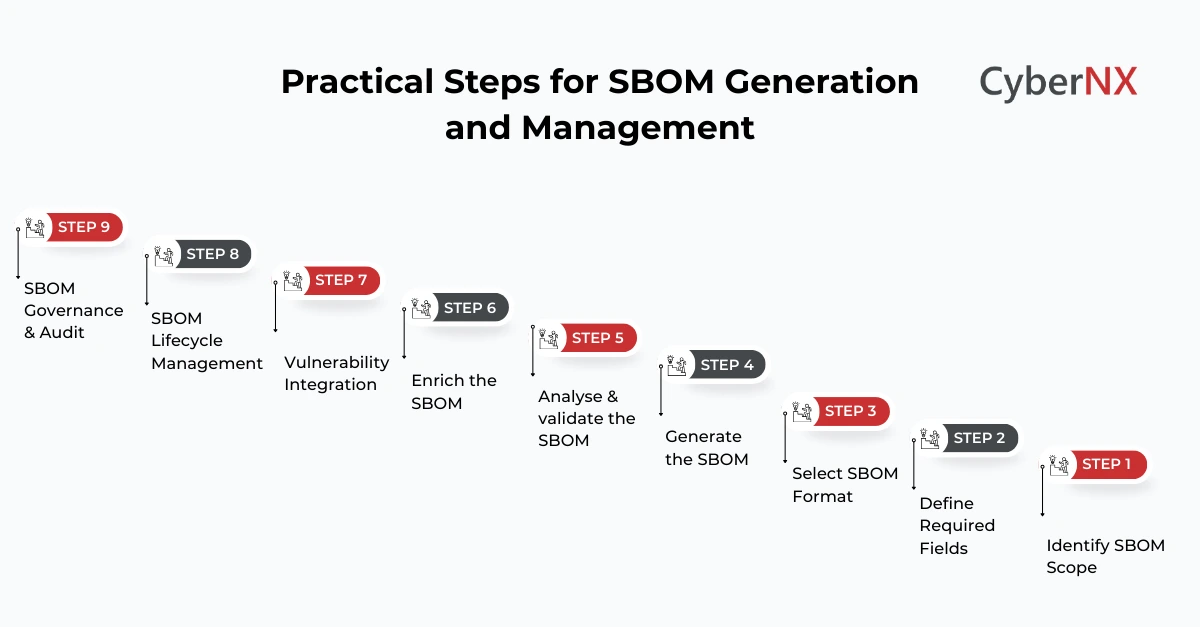
Step 1: Identify applications that require SBOMs
SBOM generation starts with scope. Without this, governance fails. Organisations should prioritise SBOMs for:
- Business critical applications
- Internet facing systems
- Applications handling customer or financial data
- Vendor supplied and third-party software
- Core platforms under RBI or SEBI oversight
Each in scope application should have:
- A named application owner
- A defined technology stack
- A clear deployment model such as on premise, cloud, containerised or SaaS
This inventory becomes the foundation of SBOM governance. It also simplifies audits.
Step 2: Understand the SBOM fields required by regulators
CERT-In mandatory fields
A regulator aligned SBOM should include, at minimum:
- Component name and version
- Supplier and origin such as open source or proprietary
- License information
- Direct and transitive dependencies
- Known vulnerabilities and CVE references
- Patch and fix status
- Release date and end of life data
- Business or technical criticality
- Usage restrictions
- Integrity hashes such as SHA-256
- Metadata including author, timestamp and unique identifiers
These fields provide traceability and lifecycle visibility. They also enable faster risk response.
SEBI minimum fields
SEBI focuses on operational clarity and control. Required elements include:
- License details
- Supplier information
- Dependency mapping
- Encryption used
- Cryptographic hashes
- SBOM update frequency
- Declared known unknowns
- Access control over SBOM data
- Methods to detect and correct SBOM errors
An effective SBOM programme must satisfy both CERT-In technical depth and SEBI governance requirements.
Step 3: Choose the right SBOM format
Indian regulators do not mandate a single format. They expect globally recognised SBOM formats and standards.
Commonly accepted formats include:
- CycloneDX, widely used for application SBOMs with strong dependency and vulnerability support
- SPDX, an ISO standard often used for licence and open-source compliance
For most RBI and CERT-In aligned environments, CycloneDX works well due to its flexibility and ecosystem maturity.
Step 4: Generate the SBOM
SBOMs can be generated in several ways depending on the application architecture.
- Common generation methods include:
- Scanning source code repositories
- Analysing compiled binaries such as JAR or EXE files
- Scanning container images
- Integrating SBOM tools into CI CD pipelines
- Ingesting vendor provided SBOMs
Our experience shows that CI CD integration makes the biggest difference. Every build produces an updated SBOM automatically. Manual effort drops. Accuracy improves.
Step 5: Analyse and validate the SBOM
Raw SBOMs are rarely audit ready.
Each SBOM should be analysed to:
- Validate completeness of mandatory fields
- Identify missing supplier or licence data
- Detect unresolved or unknown components
- Confirm integrity hashes
- Verify dependency graphs
At this stage, teams should explicitly check alignment with CERT-In and SEBI requirements. Any gaps must be flagged early.
Step 6: Enrich the SBOM
Most SBOMs require enrichment before they meet regulatory expectations.
Enrichment typically includes:
- Adding business criticality and internal classification
- Clarifying usage restrictions
- Improving component origin data
- Enhancing dependency accuracy
Automation helps. Manual inputs still matter for business context.
SEBI expects known unknowns to be clearly declared. This transparency is part of good governance.
Step 7: Integrate SBOMs with vulnerability management
SBOMs deliver real value when linked to vulnerability data.
Effective practices include:
- Mapping SBOM components to CVE databases
- Tracking vulnerable components across applications
- Prioritising remediation based on exposure and criticality
- Monitoring new vulnerabilities affecting existing SBOMs
This approach supports faster response to zero-day issues and limits business impact.
Step 8: Establish SBOM lifecycle management
SBOMs must be maintained. One time generation is not enough.
Key lifecycle practices include:
- Updating SBOMs on every release or defined cadence
- Maintaining historical versions
- Tracking component end of life
- Managing vendor SBOM updates
- Enforcing access control and audit logs
SEBI expects defined update frequency and clear correction processes. Governance matters as much as tooling.
Step 9: SBOM governance and audit readiness
Audit readiness requires structure.
Organisations should:
- Maintain a central SBOM repository
- Retain evidence of updates and approvals
- Document enrichment and correction workflows
- Track vendor compliance
- Ensure application owner sign off
SBOMs should be reviewed during internal audits, regulatory assessments and vendor risk evaluations.
SBOM generation and management checklist
This checklist summarises the essential controls required to meet RBI, SEBI and CERT-In expectations. It helps organisations ensure SBOMs are complete, governed and audit ready across their software estate.
- Identify in scope applications
- Define application ownership
- Select CycloneDX or SPDX format
- Automate SBOM generation
- Validate CERT-In and SEBI fields
- Enrich missing metadata
- Declare known unknowns
- Map vulnerabilities to components
- Track licence and end of life risks
- Maintain version history
- Enforce access control
- Include SBOMs in audits
How CyberNX’s NXRadar simplifies SBOM compliance
Managing SBOMs at scale is difficult with spreadsheets or isolated tools.
NXRadar is an AI powered SBOM compliance and software supply chain security platform from CyberNX. It supports end to end SBOM operations aligned with RBI, SEBI and CERT-In expectations.
With NXRadar, organisations can:
- Generate SBOMs from code, binaries, containers and CI CD pipelines
- Support CycloneDX and SPDX formats
- Enrich SBOMs to meet regulatory field requirements
- Ingest and validate vendor SBOMs
- Map vulnerabilities and end of life risks
- Maintain version history and audit trails
- Enforce access control and governance
- View compliance and risk through central dashboards
Centralisation reduces effort and governance becomes consistent.
Conclusion
SBOM compliance under RBI, SEBI and CERT-In requires more than documentation. It demands a structured and repeatable operating model.
Organisations that treat SBOMs as a living security asset gain stronger audit readiness. They also gain better visibility into vendor risk and software exposure.
With our in-house SBOM management tool NXRadar, SBOM compliance becomes scalable, measurable and aligned with real security outcomes. If you want to strengthen your SBOM programme, our team is ready to help. Connect with us today.
SBOM generation checklist as per RBI, SEBI and CERT-In guidelines FAQs
How often should SBOMs be updated for regulatory compliance?
SBOMs should be updated whenever there is a software release, patch, or change in dependencies. Regulators, especially SEBI, expect organisations to define and follow a clear update frequency. Maintaining current SBOMs demonstrates active control over software risk and dependencies. Outdated SBOMs often surface as audit gaps during regulatory reviews.
Are vendor provided SBOMs sufficient for audits?
Vendor provided SBOMs are an important input, but they do not remove accountability from the regulated entity. Organisations are expected to validate, enrich and assess these SBOMs against CERT-In and SEBI requirements. Any gaps in accuracy, completeness or context must be addressed internally. Auditors typically look for evidence of this validation process.
Can SBOMs be shared directly with regulators?
Yes, SBOMs are recognised as formal compliance artefacts and may be requested during inspections or supervisory audits. Before sharing, organisations should ensure the SBOM is complete, approved and version controlled. Access controls and audit trails are also expected. This helps prevent data leakage while demonstrating governance maturity.
Do legacy applications also require SBOMs?
Legacy applications are very much in scope, particularly when they process sensitive or financial data. These systems often contain undocumented dependencies and outdated libraries. SBOMs help uncover hidden risks and end of life components. This visibility supports safer remediation and modernisation planning.