SBOM challenges are fast becoming a boardroom topic. This is because regulators are now asking for SBOMs. As a result, customers are requesting them in procurement cycles and vendors are producing them at scale. Yet many security leaders quietly admit the same concern. The SBOMs they receive look impressive but rarely help them make faster or better risk decisions.
We see this often when working with large enterprises. Teams invest time collecting SBOMs, only to find incomplete data, confusing identifiers, outdated vulnerability results, and no clear ownership when issues appear. Instead of clarity, SBOMs sometimes add friction.
This blog unpacks the most pressing SBOM challenges holding organisations back today. More importantly, it explains why these problems exist and what security leaders should expect if SBOMs are to become a practical security control rather than a compliance artefact.
Viewing SBOM challenges in full context
SBOM adoption has accelerated faster than the supporting processes around it. Many organisations now generate SBOMs because they are told to, not because their tooling, governance, or teams are ready to act on them.
As a result, SBOM challenges tend to surface at the worst possible time. During an incident and an audit or during a supplier risk review where confidence matters most. To understand how to move forward, we need to examine the challenges in detail rather than treating SBOMs as a silver bullet.
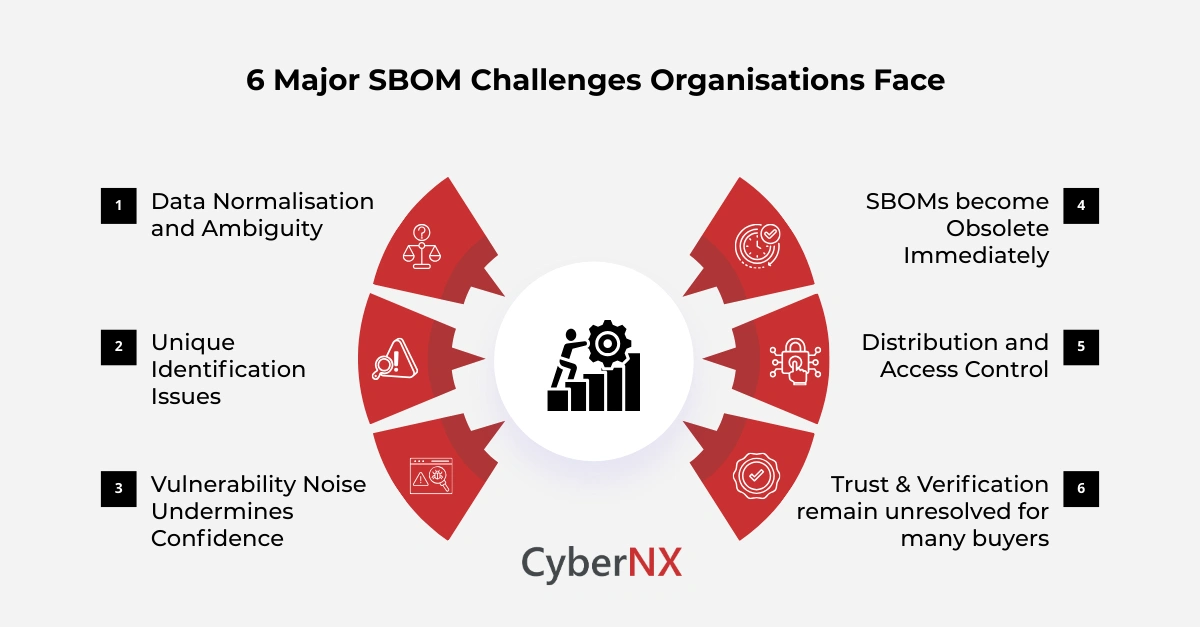
1. Data normalisation and ambiguity
At the heart of most SBOM challenges is a simple problem. Poor input quality leads to poor outcomes.
SBOM formats such as CycloneDX and SPDX are highly structured. They define fields, schemas, and relationships clearly. However, they do not enforce consistent interpretation of those fields. This creates ambiguity that quickly erodes trust.
The supplier field is a common example. One SBOM may list the package manager. Another lists the open-source foundation. A third lists an individual developer. All are technically valid, but none provide clarity on who owns remediation or updates.
From a security leader’s perspective, this ambiguity makes SBOMs harder to operationalise. You may comply with regulations yet still struggle to answer basic questions when vulnerabilities appear.
Our experience shows that SBOM programmes fail early if data normalisation is treated as an afterthought rather than a design requirement.
2. Unique identification issues
Accurate identification of software components underpins every meaningful SBOM use case. Yet this is one of the most misunderstood SBOM challenges.
For years, the industry relied heavily on Common Product Enumeration identifiers. In practice, this approach introduces several risks.
CPEs are often created only after a vulnerability is discovered. That means they are reactive by design. Small formatting inconsistencies can break vulnerability lookups entirely, especially when mapping to databases such as the National Vulnerability Database.
The outcome is dangerous. Security teams may believe a component is clean simply because no matching CPE exists.
Package URLs offer a more reliable path forward. PURLs uniquely identify software using namespace, name, and version. This allows teams to independently validate components rather than relying on delayed or inconsistent mappings.
Without reliable identifiers, SBOM challenges cascade quickly into false confidence and missed exposure.
3. Vulnerability noise undermines confidence
One of the most common complaints we hear from CISOs is that SBOMs surface too many vulnerabilities to be useful. This is not a tooling failure alone rather a contextual problem.
Most scanners flag vulnerabilities based on presence, not exploitability. A library may contain vulnerable code paths that are never invoked. Yet they still appear as critical issues in reports.
The Vulnerability Exploitability Exchange was introduced to address this. VEX allows suppliers to state whether a vulnerability affects their product in practice. However, this introduces a new SBOM challenge. Risk tolerance is subjective.
A supplier may mark a vulnerability as not affected due to internal mitigations. A financial services or critical infrastructure customer may still consider the risk unacceptable because the vulnerable code exists in memory.
SBOMs cannot resolve this tension on their own. They need to be paired with governance models that respect different operational risk appetites.
4. SBOMs become obsolete immediately
Another often overlooked SBOM challenge is time. An SBOM is a snapshot. The moment it is generated, it starts ageing. New vulnerabilities are disclosed daily. Dependency trees change with every build. A clean SBOM from last week may already contain high risk components today.
This creates friction for teams that treat SBOMs as static documents stored in shared drives or ticketing systems. The data may satisfy an audit requirement, but it does not reflect live risk.
Security leaders should view SBOMs as living artefacts that need continuous enrichment, validation, and monitoring. Without this mindset, SBOMs quickly lose operational relevance.
5. Distribution and access control
Even when SBOMs are accurate, sharing them securely remains a challenge.
Many organisations still distribute SBOMs via email or shared folders. This approach does not scale and offers little visibility into who accessed what and when.
There is also ongoing debate about public versus private disclosure. Some fear that sharing SBOMs widely gives attackers a roadmap. In practice, most attackers already know which libraries are popular. The risk lies more in unmanaged access than transparency itself.
Enterprises increasingly require role-based access control, time bound tokens, and audit trails for SBOM access. Without these controls, SBOM distribution becomes a bottleneck rather than an enabler.
6. Trust & verification remain unresolved for many buyers
Perhaps the most sensitive SBOM challenge is trust. When a supplier provides an SBOM, how do you know it is complete? How do you know it has not been altered? How do you verify it reflects the shipped software?
Most organisations have no technical way to validate these claims today. This places pressure on procurement teams, legal clauses, and post contract assurance.
Digital signatures, hashing, and checksums can help protect integrity. Contractual language can define accountability. But these measures require maturity on both sides of the relationship.
Until trust and verification improve, SBOMs will struggle to move beyond advisory artefacts.
What security leaders should do next
Challenges are not a reason to abandon SBOMs. They are a reason to evolve how they are used.
Security leaders should focus on outcomes rather than formats. That means prioritising accurate identifiers, consistent data interpretation, contextual vulnerability analysis, and controlled distribution models.
We have seen meaningful progress when organisations treat SBOMs as part of a broader software supply chain risk programme rather than a standalone requirement. Small improvements in process often unlock far greater value than chasing perfect tooling.
Conclusion
SBOM challenges are real, complex, and often underestimated. Yet they also represent an opportunity.
Organisations that address data quality, trust, and operational context early will gain faster visibility into software risk than their peers. They will respond to incidents with greater confidence. They will build stronger supplier relationships grounded in transparency rather than paperwork.
At CyberNX, we make SBOMs practical, actionable, and aligned with real world risk. If you are struggling to turn SBOM data into decisions, we would be happy to help. Our in-house SBOM management tool NXRadar can help overcome SBOM challenges and help you scale. Request a demo today to explore how we can strengthen your software supply chain security.
SBOM Challenges FAQs
How do SBOM challenges affect regulatory compliance?
SBOM challenges can lead to technical compliance without practical assurance. Regulators may accept the format, but risk remains unmanaged.
Can SBOMs replace traditional vulnerability scanning?
No. SBOMs complement vulnerability scanning by adding context and provenance, but they do not replace runtime or behavioural analysis.
How often should SBOMs be updated?
Ideally with every build or release. Static annual updates rarely reflect real exposure.
Are SBOM challenges different for cloud native environments?
Yes. Dynamic dependencies and rapid deployments amplify issues around timeliness and data accuracy.