Organisations processing digital personal data in India are now preparing for the rights granted under the DPDPA. For IT and cybersecurity leaders, understanding the rights of data principals under DPDPA is essential.
These rights place obligations on your data-processing practices and shape how you design consent, governance and redress mechanisms. The compliance clock is already running. The DPDP Rules 2025 came into force on 13 November 2025, and organisations have until 13 May 2027 to achieve full operational compliance. That is the window you have to build the systems, workflows and governance structures that make these rights real.
With many years of experience in regulatory compliance, we understand how complex this can feel. Therefore, we have crafted this blog to simplify it for you, offering practical insights and much needed clarity.
What is a “data principal” and what rights does the DPDPA provide?
Under DPDPA, a “data principal” is an individual whose digital personal data is being processed by a “data fiduciary”. The Act grants the data principal specific rights that organisations must honour.
These rights are intended to give individuals greater transparency and control over their data, and to hold organisations accountable for how they process digital personal data. The following sections cover each right in turn – and outline practical implications for your security and data governance teams.
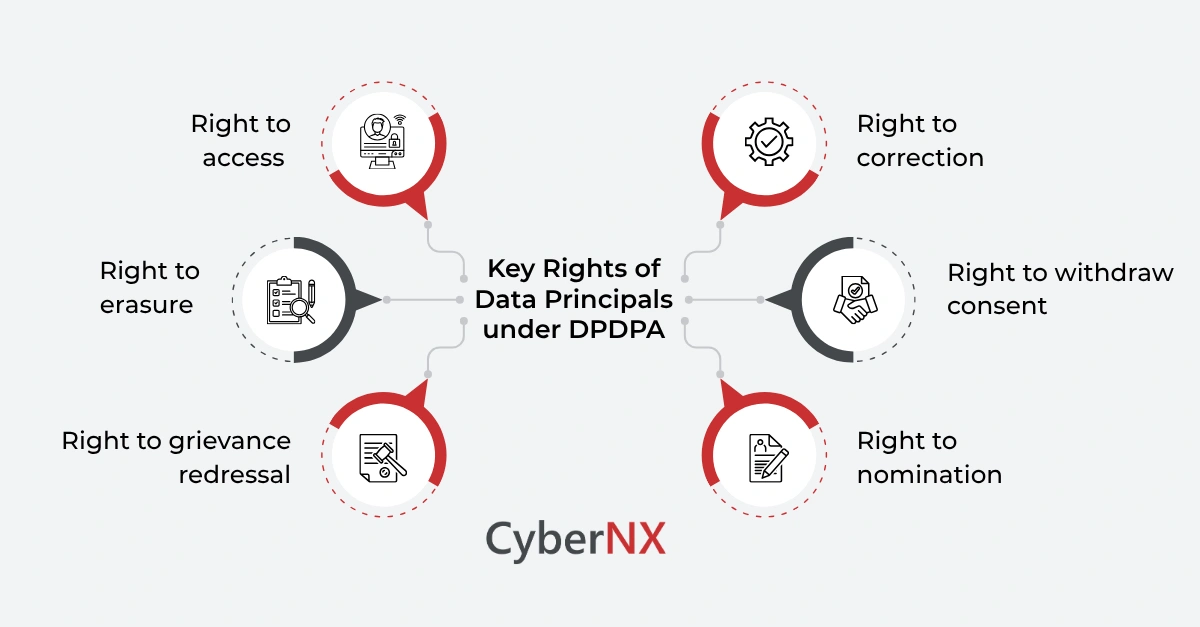
Key rights of data principals
What are the main rights granted under the DPDPA? We dissect and simplify each one of these for you:
1. Right to access
Data principals have the right to obtain from the data fiduciary information about:
- which categories of their personal data are processed
- the purposes of processing
- the third parties with whom data is shared
- other relevant processing details.
It ensures transparency and helps individuals understand how their data is used. Organisations must therefore maintain up-to-date data inventories, establish request channels and verify identity before responding.
2. Right to correction (rectification)
If the personal data processed is inaccurate or incomplete, data principals can request correction.
This ensures data quality, which is critical for accurate decisions (e.g., credit scoring, healthcare). As for organisations, you need to define processes to update or rectify data; log changes and maintain audit trails.
3. Right to erasure
Data principals can request deletion (‘erasure’) of their digital personal data when certain conditions are met – for example when consent is withdrawn or the data is no longer necessary.
It gives individuals control over how long data lives in your systems. In this scenario, organisations need to review retention policies, implement deletion workflows and ensure backups/dumps are also cleansed where feasible.
4. Right to withdraw consent
Since consent is central under DPDPA, data principals can withdraw their consent for processing. This matters because consent must be freely given – and easily withdrawn.
As a result, organisations would need to provide simple mechanisms (buttons, portals, notifications) to withdraw consent; update processing logs accordingly.
5. Right to grievance redressal
A distinctive right under DPDPA: data principals have the right to raise grievances and seek resolution from the data fiduciary and subsequently escalate if needed. This right is given to enable accountability and creates trust. Organisations must comply by appointing a grievance officer, publish channels, track responses and escalate as required by law.
6. Right to nomination
Under DPDPA, a data principal can nominate a trusted individual to exercise their rights in case of death or incapacity. This is especially relevant for long-living digital profiles, legacy accounts, family inheritance issues. What organisations should do? Allow nominees in your user-rights workflows; verify nominations; assign access rights carefully.
Practical compliance implications for security and data teams
Keeping the rights of data principals at the centre, IT and security teams need to take the following steps:
- Processes and workflows: Your data-processing lifecycle must support access, correction, erasure and nomination rights.
- Identity verification: Before fulfilling rights requests, verify the identity of data principals and nominees.
- Audit trails: Maintain logs of requests, decisions, timelines and actions to demonstrate accountability.
- Consent management: Consent must be captured clearly, withdrawal supported smoothly, and processing halted when required.
- Retention & deletion: Review retention schedules; implement deletion mechanisms especially after consent withdrawal or purpose fulfilment.
- Grievance mechanism: Set up published channels, escalate processes, and integrate with security incident-response (some requests may point to breaches).
- Data mapping & inventories: Know where personal data lives; map flows; ensure you can locate data when a principal requests their rights.
- Nomination workflows: Provide option for nomination, ensure verification, update records on events like death/incapacity.
- Security safeguards: Rights requests may trigger review of controls; ensure your logging, monitoring and incident-response capabilities are aligned.
Challenges and unforeseen developments
While the full compliance deadline is 13 May 2027, organisations need to begin building systems now. Here are the key implementation challenges to plan for:
- Rule 14 compliance: This is operationally demanding. You must prominently publish rights request channels and identifier types (customer ID, email, mobile number) on your website or app. Every grievance must be resolved within 90 days.
- Legacy data and complex ecosystems: Large volumes of historical data, cross-system data flows and third-party processors make it difficult to fulfil access, correction and erasure requests properly and within deadline.
- Cross-border data transfers: Under Rule 15, personal data can be transferred abroad only to countries not restricted by the Central Government, adding complexity for organisations with global data flows or offshore processors.
- Integration with existing security frameworks: Rights-fulfilment workflows must align with your breach notification obligations (72-hour reporting to the Board), security safeguard requirements and audit-trail standards, not run as a separate compliance exercise.
Conclusion
Understanding the rights of data principals under DPDPA is essential for building trustworthy, compliant data-processing systems. These rights give individuals transparency, control and recourse – and they place accountability on organisations.
For organisations, it is high time you map rights-fulfilment workflows, integrate them into your security and compliance posture and ensure your systems support access, correction, erasure, nomination and grievance mechanisms.
Want to review your rights-fulfilment processes under DPDPA? Connect with us for DPDP Act consulting and align your data-flows, consent models and rights-mechanisms with the new law.
Rights of Data Principals under DPDPA FAQs
Can a data principal nominate someone who lives outside India to exercise their rights?
Yes, nomination is allowed; however, the fiduciary must still verify identity and ensure cross-border considerations (if relevant) are addressed – especially if the nominated person resides outside India.
Is there a fixed timeline under the DPDPA for responding to a data-rights request?
Yes, the DPDP Rules 2025 have specified this. Data fiduciaries must resolve grievances within a maximum of 90 days from the date of receipt. Organisations must publish their grievance redressal mechanisms clearly on their website or app, including the identifiers a data principal needs to submit a request. Failure to meet this deadline can be escalated to the Data Protection Board of India.
Does the right to erasure apply even if the data is used for legal obligations (e.g., tax, employment)?
No. Just as with other global data-protection laws, erasure requests can be refused where processing is necessary for legal obligations or as permitted by the law. Organisations should document reasons for refusal and provide explanation to the data principal.
Are rights like data portability and objection to automated decision-making included under DPDPA?
Not explicitly. Current interpreting guidance shows DPDPA does not clearly provide rights equivalent to full data portability or avoiding automated decisions.