Organisations tend to approach audits the same way every year – collect documentation, answer questionnaires and verify controls. But attackers don’t really wait for audits. They find gaps long before compliance reviews start. That’s why a lot of experienced security teams now rely on a red team report before starting an audit cycle.
A red team report reveals how real attackers would target your organisation. It highlights weak controls, risky settings, and gaps in detection that an audit alone can’t find. This blog post talks about how starting your audit process with a red team report changes both your readiness and your long-term security posture.
What is a red team report?
A red team report documents the results of a controlled attack simulation conducted by ethical hackers. It captures real attack paths, exploited weaknesses and suggestions for making security stronger.
A typical report contains:
- Initial foothold and exploitation techniques
- Details about privilege escalation
- Lateral movement paths
- Signs of a breach
- Blind spots in defence
- Steps to remediate
This report is different from traditional assessments because it looks at impact instead of just weaknesses.
Why audits alone don’t reveal the full security picture
Audits validate if controls are in place, but they don’t check to see how well these controls work when things get tough. And here’s where gaps appear.
Some common limitations of just doing audits are:
- Controls work on paper, but they don’t work against modern attack methods.
- Detection rules only find known risks.
- Configuration weaknesses go unnoticed
- Too much trust in automated tools
- Security workflows may not show how threats really behave.
These gaps often stay hidden until a real incident happens.
How a red team report makes you audit-ready
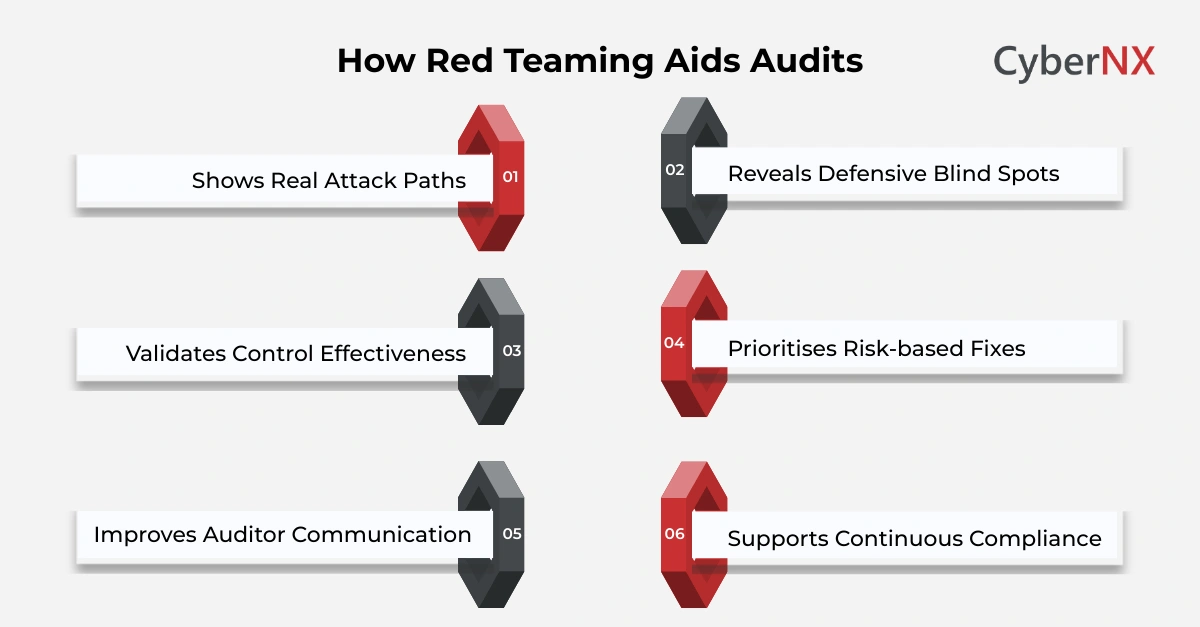
Beginning the audit process with a realistic attack simulation helps to bring clarity and keep things on track. Here’s how it can strengthen preparation.
1. Shows real attack paths
Audits check policies and procedures.
A red team report shows:
- how hackers really get in
- which systems are the easiest to hack
- where it’s easiest to get more power
- which controls fail silently
This helps auditors get a better and more accurate picture of risk.
2. Reveals defensive blind spots
Before audits start, teams learn about weak or missing controls.
The report usually finds:
- gaps in monitoring
- incomplete log coverage
- misconfigured identity or access rules
- missing network segmentation
- weak protections at the endpoints
Fixing these problems ahead of time improves both audit scores and real-world resilience.
3. Validates control effectiveness
Controls may exist – but do they detect or stop actual attacks?
The report helps verify:
- SIEM rule effectiveness
- EDR response accuracy
- firewall rule enforcement
- authentication and MFA protections
- cloud security guardrails
This moves audits from checkbox reviews to evidence-driven evaluations.
4. Prioritises risk-based fixes
Instead of treating all findings equally, the report clarifies what truly matters.
Teams can prioritise improvements by evaluating:
- exploitability
- business impact
- lateral movement potential
- data exposure risk
- time-to-fix
This gives auditors confidence that your remediation strategy is risk-driven.
5. Improves auditor communication
Auditors need clear information, evidence and documented processes. A red team report makes this communication stronger.
It gives:
- structured attack narratives
- clear impact summaries
- detailed technical proof
- validated suggestions for reducing risk
This makes it easier and faster for auditors to understand the situation.
6. Supports continuous compliance
A single audit offers a point-in-time snapshot. A red team report talks about how to make continuous improvement.
It helps keep:
- ongoing visibility
- consistent remediation cycles
- stronger incident response processes
- measurable security maturity over time
This changes the organisation from reactive compliance to proactive assurance.
Common weaknesses uncovered in red team reports
Reports from different fields show similar patterns. Teams can prepare better if they know about these trends.
Common weaknesses are:
- overly permissive access policies
- weak network segmentation
- unpatched internal systems
- ineffective alert tuning
- excessive reliance on legacy controls
- incomplete cloud logging
- slow or fragmented incident response
Taking care of these things before an audit makes your security narrative much stronger.
Conclusion
Relying on traditional audit checklists offers only a partial view of organisational risk. A red team report shifts this perspective. When teams analyse attack paths, defensive blind spots and response patterns, audits become more meaningful and security maturity becomes measurable over time.
If your organisation is preparing for an upcoming audit, our red teaming services offer a structured and intelligence-led approach. We work with teams to simulate realistic threats, uncover hidden weaknesses and build stronger defence workflows ahead of compliance reviews. Connect with us to plan a tailored red team engagement that supports your audit goals and long-term resilience.
Red team report FAQs
How often should organisations conduct red team exercises?
Most organisations benefit from a full red team exercise at least once a year to validate real attack paths and understand evolving risks. High-risk sectors, cloud-heavy environments or companies undergoing fast changes may require more frequent and targeted simulations.
Can a red team report replace a penetration test?
No, a red team report cannot replace a penetration test because the two serve different purposes. Penetration testing focuses on discovering and validating vulnerabilities, while red teaming checks how attackers exploit those weaknesses end-to-end. Together, they provide a complete understanding of technical as well as real-world impact on your organisation.
Who should review the red team report internally?
A red team report should be reviewed by security leadership, SOC teams, threat hunters and IT or DevOps teams who own the affected systems. Compliance and risk leaders also gain value from the insights, as the report highlights behavioural attack patterns and defensive blind spots.
Does red teaming disrupt business operations?
A professionally executed red teaming is designed to be safe, controlled and non-disruptive. Activities are planned with clear scope boundaries, pre-approved techniques and coordination with key stakeholders to avoid impact on production systems. The objective is to simulate real adversaries while making sure normal business operations remain uninterrupted.