Your monitoring dashboard shows all green. No alerts, no anomalies, no flags. Then a client calls to say their transactions are failing. You investigate for hours before finding the root cause buried three services deep. The dashboard never saw it coming.
This scenario plays out more often than most IT teams would like to admit. And it exposes a gap that traditional monitoring alone cannot close.
The debate around observability vs monitoring is not just a technical one. It is a strategic question about how much visibility your organisation truly has into its systems, and whether that visibility is enough to protect your operations and your clients.
In this post, we break down both concepts clearly – what they mean, how they differ and what you actually need to build a resilient, secure environment.
What is monitoring?
Monitoring is the practice of collecting predefined metrics from your systems and alerting your team when those metrics cross set thresholds. Think of it as a smoke detector. It does its job well – but only for the smoke it was designed to detect.
What monitoring tracks
Monitoring tools typically track a fixed set of data points. These include CPU usage, memory consumption, disk space, uptime, error rates and response times. Your team sets the rules in advance: “Alert me if CPU exceeds 90%” or “Flag if the server goes down.”
This approach works reliably for known failure modes. It gives you a clear picture of system health within defined parameters.
Where monitoring falls short
The limitation of monitoring is that it is reactive by design. It can only catch the issues you anticipated. If a new failure pattern emerges – one you never thought to measure – monitoring stays silent.
In complex, distributed environments like microservices architectures or hybrid cloud setups, the number of potential failure combinations grows exponentially. Monitoring alone cannot keep pace. You end up with blind spots – and blind spots are where incidents hide.
What is observability?
Observability is the ability to understand the internal state of a system based on its external outputs. Where monitoring tells you that something is wrong, observability helps you understand why.
The term comes from control theory and has been adopted by modern engineering and security teams to describe a deeper, more flexible approach to system intelligence. Full Stack Observability is built on three data types that work together to give you a complete picture:
- Logs: Logs tell you what happened and when.
- Metrics: Metrics tell you how a system is performing at any given moment.
- Traces: Traces tell you where a slowdown or failure occurred in a chain of dependencies.
Together, these three pillars let you ask questions your monitoring setup never anticipated and still get answers.
What observability tells you that monitoring can’t
Observability is proactive and exploratory. Instead of waiting for a threshold to be breached, your team can query system behaviour in real time. You can trace a failed transaction across five microservices, identify the exact point of breakdown and understand the conditions that caused it.
This is the difference between watching a gauge and understanding an engine.
Observability vs monitoring: the key differences
Understanding observability vs monitoring comes down to one core distinction: monitoring tells you when something breaks, observability helps you understand why and how.
Reactive vs proactive intelligence
Monitoring is reactive. It waits for something to go wrong and then triggers an alert. Your team responds to a notification.
Observability is proactive. It gives your team the tools to explore system behaviour continuously – before incidents escalate into outages or breaches. You are not waiting for the alarm. You are asking questions of your environment in real time.
Known unknowns vs unknown unknowns
Monitoring is designed for known unknowns. Failure modes you have already identified and configured alerts for. It performs well within those boundaries.
Observability addresses unknown unknowns. The failures and anomalies you never predicted. In a world of rapidly evolving threats and increasingly complex infrastructure, unknown unknowns are where the real risk lives.
This distinction matters enormously for security teams. Attackers rarely follow the playbook your monitoring was built around.
How to choose the right approach for your organisation
The answer to observability vs monitoring is not either/or. Monitoring is the foundation. Observability is the intelligence layer built on top of it.
Start with monitoring if you have not already. Establish clear baselines, configure alerts for critical thresholds and ensure your team has visibility into core infrastructure health. This is non-negotiable.
Then build toward observability. Instrument your applications to emit logs, metrics and traces. Invest in tooling that lets your team query system state dynamically. And critically – connect your observability data to your security operations.
Signs you need to go beyond monitoring
Your organisation may be ready to invest in observability if you are experiencing any of the following:
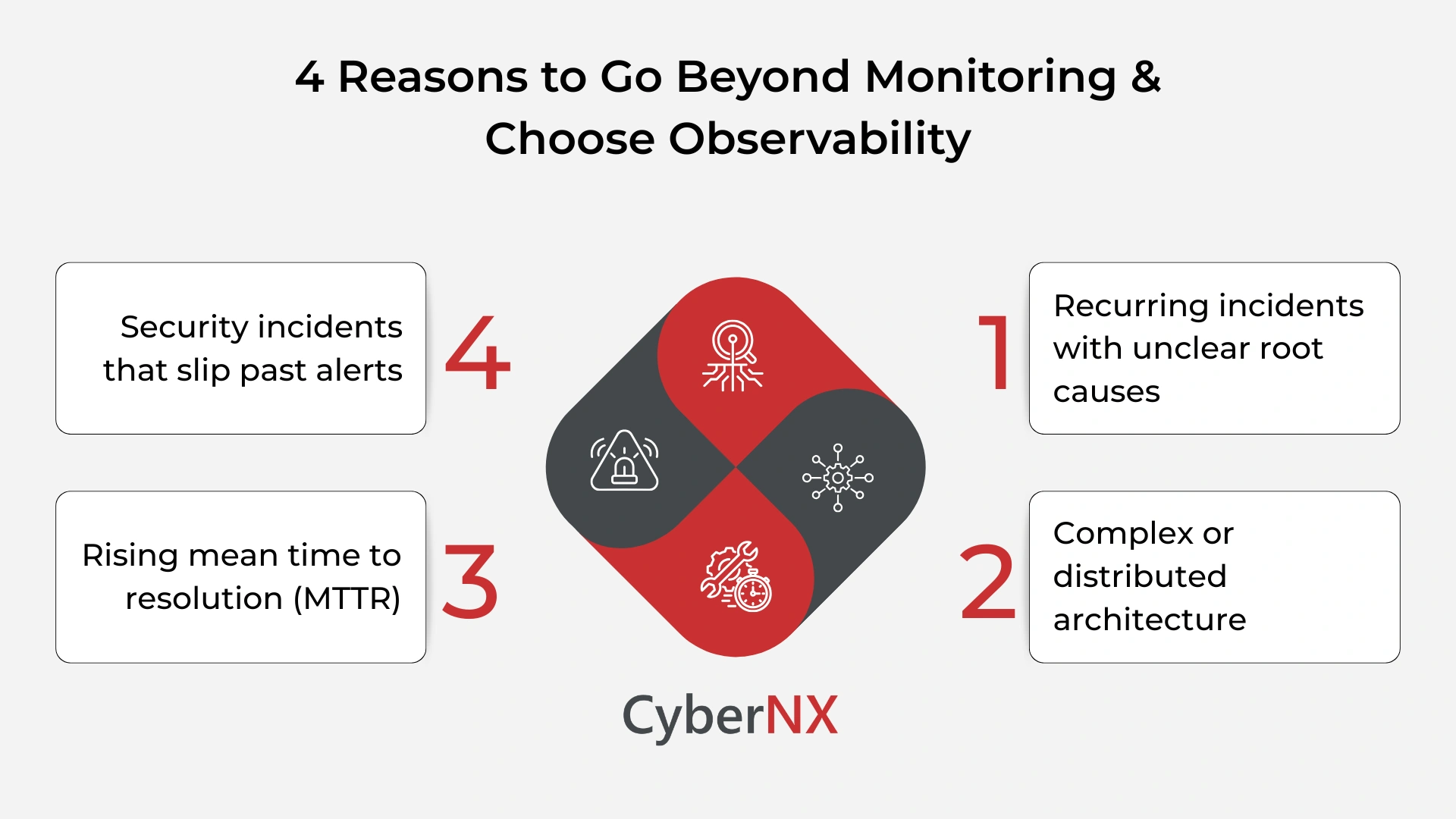
- Recurring incidents with unclear root causes: Your alerts fire but your team spends hours tracing the source.
- Complex or distributed architecture: Microservices, containers and multi-cloud environments create more failure combinations than monitoring can anticipate.
- Rising mean time to resolution (MTTR): If it takes too long to diagnose issues, you need richer system context.
- Security incidents that slip past alerts: Sophisticated threats often exploit gaps between monitored parameters.
If any of this sound familiar, observability is a necessity.
Conclusion
Monitoring tells you when the lights go out. Observability helps you understand why the wiring failed in the first place.
Both are essential. Monitoring gives you the alerts and baselines your team depends on. Observability gives you the depth to investigate, learn and get ahead of the next failure before it reaches your clients.
As systems grow more complex and threats more sophisticated, the organisations that invest in deeper visibility will respond faster, recover quicker and protect more.
At CyberNX, our Full Stack Observability Solutions are built on exactly this principle – giving your team unified visibility across logs, metrics and traces so you can detect, investigate and resolve issues before they impact your clients. We do not just monitor your environment. Instead, we make it fully observable.
Ready to move beyond monitoring? Explore our Full Stack Observability Solutions today.
Observability vs monitoring FAQs
Is observability replacing monitoring?
No. Observability extends monitoring – it does not replace it. Monitoring remains essential for tracking known thresholds and triggering alerts. Observability adds the depth to investigate and understand what monitoring surfaces. You need both working together.
What tools are used for observability?
Common observability tools include ELK Stack (Elasticsearch, Logstash and Kibana) for log management. Platforms like Datadog, Dynatrace and New Relic combine all three pillars in a single interface.
Why does observability matter for cybersecurity?
Observability gives security teams the context they need to detect sophisticated threats. Attackers often operate below monitoring thresholds – making small, incremental moves that individually look normal. Observability lets your team correlate signals across logs, metrics and traces to spot patterns that isolated alerts would miss.
How do logs, metrics and traces work together?
Think of them as three lenses on the same system. Metrics alert you that something is off. Logs give you the event-level detail of what happened. Traces show you the path a request took across your services so you can pinpoint exactly where it broke down. Used together, they give your team the full picture – not just a fragment of it.