Most security teams have heard of SBOM. Many are now building one. But here is the reality: your technology stack is not just software. It runs on hardware. It encrypts data using cryptographic libraries. It deploys AI models. It pulls from SaaS platforms and cloud APIs. Each of these layers carries its own supply chain risk. Each one needs its own inventory.
A Bill of Materials (BOM) is that inventory. Not one document – a stack of them. And understanding the full stack is now the difference between surface-level compliance and genuine supply chain security.
What is a bill of materials in cybersecurity?
The concept of a Bill of Materials started in manufacturing. A car maker uses a BOM to list every part in a vehicle, down to individual bolts. When a defect surfaces, the manufacturer knows exactly which vehicles are affected and can act immediately.
Cybersecurity borrowed this idea. A BOM in cybersecurity is a structured, machine-readable inventory of the components that make up your digital systems. When a vulnerability is disclosed, a BOM tells you in minutes whether you are exposed, instead of days or weeks of manual investigation.
SBOM: the foundation of your supply chain security
A Software Bill of Materials (SBOM) lists every component inside an application – open-source libraries, third-party packages, their versions and dependencies. It is the starting point for every other BOM type.
SBOM gives your security team three things. First, it provides instant vulnerability response. When a CVE lands, you know which systems are affected before the attacker does. Second, it surfaces licence risk. Hidden open-source components with incompatible licences create legal exposure that most teams discover only during audits. Third, it enables vendor accountability. You can require SBOMs from third-party software suppliers the same way a manufacturer requires component certifications.
In India, SBOM is no longer optional for regulated entities. SEBI mandates it for all critical IT systems under CSCRF. RBI directs all regulated entities to follow CERT-In’s 21-field SBOM baseline via its CSITE Advisory. CERT-In’s own technical guidelines, updated in July 2025, make SBOM the anchor of a broader visibility framework.
SBOM is your foundation. But it only covers the software layer.
CBOM: the cryptographic layer most teams miss
Every application relies on encryption. TLS protocols, certificate chains, hashing algorithms, key management libraries – these are the invisible infrastructure of trust. Most organisations have no inventory of them.
A Cryptographic Bill of Materials (CBOM) maps every algorithm, key, certificate and cryptographic protocol your systems use. It links directly to your SBOM, telling you not just what software you run but how that software protects data.
The urgency behind CBOM goes beyond today’s threats. Quantum computing is advancing. The “harvest now, decrypt later” attack strategy – where adversaries collect encrypted data today to decrypt it once quantum computers mature – is already active. Without a CBOM, you cannot assess your quantum exposure or plan a migration to post-quantum cryptographic standards.
CERT-In’s v2 guidelines explicitly include CBOM alongside SBOM. For BFSI organisations managing cryptographic assets across core banking systems and payment infrastructure, a CBOM is quickly moving from best practice to audit expectation.
Read: SBOM vs CBOM Guide
AIBOM: the fastest-growing BOM your organisation is not tracking
AI adoption is accelerating. Models are embedded in customer service, fraud detection, credit scoring and security operations. Most of these integrations happened quickly – and without formal oversight.
According to Cycode’s 2026 State of Product Security report, only 19% of organisations have full visibility into where and how AI is used across development. That means 81% have an AI supply chain they cannot see or govern.
An AI Bill of Materials (AIBOM) is a continuously updated inventory of every AI asset in your organisation – models, training datasets, inference pipelines, software dependencies and governance metadata. It is the SBOM concept applied to your AI stack.
AIBOM directly addresses shadow AI risk. When developers quietly integrate third-party models without security review, those models bring their own training data provenance, licence terms and potential bias into your production systems. AIBOM makes the invisible visible.
Globally, the EU AI Act’s technical documentation requirements for high-risk AI systems are pushing AIBOM from optional to enforceable. In India, CERT-In’s v2 guidelines already include AIBOM. If you are deploying AI in production today, building your AIBOM now puts you ahead of the next regulatory revision.
HBOM, QBOM and SaaSBOM: completing the stack
Here is the bill of materials stack you need to know:
Hardware Bill of Materials (HBOM) extends visibility to physical components – servers, network devices, IoT equipment and their firmware. Supply chain compromise at the hardware layer is a real and growing threat. HBOM gives you the documentation to assess supplier risk, respond to firmware vulnerabilities and satisfy hardware-specific audit requirements.
Quantum Bill of Materials (QBOM) builds on CBOM. Where CBOM inventories your current cryptographic assets, QBOM maps the migration path – identifying which algorithms are quantum-vulnerable and what post-quantum alternatives need to replace them. It is the planning layer for organisations preparing for the post-quantum transition.
SaaSBOM applies the same inventory logic to your SaaS stack – mapping every API integration, third-party data flow and service dependency. As organisations run more operations through cloud platforms, SaaSBOM closes the visibility gap that neither SBOM nor HBOM covers.
What India’s regulators mandate and what’s coming
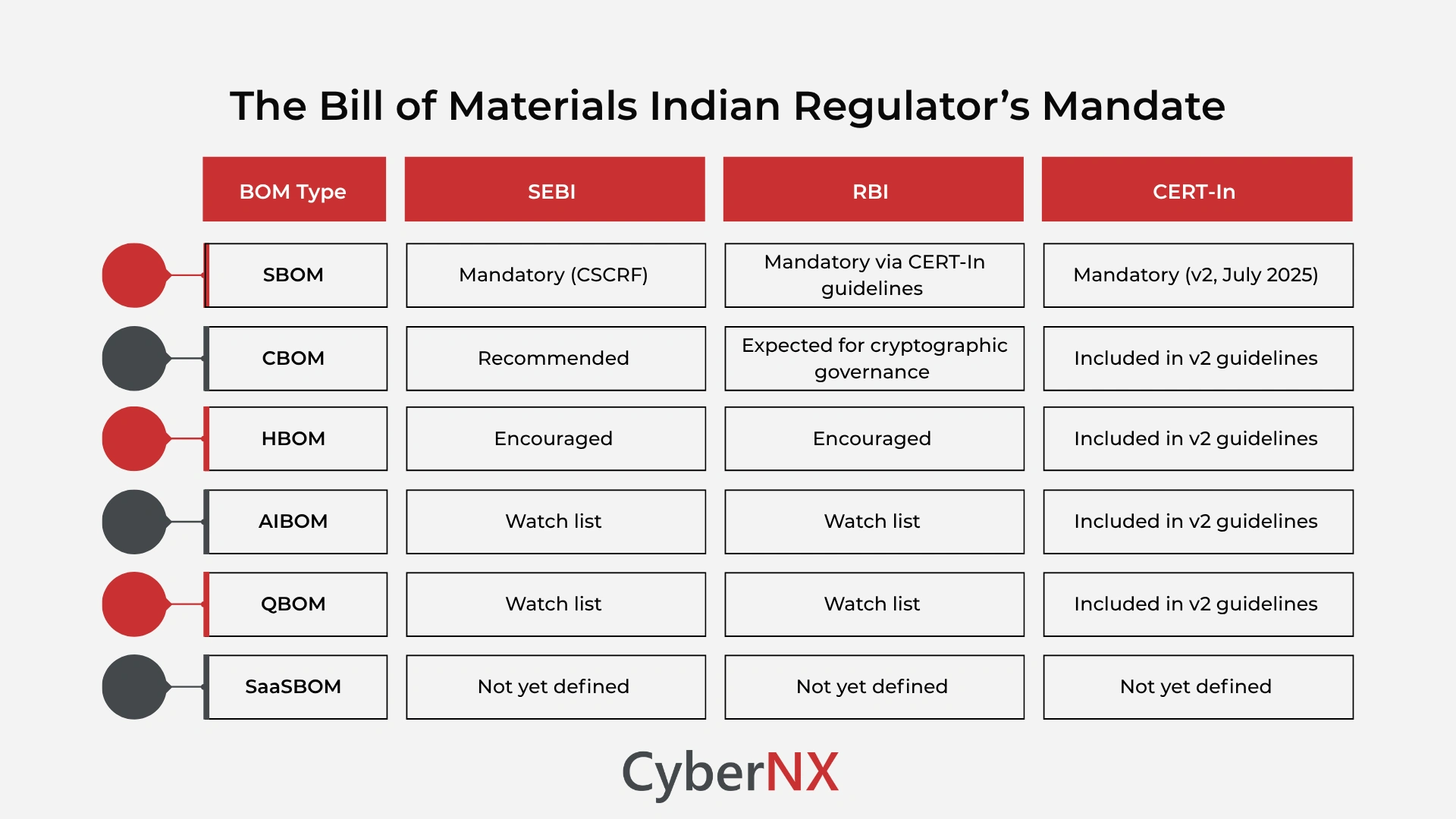
The signal is clear. Regulators started with SBOM because it is the most immediate risk. But CERT-In’s v2 guidelines already include CBOM, HBOM, AIBOM and QBOM. The mandate is expanding – the question is whether your organisation moves proactively or reactively.
Where to start: the BOM priority sequence
You do not need to build all six BOMs at once. A practical sequence based on risk and regulatory urgency looks like this.
1. Start with SBOM
Software Bill of Materials is mandatory, it delivers immediate vulnerability response value and it creates the foundation that every other BOM builds on.
2. Add CBOM
Adding Cryptographic Bill of Material is the natural next step if you are in BFSI. This is because you handle sensitive data and rely on encryption-heavy infrastructure. Cryptographic risk is the quiet gap that auditors are beginning to probe.
3. Build your AIBOM
Adopt AI Bill of Materials immediately if you are deploying AI in production or procuring AI-powered software. Shadow AI risk is real, the tooling exists and the regulatory signal is strong.
HBOM, QBOM and SaaSBOM come next based on your specific infrastructure profile – prioritise HBOM for hardware-dependent operations and QBOM for organisations on a post-quantum planning timeline.
Visibility is your security strategy
A Bill of Materials is how you answer the most fundamental question in security: what are we running, and is it safe?
Each BOM type covers a different attack surface. Together, they give you the full picture – from the open-source library in your application to the AI model embedded in your workflow to the encryption protecting your customer data.
We help organisations build and operationalise the complete BOM stack through NXRadar, our AI-powered SBOM management tool designed for regulated enterprises in India and helps with CERT-In, RBI and SEBI SBOM requirements. If you are starting with SBOM or planning your CBOM and AIBOM roadmap, our team is ready to help you move from compliance to genuine supply chain control. Talk to our experts today.
Bill of Materials Guide FAQs
What is the difference between a BOM and an SBOM?
A BOM is a broad inventory concept covering any technology layer – software, hardware, cryptography or AI. An SBOM is the software-specific version. In cybersecurity, BOM now refers to a family of six inventory types, each covering a different attack surface.
Which bill of materials does SEBI mandate for regulated entities?
SEBI mandates SBOM for all regulated entities under CSCRF. CBOM is increasingly expected for organisations managing cryptographic assets and payment infrastructure. AIBOM and QBOM are on the regulatory watch list.
Do I need an AIBOM if my organisation uses third-party AI tools?
Yes. Third-party AI tools bring model provenance risk and shadow AI exposure that your SBOM cannot capture. If AI touches your production environment in any form, an AIBOM is advisable now – before the mandate arrives.
What is the right order to implement multiple BOM types?
Start with SBOM – it is mandatory and delivers immediate vulnerability response value. Add CBOM next if you are in BFSI. Build your AIBOM as soon as AI enters your production stack.