It is now a well-known fact that AI is powering application development and transforming the software supply chain management. But like with any advancements, new challenges have also come to light such as transparency and security.
To keep a tab on criticalities related to AI in development and deployment stage, AI Bill of Materials (AIBOM) is helpful. How? AIBOM brings structure, clarity and accountability to AI environments that often feel opaque. It answers uncomfortable questions like: what models are we using? where did the data come from? who maintains them? and what risks are hiding inside third-party AI components?
In this guide, we explain what is AIBOM, why it matters in the age of AI, and how you can adopt it without compromising on innovation. We also share practical insights based on what we see across real enterprise environments.
What is AIBOM?
The core definition
An AIBOM is a structured, continuously updated inventory of every component that makes up an AI system. This includes the models themselves, the datasets used to train or fine-tune them, the algorithms, software libraries, infrastructure dependencies and the cryptographic assets that secure them. It also captures provenance, where each component came from, who approved it and how it has changed over time.
Think of it as the ingredient label for your AI. Not a static document produced once and filed away, but a living record that evolves with every model update, dataset change or dependency upgrade.
Why AI systems need their own bill of materials
Traditional software can be inventoried at build time. The components are deterministic and the same code and packages produce the same output. AI systems do not work this way.
A model trained on one dataset behaves differently from the same architecture trained on another. Behaviour changes over time as models drift, as upstream data sources evolve and as inference pipelines are updated. A point-in-time snapshot is not enough. An AIBOM must be continuous, rebuilt and re-evaluated on every material change.
How AIBOM differs from traditional SBOM
A Software Bill of Materials, or SBOM, documents the open-source libraries, third-party packages and code dependencies in a software application. It answers: what software components are we running and are any of them vulnerable?
An AIBOM goes further. It captures the dynamic elements an SBOM cannot – training data sources, model versions, fine-tuning history, inference pipelines, prompt lineage and the legal and ethical considerations attached to AI behaviour. A vulnerability in a dataset or model architecture can be as damaging as a flaw in code. AIBOM acknowledges that reality.
Read our blog: SBOM vs AIBOM
A Cryptographic Bill of Materials, or CBOM, inventories the cryptographic assets inside your systems – algorithms, key lengths, certificates and protocols. It assesses each against current standards and flags deprecated or weak cryptography before it becomes a risk.
SBOM, CBOM and AIBOM together form a complete picture of your software supply chain. Your code, your cryptography and your AI – all inventoried, all continuously monitored. This is the direction CyberNX is building toward with BOM solutions, giving security, compliance and engineering teams a single source of truth across all three domains.
The hidden risks inside modern AI systems
Most AI systems in production were built using datasets that are only partially understood by the teams deploying them. Training data may include biased, outdated or unlicensed information. It may have originated from sources that carry data privacy obligations under India’s Digital Personal Data Protection Act, or DPDPA. Without documented provenance, you cannot demonstrate to a regulator, an auditor or a customer that the data powering your AI decisions met the standards it should have.
Third-party model risk in regulated environments
Most enterprise AI deployments rely on third-party foundation models. Each introduces risk that is invisible without an inventory. A model sourced externally carries its own training history, its own licensing terms and its own limitations. When that model is embedded inside a credit decision system or a fraud detection pipeline, the organisation using it inherits those risks – whether it knows about them or not.
When absence of AIBOM caused real damage
Two cases now widely cited in the security community illustrate what happens without AI transparency.
In the first, a US attorney submitted legal filings citing six court cases that did not exist, generated by an AI tool with no version record, no validation log and no documentation of its known limitations. Research now estimates enterprises lose tens of billions of dollars annually to AI hallucinations. An AIBOM’s model inventory exists precisely to prevent undocumented model behaviour reaching production.
In the second, an employee at a financial firm transferred funds after a convincing deepfake impersonated senior management. Organisations with documented AI detection controls and vendor risk profiles in their AIBOM responded faster and with greater clarity about what systems were involved and who was accountable.
In both cases the root cause was the same: nobody knew what was inside the AI system.
Core components of an AIBOM
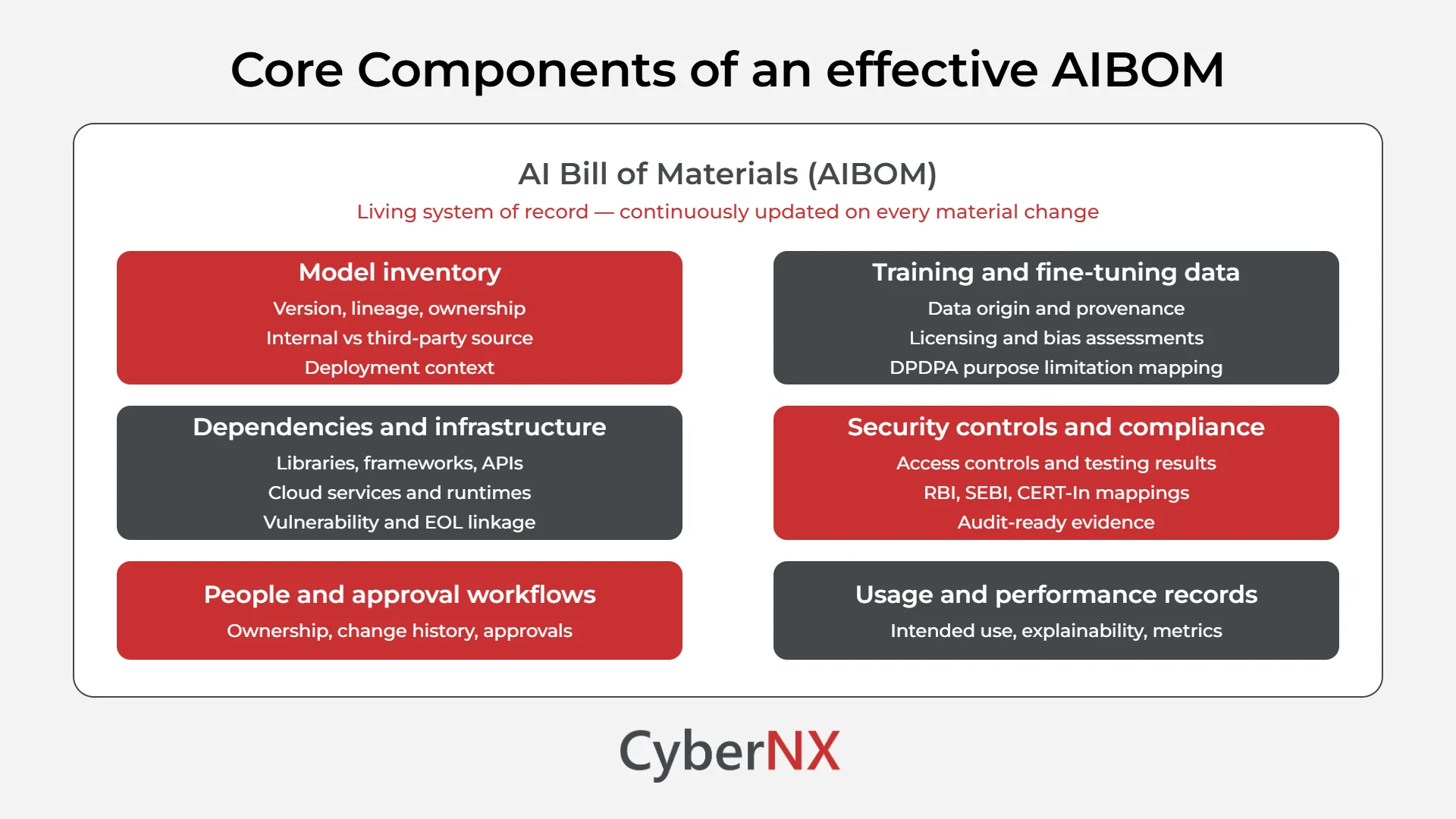
An AIBOM is not a static document but a living system of record that evolves with your AI stack.
1. Model inventory and lineage
This section documents all models in use, including version history, ownership and deployment context. It also records whether models are developed internally or sourced externally. Clear lineage enables faster incident response and accountability when models behave unexpectedly.
2. Training and fine-tuning data sources
Data transparency is central to AIBOM. Leaders need to know where data originates, how it is curated and whether it complies with legal and ethical standards. This reduces exposure to bias, data leakage and regulatory penalties.
3. Dependencies and frameworks
AI systems rely on libraries, frameworks and cloud services. AIBOM tracks these dependencies and their update cycles. This visibility supports proactive vulnerability management and patching.
4. Security and compliance controls
A strong AIBOM includes security testing results, access controls and compliance mappings. It shows how AI components align with internal policies and external regulations. This is increasingly important as AI governance frameworks mature.
AIBOM for agentic AI: why static inventories fall short
Most AIBOM frameworks were designed for static model deployments. Agentic AI changes that entirely. When large language models autonomously orchestrate tools, call external APIs and delegate tasks to sub-agents, the components shift at runtime. A traditional inventory captures what was deployed – not what the agent invoked or pulled from external services during a live task.
Gartner forecasts that by 2027, 70% of multi-agent systems will include specialised agents working in concert. Each delegation path and tool call is a potential risk entry point that a static AIBOM will miss.
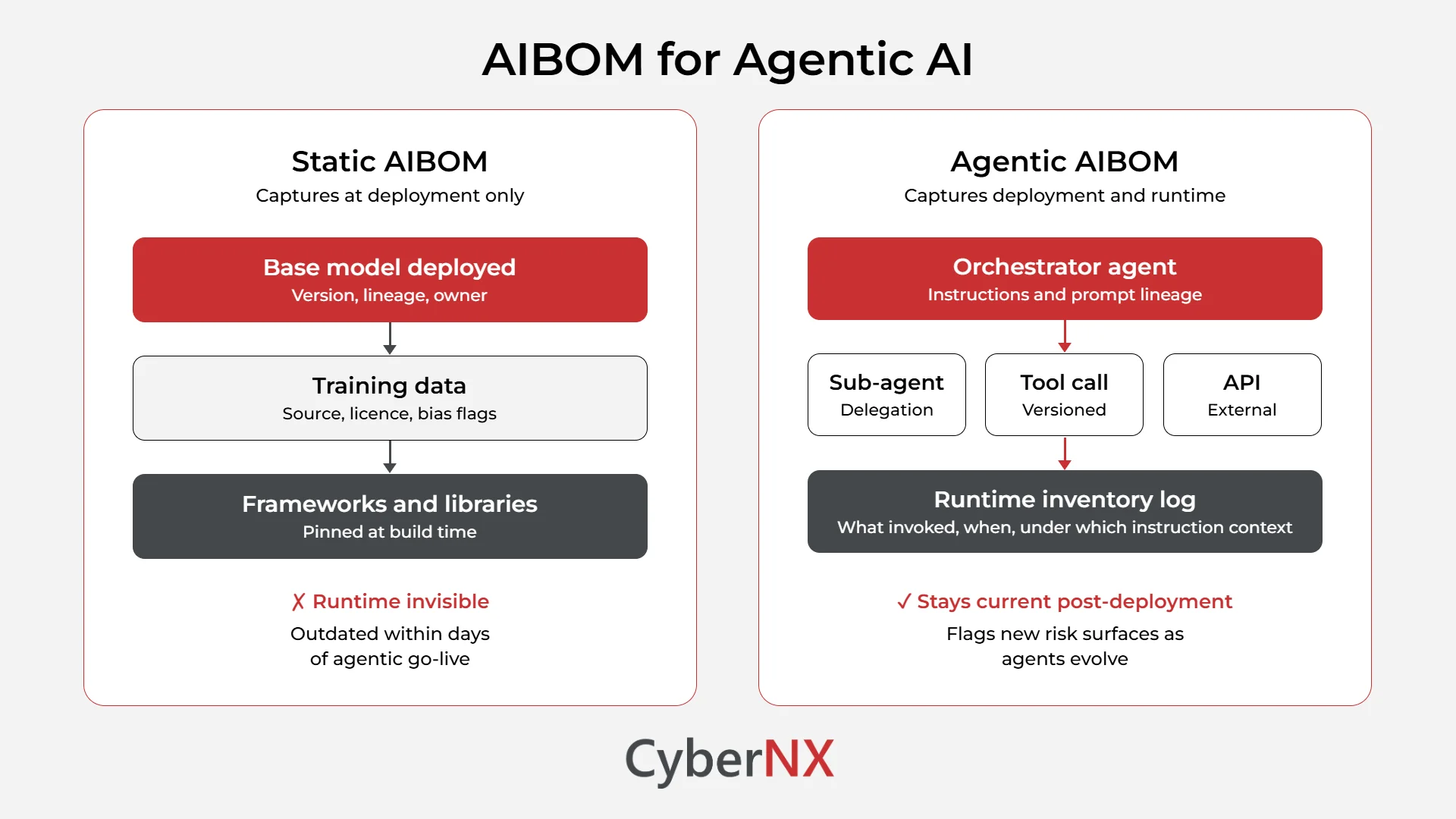
What a dynamic AIBOM must track at runtime
An agentic AIBOM must capture four dimensions a static inventory cannot see.
- Tool and skill inventories: every external tool or API the agent can call, with version and access scope documented.
- Orchestration and delegation paths: which agents can instruct which other agents and under what conditions.
- Runtime API dependencies: the external services accessed during task execution, not just at deployment time.
- Prompt and instruction lineage: versioned records of the system prompts and instructions governing agent behaviour.
What to log and how to treat agent tool calls like libraries
Treat every tool an agent can touch with the same rigour applied to software libraries in an SBOM. Implement runtime logging that captures which tools were invoked, by which agent and under which instruction context. Organisations that treat agentic AI as just another model deployment will find their AIBOM outdated within days of going live.
India’s regulatory obligations and what AIBOM addresses
Regulators worldwide are tightening expectations around AI transparency and accountability. Frameworks such as the EU AI Act emphasise traceability, risk management and documentation. What about India? The obligations below are active or imminent and an AIBOM is the baseline input for meeting each of them.
DPDPA 2023 and DPDP Rules 2025
The DPDPA and its accompanying Rules create direct obligations that connect to AIBOM at three points. Training data documentation maps to DPDPA’s purpose limitation requirement – data collected for one purpose cannot be used to train a model for another without fresh consent. Model explainability supports a customer’s right to information about automated decisions. And third-party model dependencies create Data Fiduciary accountability that cannot be delegated to a vendor.
Large BFSI organisations will likely qualify as Significant Data Fiduciaries, triggering mandatory Data Protection Impact Assessments. Any AI system processing customer data at scale – credit scoring, fraud detection, customer profiling – falls within scope. The AIBOM is the structured input that makes a defensible DPIA possible. The DPDP Act penalty ceiling of Rs 250 crore is the most direct financial reference point for board conversations about AIBOM investment.
RBI Master Directions and incident traceability
RBI’s IT framework and Master Directions require financial institutions to maintain traceability and documentation for technology incidents. Without an AIBOM, meeting RBI’s incident reporting windows for AI-related events is operationally difficult. When an AI system fails, investigation requires knowing exactly what version of which model was running, what data it had access to and who last modified its configuration.
SEBI CSCRF and CERT-In guidelines
SEBI’s Cyber Security and Cyber Resilience Framework, or CSCRF, requires regulated entities to document and govern their technology systems. As AI becomes embedded in market surveillance and trading operations, AIBOM provides the structured documentation that CSCRF governance reviews increasingly require. CERT-In’s SBOM guidelines establish the foundation for software supply chain transparency in India – the natural extension of that work, as AI components become as significant as software dependencies, is AIBOM.
IRDAI and the reassessment of AI in underwriting
IRDAI has issued directives leading to a reassessment of cyber underwriting frameworks. As AI is used in claims assessment and fraud detection, IRDAI-regulated entities face growing pressure to document their AI systems and demonstrate that human oversight is maintained.
How to build an AIBOM – a practical starting point
Based on what we see across regulated environments in India, five steps form a workable foundation for organisations beginning their AIBOM journey.
1. Define scope and prioritise by risk
Begin with the AI systems that support critical operations, process personal data at scale or fall within regulatory scope. Credit scoring models, fraud detection pipelines and customer-facing AI decisions are the natural starting point for BFSI organisations.
2. Inventory all models, data sources and dependencies
For each in-scope system, document the model name, version, source and ownership. Record training data sources – including licensing terms and bias assessments. Map all software dependencies, frameworks and third-party services the system relies on.
3. Document provenance, approvals and update history
Every material change to a model, dataset or dependency should be recorded – who made it, who approved it and what it involved. Building this history from the start is significantly easier than reconstructing it after an incident.
4. Embed AIBOM generation into CI/CD pipelines
Manual documentation does not scale alongside pipelines that ship changes daily. Automated AIBOM generation – triggered by every build, deployment or configuration change – ensures the inventory reflects the actual state of the system. Structured formats such as CycloneDX ML-BOM v1.7 and SPDX 3.0 AI Profile support both automated generation and regulatory reporting.
5. Establish review cycles tied to regulatory windows
AIBOM review cycles should align with your regulatory reporting obligations. For RBI-regulated entities, that means cadences compatible with incident reporting and IT audit timelines. For SEBI-regulated entities, alignment with CSCRF review requirements. The goal is that your AIBOM is always audit-ready – not assembled the week before an examination.
Building the AIBOM business case for your board
AIBOM requires cross-functional investment. Sustaining that effort requires board-level support. Getting there means moving the conversation beyond compliance.
1. Start with breach economics
AI supply chain incidents are a growing share of that figure. A ten per cent reduction in incident likelihood translates into millions of avoided cost for most mid-to-large organisations.
2. Connect AIBOM to commercial trust
Enterprise procurement, insurance renewals and partner due diligence increasingly include AI transparency requirements. Organisations that cannot document their AI components will face friction in sales cycles before regulators even act.
3. DPDP Act penalty
For Indian BFSI teams, the DPDP Act penalty ceiling of 250 crore rupees is the most direct financial reference point. Presenting AIBOM investment against that exposure is a conversation finance committees understand.
4. AIBOM as investment
Finally, frame AIBOM as an enabler of AI investment, not a restriction on it. Boards approving AI programmes want evidence, not assurance. AIBOM gives them the documentation to approve AI scaling with confidence.
Those who position AIBOM as a business instrument rather than a compliance requirement will find it significantly easier to secure the support they need.
Conclusion
Many enterprises lack the internal capacity to design and operationalise AIBOM alone. External partners can accelerate maturity by bringing proven frameworks, tooling expertise and regulatory insight.
AI is becoming foundational to enterprise operations. With that comes responsibility.
This AIBOM guide shows that transparency, trust and innovation are not opposing goals. When implemented thoughtfully, AI Bill of Materials strengthens security while enabling confident AI adoption.
Security leaders who act now will be better prepared for regulatory scrutiny, supply chain risks and the next wave of AI-driven change.
If you are exploring how to implement an AI Bill of Materials or strengthen AI governance, we are here to help. A short conversation can clarify next steps and avoid costly missteps.
Ready to bring structure and confidence to your AI security strategy? Speak with us to explore how our AIBOM solutions can help your security and operational needs. Plus, find out how AIBOM can be integrated into your existing security and governance frameworks.
AIBOM FAQs
How often should an AIBOM be updated?
An AI Bill of Materials should be updated whenever models, data sources or dependencies change. Continuous updates are ideal for high-risk systems.
Does AIBOM slow down AI development?
When implemented well, AIBOM improves clarity and reduces rework. It supports faster, safer innovation rather than slowing teams down.
Can AIBOM be automated?
Parts of AIBOM can be automated, especially dependency tracking and version control. Human oversight remains critical for data and ethical considerations.
Is AIBOM relevant for small AI deployments?
Yes. Even limited AI use can introduce risk. A lightweight AIBOM helps establish good practices early.