More organisations now want practical ways to understand how attackers think. Many invest in tools, but still feel unsure about their true resilience. That’s where ethical red teaming makes a difference. It gives teams a clear view of how an adversary could move through their environment, what they might target and how far they could get.
We use ethical red teaming to help businesses test their defences safely, spot hidden weaknesses and build confidence in their security investments. It offers clarity that routine assessments often miss.
The ultimate security drill: what and why of ethical red teaming
Red teaming is a process designed to detect network and system vulnerabilities and test security by taking an attacker-like approach to system, network, or data access.
While the ultimate purpose is to enhance security, red teaming is done keeping employees, internal security teams and others in the dark. This is the reason why the red teaming process is also known as “ethical hacking” or “ethical red teaming.” Red teamers and everyone else involved (CISOs, CEOs and security heads) follow a strict code of conduct to perform this exercise.
So, why does it matter to your business? Or how does it help your security program? By simulating full-spectrum information attacks, your defenders (the Blue Team) receive hands-on training to practise their detection and mitigation skills in a managed and measurable way.
In addition, the wider scope of red teaming helps to identify and address weaknesses before real attackers can exploit them. When conducted professionally, it enhances security, strengthens resilience, and fosters trust, all without compromising safety, privacy or business integrity.
The code of conduct: core principles of ethical red teaming
The core principles ensure the simulated attack remains a controlled, beneficial exercise rather than a destructive event. These include:
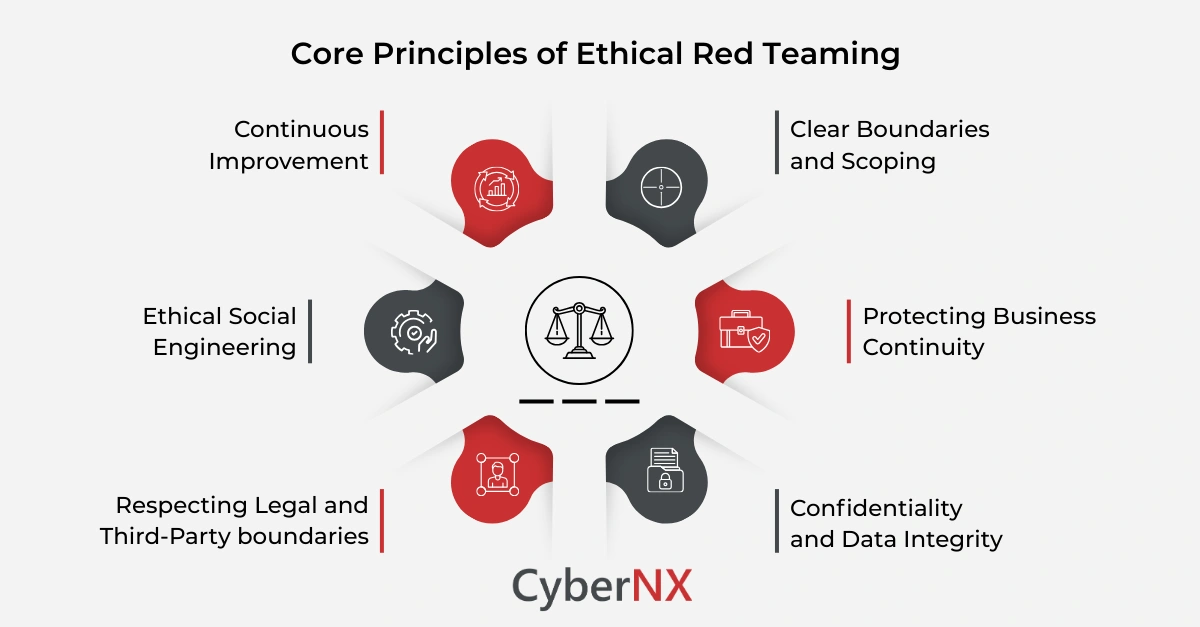
1. Clear boundaries and scoping
Professional red teams define clear objectives, establish detailed rules of engagement, and agree on safe attack scenarios with the client before they begin.
2. Protecting business continuity
Responsible red teams understand that realism does not require downtime or data loss. Techniques are carefully controlled, sensitive activities scheduled during maintenance windows or low-impact periods.
3. Confidentiality and data integrity
Ethical red teaming places the highest priority on confidentiality. Findings are handled under strict agreement, securely stored, and only shared with authorised stakeholders.
4. Respecting legal and third-party boundaries
Teams comply with applicable laws and industry standards, focus strictly on approved targets and avoid unauthorised testing of third-party infrastructure.
5. Ethical social engineering
Social engineering is a core part of effective red teaming but must be executed responsibly. Scenarios reveal weaknesses in human behaviour but avoid tactics that humiliate or harm employees.
6. Continuous improvement
Service providers adhere to ethical frameworks (such as those by CREST) and foster a culture of professionalism, review and ongoing training.
How ethical red teaming includes people, process and technology
Ethical red teaming blends offensive testing with safe, controlled execution. It covers more than just technology. We evaluate the full environment including staff awareness, access control and response patterns.
Typical phases include:
- Reconnaissance: the team studies the organisation the way an attacker would.
- Initial access: finding entry points via weak credentials, exposed services or misconfigurations.
- Privilege escalation: once inside, attempts to increase access.
- Lateral movement: moving within the network, crossing segmentation boundaries.
- Objective execution: reaching the defined target (e.g., data, system, process).
- Reporting and uplift: providing findings, recommendations and helping the Blue Team improve.
The importance of ethical boundaries and management
Because red teaming simulates adversaries, the risks if poorly managed are real: data loss, reputational damage, business disruption and legal exposure.
Key aspects of responsible engagement include those core principles listed earlier: scoping, continuity, confidentiality, legal boundaries, ethical social engineering, continuous improvement.
Proper management means having a White Team or oversight board, defined rules of engagement, clear rollback/abort procedures, and after-action review sessions with your Blue Team.
Reporting, outcomes and how we view success
The value of the exercise comes from providing clear, actionable recommendations – not just finding vulnerabilities. Ethical red teams deliver professional reports that prioritise solutions over sensationalism. Reports detail vulnerabilities, explain their potential business impact, and provide practical remediation steps tailored to your environment.
Importantly, success is measured not only if the Red Team reached its crown-jewel objective, but how well the Blue Team improved detection, response, containment and how the organisation used the findings to strengthen its posture.
We always emphasise the lift-off from findings to continuous improvement.
Differences between ethical red teaming and other security testing
This table gives an overview of how ethical red teaming differs from traditional security testing exercises.
| APPROACH | SCOPE | OUTCOME | TYPICAL DURATION |
| Vulnerability assessment | Known issues across tech | List of vulnerabilities | Days |
| Penetration testing | Specific assets | Exploitable vulnerabilities | Days to weeks |
| Ethical red teaming | Full people/process/tech, adversary-goals | Realistic end-to-end attacks, process gaps, detector gaps | Weeks to months |
As you can see red teaming goes deeper, challenges assumptions, and provides a realistic view of how an attacker might succeed.
Why this matters for security leaders
For CISOs, IT Heads and security leaders, ethical red teaming offers:
- Evidence-based insight into true risk.
- A tool to justify security investment based on adversary simulation.
- A framework to align people, process and technology improvement.
- Board-level narrative of improvement, not just technical fixes.
- Confidence that security programmes aren’t static but evolve.
The blueprint for defence with strategic red teaming
Strategic red teaming transforms guesswork into a defence blueprint built on real-world attacker behaviour.
- Set clear goals: Pick an objective meaningful to your business (eg. data exfiltration, business-process compromise).
- Engage leadership early: Secure buy-in from execs and the board.
- Define scope and rules: Boundaries, safe-exit, authorised systems and data.
- Protect operations: Ensure the test does not disrupt business.
- Follow-up & track improvement: Use the findings to measure progress year-to-year.
- Report in business terms: Use narratives, heat-maps, metrics aligned to the business rather than purely technical detail.
- Embed into cycle: Consider continuous or periodic red-team engagements to maintain readiness.
Conclusion
Ethical red teaming helps organisations move from guesswork to clarity. It offers a practical, safe and effective way to understand how attackers think and how far they could go. The insights help businesses strengthen defences, improve readiness and protect what matters most.
We work closely with business and security teams to create red-team exercises that fit their goals, scale and risk profile. The result is a stronger, more confident and more prepared organisation. Speak with our experts to find out how our ethical red teaming services exercise can help you uncover the improvements that will strengthen your defence strategy.
Ethical red teaming FAQs
How often should organisations conduct ethical red teaming?
Most organisations run a full red-team exercise annually, with smaller follow-ups every quarter to track improvement. Regular cadence ensures security maturity is continuously measured, not just checked once a year.
Is ethical red teaming safe for live environments?
Yes. When properly scoped and managed, the exercise avoids damage and uses evidence-based methods rather than actual data compromise. Clear rules of engagement keep business operations uninterrupted while still revealing real weaknesses.
Can small or mid-size organisations benefit from ethical red teaming?
Absolutely. Smaller environments often gain clarity quickly because the test highlights focused, achievable improvements. It helps teams prioritise investments and fix the most impactful gaps without overextending budgets.
How long does a typical ethical red team exercise take?
Most red team exercises run between four and eight weeks, depending on goals, scope and complexity. This timeframe allows teams to plan, simulate attacks meaningfully, and generate actionable insights.
What qualifications should the red-team providers have?
Look for credible providers with certifications, experience in adversary simulation, and a professional method with clear rules of engagement, reporting and improvement pathways. A mature provider brings both technical depth and the ability to translate findings into business-aligned recommendations.