
Red teaming for cloud infrastructure has become a priority for organisations that rely on cloud platforms for scale, speed and resilience. Cloud adoption has moved faster than many security programmes can adapt. As a result, misconfigurations, identity sprawl and over-permissioned workloads remain common. These gaps rarely show up in standard audits or automated scans.
We see this challenge across enterprises migrating complex environments to the cloud. Controls look strong on paper, yet attackers think differently. They chain small weaknesses into major incidents. Red teaming brings that attacker mindset into your cloud environment. It safely simulates how a real adversary would target your cloud infrastructure, identities and data. The goal is simple. Show what truly works, what quietly fails and where risk hides.
What red teaming means in a cloud context
Red teaming has long been used to test on-premise security. In cloud environments, the scope changes but the objective stays the same. It tests detection, response and resilience against realistic attack scenarios.
In cloud infrastructure, red teaming focuses on how identities, APIs, workloads and configurations interact. Attackers rarely exploit a single vulnerability. Instead, they move through IAM roles, storage services and management planes.
Cloud red teaming typically includes simulated attacks across platforms such as Amazon Web Services, Microsoft Azure and Google Cloud Platform. Each platform has unique services, controls and failure modes. Testing must reflect those differences.
Unlike penetration testing, red teaming has no fixed checklist. It adapts to your environment, your controls and your business risks.
Why traditional security testing falls short in the cloud
Most organisations still rely on vulnerability scans and compliance assessments. These are useful, but they only show part of the picture.
Cloud risk often comes from how services are combined. A storage bucket might be private. An identity role might seem limited. Together, they may allow data exfiltration or privilege escalation.
Automated tools struggle to test these chains. They also cannot assess human response. When alerts fire, teams must investigate, contain and recover. Red teaming tests that entire journey.
Another limitation is shared responsibility confusion. Cloud providers secure the platform, not your configurations. Red teaming exposes where that responsibility line is misunderstood or ignored.
Key attack paths tested during cloud red teaming
Every digital system has different paths which are exploited by cybercriminals. For cloud, it ranges from identity, misconfigurations to control planes and others.
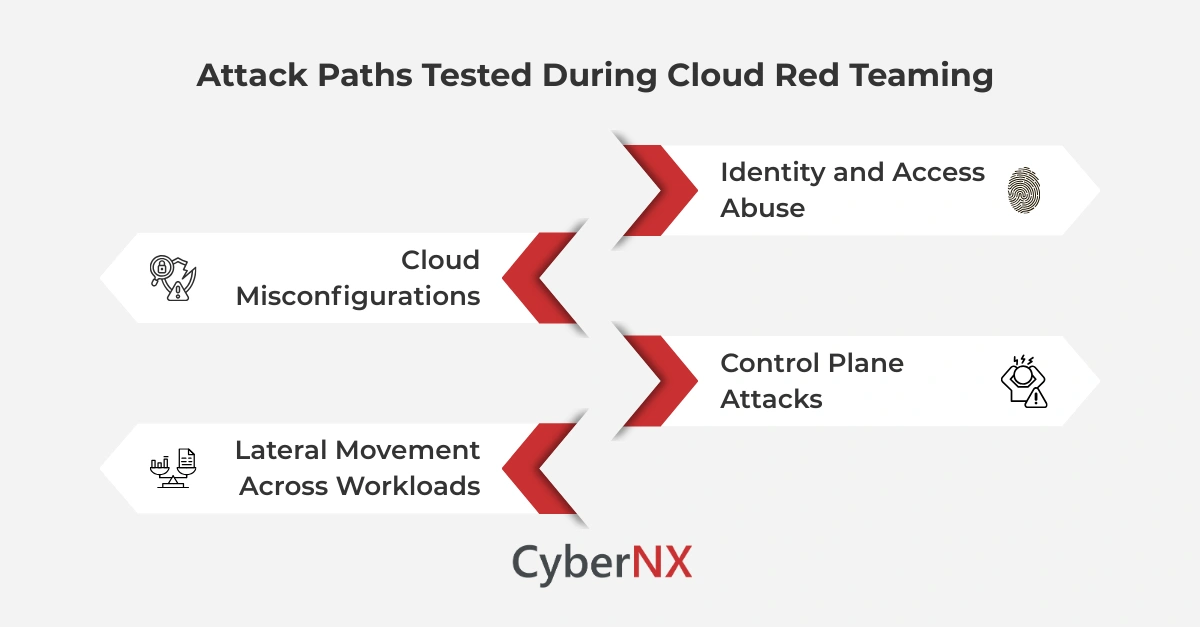
1. Identity and access abuse
Identity is the new perimeter in the cloud. Red teams target excessive permissions, unused credentials and poorly protected service accounts. A single compromised identity can open paths across multiple services.
We often see privilege escalation through misconfigured IAM policies or inherited permissions. Red teaming shows how quickly attackers can move once inside.
2. Cloud misconfigurations
Misconfigurations remain one of the leading causes of cloud breaches. Public storage, open management ports and weak network rules are common findings.
Red teams validate whether these weaknesses can be discovered and exploited under realistic conditions. More importantly, they assess whether monitoring tools detect them in time.
3. Control plane attacks
The cloud control plane is powerful. If compromised, attackers can create resources, disable logging or erase evidence. Red teaming tests how well access to management APIs is protected and monitored.
This area is often overlooked in traditional testing, yet it poses severe business risk.
4. Lateral movement across workloads
Modern cloud environments use containers, serverless functions and microservices. Red teaming examines whether attackers can pivot between workloads, exploit trust relationships or access sensitive data stores.
These scenarios mirror real incidents observed across global enterprises.
Business value of red teaming for cloud infrastructure
Red teaming provides clarity that dashboards cannot. It answers questions boards and CISOs care about, such as:
- Can attackers reach crown-jewel data?
- Would our security team spot the attack quickly?
- How effective is our incident response under pressure?
According to IBM’s Cost of a Data Breach Report, breaches involving cloud misconfigurations and compromised credentials continue to drive higher recovery costs. Red teaming helps reduce this risk by exposing weaknesses before attackers do.
It also improves collaboration. Security, cloud and operations teams see how their decisions intersect. That shared understanding leads to stronger controls and faster response times.
How cloud red teaming differs from penetration testing
Penetration testing looks for vulnerabilities at a point in time. Red teaming simulates a full attack lifecycle.
In cloud environments, this difference matters. Attackers may start with phishing or credential abuse, then pivot into cloud services. A pen test might miss that path. Red teaming follows it.
Another difference is stealth. Red teams avoid obvious noise. They test whether your detection tools notice subtle abuse of legitimate services. This reflects how modern attackers operate.
Red teaming also includes debriefs and purple team exercises. These sessions help defenders understand what happened and how to improve.
Designing an effective cloud red team engagement
So now that you understand why red teaming is effective for cloud security, how can you design one? Find out below:
1. Define realistic objectives
Every red team exercise should start with business goals. These might include access to regulated data, disruption of critical workloads or compromise of management accounts. Clear objectives ensure the exercise stays relevant and safe.
2. Map the cloud architecture
Cloud environments change quickly. Red teams must understand your architecture, identities and integrations. This includes third-party services and CI/CD pipelines. Accurate scoping avoids wasted effort and ensures meaningful results.
3. Execute safely but realistically
Cloud red teaming must balance realism with operational safety. Experienced teams simulate attacker behaviour without causing outages or data loss. This requires deep platform knowledge and careful coordination.
4. Deliver actionable outcomes
The final output matters as much as the attack itself. Findings should link technical issues to business impact. Clear remediation guidance helps teams act quickly.
We believe the best red team reports tell a story. They show how small issues combine into serious risk.
Conclusion
Red teaming for cloud infrastructure gives organisations a clear view of their true security posture. It moves beyond theory and tests what happens when a skilled adversary targets your cloud environment.
For leaders responsible for protecting complex cloud estates, this insight is invaluable. It helps prioritise investment, improve response and reduce the risk of costly breaches.
We work alongside your team to strengthen your defences through realistic, safe and business-focused red teaming services. If you want to understand how attackers see your cloud, a conversation with our experts is a strong place to start.
Ready to test your cloud security the way attackers do? Speak with us about red teaming for cloud infrastructure and gain clear, actionable insight into your real risk.
Red Teaming for Cloud Infrastructure FAQs
How often should organisations conduct cloud red teaming?
Most mature organisations run red teaming annually or after major cloud changes. High-risk environments may benefit from more frequent exercises.
Is cloud red teaming safe for production environments?
Yes, when conducted by experienced teams with clear rules of engagement. Activities are carefully controlled to avoid disruption.
Does red teaming replace vulnerability scanning?
No. Red teaming complements scanning by testing real attack paths and human response, not just technical flaws.
Can red teaming support regulatory compliance?
While not a compliance activity, red teaming provides evidence of proactive risk management that supports audits and governance discussions.