Many security leaders feel confident about their internal controls. But cybercriminals today look for exposed systems, forgotten domains, leaked credentials, and shadow IT assets sitting outside the organisation’s direct visibility. These external assets quietly expand the attack surface.
So, how digital risk monitoring reduces external attack surface? Digital risk monitoring continuously scans the internet-facing footprint of an organisation. It identifies assets, exposures, and risks that traditional internal security tools often miss. When done right, it gives security teams a clear view of what attackers see first.
In this blog, we explore how this approach helps organisations shrink their external attack surface and strengthen security posture.
Understanding the external attack surface
The external attack surface includes every digital asset that is reachable from the public internet. These assets may include:
- Public-facing applications
- Cloud infrastructure
- APIs
- Domains and subdomains
- Third-party integrations
- Exposed credentials
- Misconfigured storage buckets
Many organisations may think they know all their internet-facing assets. But the reality is that the digital environment today changes constantly. New services are launched and development teams spin up temporary infrastructure. Then, there are third-party platforms that connect to internal systems.
Over time, these additions create gaps in visibility. Attackers actively scan the internet looking for such gaps. Even a small, overlooked asset can become the entry point. Reducing this exposure requires continuous monitoring beyond the traditional network boundary.
Why external attack surface keeps expanding
Before discussing how digital risk monitoring helps, it is important to understand why the external attack surface grows so quickly.
1. Cloud adoption
Cloud platforms allow teams to deploy infrastructure within minutes. While this flexibility accelerates innovation, it also creates visibility challenges. A development team might create a temporary environment and forget to remove it. Months later, that exposed instance becomes an easy target.
2. Shadow IT
Employees often adopt tools or services without formal security review. These tools may integrate with company data or authentication systems. Security teams may not even know they exist.
3. Third-Party ecosystems
Modern businesses depend heavily on partners, vendors, and SaaS providers. Each integration adds another potential exposure point. If a third-party system is compromised, attackers may pivot towards the enterprise.
4. Forgotten digital assets
Old domains, test environments, and legacy applications often remain online long after their intended use. Attackers actively search for such assets because they are rarely monitored. These realities make it nearly impossible to manage exposure manually.
How digital risk monitoring reduces external attack surface
Digital risk monitoring provides continuous visibility into internet-facing assets and potential risks. It allows organisations to identify and reduce exposure before attackers exploit it.
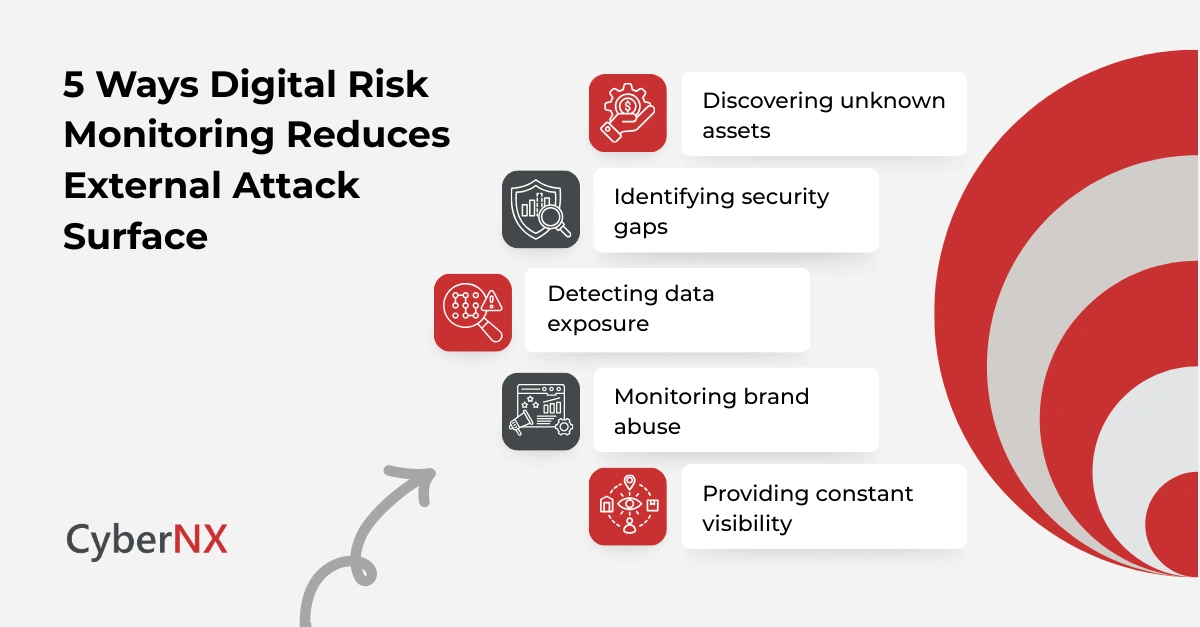
1. Discovering unknown internet-facing assets/ Discovering unknown assets
Many organisations underestimate how many assets exist outside their security perimeter.
Digital risk monitoring scans the internet to identify:
- Unknown domains and subdomains
- Exposed servers and applications
- Cloud resources linked to the organisation
- Forgotten or abandoned infrastructure
Once these assets are discovered, security teams can assess their risk level.
Sometimes the safest step is simply shutting down an unnecessary asset. In other cases, the issue may require patching, configuration updates, or stronger authentication. This discovery process alone significantly reduces the external attack surface.
2. Identifying misconfigurations and security gaps/ Identifying security gaps
Misconfigured systems remain one of the most common causes of breaches.
Examples include:
- Open databases
- Publicly accessible storage buckets
- Exposed administrative interfaces
- Weak TLS configurations
Digital risk monitoring tools continuously scan external assets to detect these weaknesses. Security teams receive early alerts and can remediate the issue before it becomes a breach opportunity. Small configuration fixes often eliminate large exposure risks.
3. Detecting credential leaks and data exposure/Detecting data exposure
Stolen or leaked credentials often circulate across the internet. They may appear in:
- Dark web marketplaces
- Data breach dumps
- Paste sites
- Public repositories
Digital risk monitoring tracks these sources to identify exposed credentials associated with the organisation. If detected early, security teams can:
- Reset affected accounts
- enforce stronger authentication controls
- investigate possible compromise attempts
By limiting credential abuse, organisations reduce the chances of attackers gaining an initial foothold.
4. Monitoring brand abuse and phishing infrastructure/Monitoring brand abuse
Attackers frequently impersonate organisations to launch phishing campaigns. They create:
- Fake domains
- Spoofed websites
- Malicious email infrastructure
These assets expand the digital threat landscape beyond the company’s own infrastructure. Digital risk monitoring identifies suspicious domains or phishing pages targeting the organisation. Security teams can then initiate takedown actions and alert affected users. Removing these malicious assets limits the avenues attackers use to deceive employees and customers.
5. Providing continuous visibility for security teams/Providing constant visibility
One of the biggest advantages of digital risk monitoring is persistent visibility. External exposure changes constantly. A one-time assessment cannot capture the full picture. Continuous monitoring allows organisations to:
- Track new assets as they appear
- identify emerging risks
- prioritise remediation efforts
Security teams gain a clearer understanding of the organisation’s evolving digital footprint. This proactive visibility helps maintain a smaller, better-managed attack surface.
Benefits for enterprise security leaders
Digital risk monitoring offers several strategic advantages for CISOs and security teams.
- First, it improves asset visibility across the entire digital ecosystem.
- Second, it enables early risk detection, allowing organisations to fix exposures before attackers discover them.
- Third, it strengthens incident prevention by reducing entry points attackers can exploit.
- Finally, it supports better risk prioritisation, helping teams focus on the most critical exposures rather than reacting blindly.
These benefits help security leaders move from reactive defence to more controlled risk management.
Conclusion
External threats rarely begin inside the network. Attackers first explore what they can see from the outside.
That is why understanding how digital risk monitoring reduces external attack surface is so important for modern organisations.
By continuously discovering assets, identifying misconfigurations, monitoring credential leaks, and tracking brand abuse, digital risk monitoring helps organisations close gaps before attackers exploit them.
At CyberNX, we work alongside security teams to uncover hidden exposures and strengthen external visibility. Our approach focuses on practical improvements that reduce risk without slowing innovation.
If you want a clearer view of your organisation’s external attack surface, connect with us to know more about our digital risk monitoring services and how a digital risk assessment can help you strengthen security.
How digital risk monitoring reduces external attack surface FAQs
How is digital risk monitoring different from attack surface management?
Digital risk monitoring focuses on identifying external threats and exposures across the internet, including brand abuse, leaked credentials, and phishing infrastructure. Attack surface management primarily focuses on discovering and securing internet-facing assets.
Can digital risk monitoring help detect supply chain risks?
Yes. Digital risk monitoring can identify exposures linked to third-party domains, services, or infrastructure connected to the organisation. This visibility helps security teams evaluate potential supply chain risks.
How frequently should external attack surface monitoring be performed?
External monitoring should ideally run continuously. Digital assets change frequently due to cloud deployments, integrations, and development activity. Continuous monitoring ensures new exposures are identified quickly.
What teams benefit most from digital risk monitoring insights?
While security teams lead the effort, insights from digital risk monitoring also help IT operations, risk management teams, and executive leadership make better decisions around cyber risk and digital exposure.