The BFSI sector in India faced the highest volume of dark web threats, according to SOCRadar’s 2025 Threat Landscape Report. What it shows is that this sector is increasingly vulnerable to modern cyberattacks. And there is a reason why it is so. Financial institutions sit on data that criminals value the most. The scale and sensitivity of this data make the sector a prime target for organised cybercrime.
Dark web monitoring has therefore moved from a specialist function to a board-level priority. If you cannot see what is being traded, you cannot respond in time.
In this blog, we discuss practical use cases of dark web monitoring for BFSI and explain why it plays a growing role in regulatory alignment. We also share how security leaders can turn dark web intelligence into measurable risk reduction.
The modern BFSI risk landscape
The banking, financial services and insurance sector operates in a high trust environment. While customers expect confidentiality and regulators expect control, the moder attackers expect profit. Dark web marketplaces offer:
- Compromised banking credentials
- Stolen card data
- Insider access to financial networks
- Leaked loan and insurance records
- Corporate email dumps
For CISOs and CROs, the challenge is clear. Traditional perimeter security does not reveal what is happening outside your network. Yet reputational damage often begins outside your infrastructure.
Dark web monitoring helps bridge this gap. It extends visibility into underground forums, encrypted channels and data leak sites. That early insight changes response timelines dramatically.
Key use cases of dark web monitoring for BFSI
Dark web intelligence becomes valuable when it connects to business risk. Below are practical use cases where Dark Web Monitoring for BFSI delivers measurable impact.
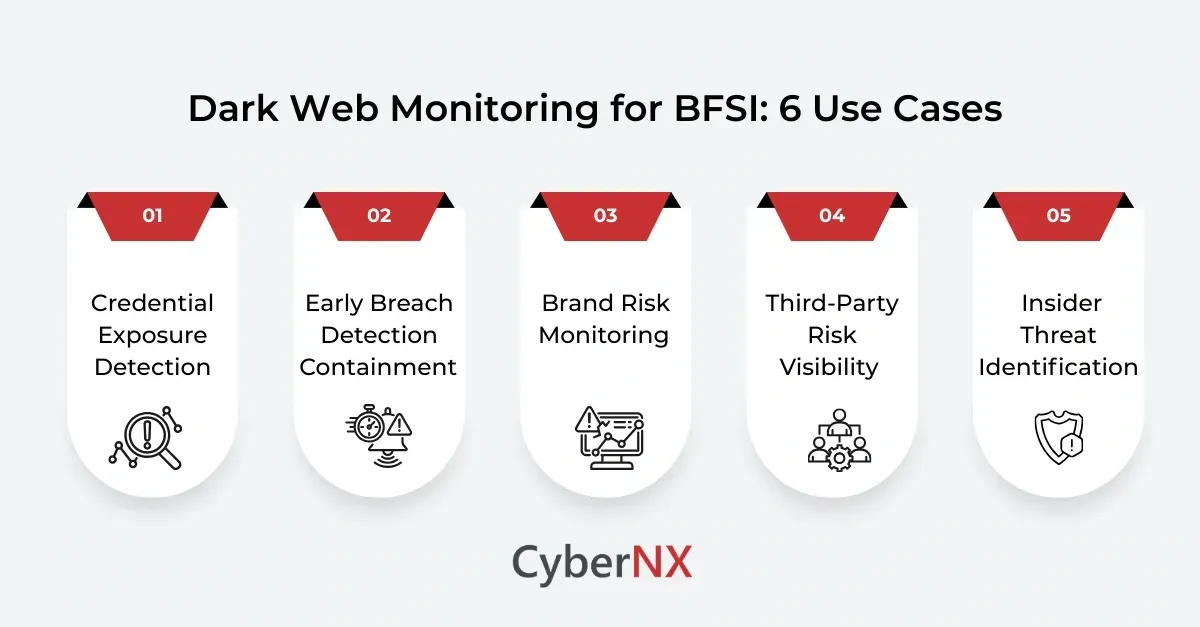
Credential exposure detection and fraud prevention/ Credential exposure detection
Credential theft remains one of the fastest routes to account takeover. Even with strong authentication, exposed usernames and passwords increase fraud risk. When monitoring tools detect employee or customer credentials on the dark web, security teams can:
- Trigger forced password resets
- Enhance monitoring for suspicious transactions
- Flag high risk accounts for step up authentication
- Investigate potential malware infections internally
This proactive move often prevents downstream fraud. We have seen cases where early detection of leaked VPN credentials avoided large scale unauthorised access.
Early breach detection and containment/Early breach containment
Data sometimes appears on dark web forums before organisations realise they have been breached. Dark web monitoring can reveal:
- Mentions of your institution in hacker discussions
- Sample data posted as proof of breach
- Ransom demands shared publicly
- Sale of database access
Such intelligence shortens dwell time. Instead of discovering a breach weeks later through abnormal activity, your team can start investigation immediately. In regulated sectors, faster detection also reduces reporting delays and potential penalties.
Brand protection and executive risk monitoring/Brand risk monitoring
Financial brands carry strong market trust. Criminals exploit that trust through phishing campaigns and impersonation schemes. Monitoring dark web chatter can uncover:
- Fake domains imitating your bank
- Phishing kit sales using your brand
- Targeting discussions involving senior executives
- Planned social engineering campaigns
By linking these findings to fraud and communications teams, organisations can take down malicious infrastructure quickly. For BFSI leaders, this reduces customer impact and reputational fallout.
Third party and supply chain risk visibility/ Third-Party Risk Visibility
Banks depend heavily on fintech partners, payment processors and outsourced service providers. If a third party is compromised, your data may still appear on underground forums. Dark web monitoring can extend to:
- Vendor domains
- Partner employee credentials
- References to shared systems
- Compromised API keys
This insight strengthens third party risk management frameworks. It also supports ongoing due diligence. Many institutions now integrate dark web intelligence into vendor risk scoring models.
Insider threat and data leakage identification/ Insider threat identification
Insider risks are complex. They may involve malicious intent or simple negligence. Monitoring underground platforms can reveal:
- Attempts to sell internal access
- Offers of sensitive internal documents
- Leaked policy or audit reports
When correlated with internal logs, this intelligence supports discreet and lawful investigations. For BFSI institutions handling sensitive financial and identity data, even minor leaks can escalate quickly. Early awareness changes that trajectory.
Regulatory relevance of dark web monitoring for BFSI
Regulators expect financial institutions to demonstrate continuous monitoring, threat awareness and proactive risk mitigation. Dark web monitoring for BFSI directly supports these expectations.
Strengthening compliance with data protection laws
Financial institutions operate under strict data protection regimes such as RBI, SEBI and CERT-In and their respective sector specific guidelines. Also, breach notification timelines are tight. Dark web intelligence can:
- Provide early evidence of data exposure
- Support breach impact assessments
- Demonstrate active monitoring controls
During regulatory reviews, being able to show that your organisation actively scans for leaked data strengthens your position. It signals maturity and shows intent.
Supporting operational resilience frameworks
Many financial regulators now emphasise operational resilience. Institutions must identify critical services and manage severe but plausible scenarios.
Dark Web Monitoring for BFSI feeds into this framework by:
- Identifying emerging attack trends targeting financial services
- Highlighting ransomware groups focusing on banking entities
- Providing intelligence on tools and techniques in circulation
This information informs scenario planning and tabletop exercises. Boards appreciate intelligence grounded in real adversary behaviour.
Enhancing fraud risk governance
Fraud risk is both a compliance and business priority. Regulators scrutinise how institutions detect and prevent account takeover and payment fraud. By integrating dark web alerts into fraud monitoring systems, BFSI organisations can:
- Adjust risk scoring models dynamically
- Prioritise high risk accounts
- Evidence proactive fraud controls to regulators
In audits, this creates a clear narrative. You are not reacting to fraud events. You are anticipating them.
Turning intelligence into action
Collecting dark web data is not enough. It must translate into operational workflows. We advise financial institutions to align dark web monitoring for BFSI with:
- Security operations centres
- Fraud management teams
- Risk and compliance units
- Incident response processes
Clear playbooks matter. When credentials are detected, who acts first. When leaked data is found, how is severity assessed. When executive threats surface, who communicates internally.
Without defined processes, intelligence remains unused. Our experience shows that even modest integration between dark web monitoring and SOC workflows can reduce incident response time significantly.
Measuring the value of dark web monitoring for BFSI
Security investments face scrutiny. Leaders must demonstrate value. Key metrics include:
- Number of exposed credentials identified and remediated
- Reduction in account takeover incidents
- Faster breach detection timelines
- Third party exposure alerts resolved
- Regulatory findings linked to proactive monitoring
Over time, patterns emerge. You begin to see recurring threat actors, common attack paths and frequently targeted business units. That intelligence strengthens strategic planning.
Conclusion
Dark web monitoring for BFSI offers far more than visibility into hidden forums. It provides early warning of credential leaks, emerging fraud campaigns, insider threats and supply chain risks. More importantly, it strengthens regulatory alignment and operational resilience.
For CISOs and risk leaders, the question is not whether threats exist on the dark web. They do. The real question is whether your institution can see them in time.
At CyberNX, we help financial institutions turn dark web intelligence into structured risk reduction. If you want to explore how dark web monitoring services can fit into your security and compliance roadmap, let us start that conversation.
Dark web monitoring for BFSI FAQs
How frequently should financial institutions review dark web intelligence reports?
High risk institutions should review alerts in near real time, with weekly strategic summaries for senior leadership. Monthly reviews are often insufficient for dynamic threat environments.
Does dark web monitoring replace threat intelligence platforms?
No. It complements them. Dark web monitoring focuses on underground exposure and criminal marketplaces, while broader threat intelligence platforms analyse malware trends, vulnerabilities and geopolitical risks.
Can dark web monitoring detect ransomware attacks before encryption occurs?
In some cases, yes. Threat actors may advertise stolen access or leaked data before deploying ransomware widely. Early detection increases containment opportunities.
How does dark web monitoring support internal audit functions?
It provides documented evidence of proactive monitoring, supports control validation and helps auditors assess whether exposure management processes are effective.