In a world where digital threats are surging and cyberattacks are snowballing into monumental disasters, business leaders should care about their brands. It is important to maintain a healthy public perception of your organisation where trust is fragile.
Today, a single phishing campaign, fake website, or social media impersonation can damage years of brand credibility. As a result, your customers could lose confidence, partners would hesitate to continue with your business and internal teams scramble to respond.
Adversaries now love to target brand perception and digital identity as much as infrastructure. This is why brand risk protection has become a strategic cybersecurity priority. You need eyes across domains, social media, dark web marketplaces, and app stores to protect how your brand appears online.
Our experience working with enterprise security teams shows something simple. When organisations actively monitor and respond to brand abuse early, the impact drops dramatically.
This guide explores how brand risk protection works, why it matters in 2026, and how security leaders can build an effective strategy.
What is brand risk protection?
Brand risk protection is a proactive cybersecurity approach focused on monitoring, detecting and mitigating digital threats that misuse an organisation’s brand identity.
Unlike traditional security controls that protect internal systems, brand risk protection focuses on external threat surfaces. These surfaces include:
- Fraudulent domains
- Phishing campaigns
- Fake social media accounts
- Counterfeit mobile apps
- Dark web brand abuse
- Executive impersonation scams
The goal is simple. Detect abuse early and remove it quickly before customers or partners are affected. Brand risk protection therefore combines threat intelligence, digital monitoring, and rapid takedown processes.
Brand risk protection in 2026
Security leaders have always cared about reputation. However, several new trends have elevated brand protection into a core cybersecurity responsibility.
1. AI powered impersonation attacks
Generative AI tools allow attackers to produce realistic phishing pages, brand assets, and fraudulent messages within minutes. Attackers can now clone brand tone, design language, and communication style. This makes fraudulent campaigns harder for users to recognise.
In some cases, deepfake voice technology is also used to impersonate executives during fraud attempts. Brand risk protection platforms monitor these campaigns across the internet and help organisations respond quickly.
2. Expansion of the external attack surface
Digital businesses operate across many channels today:
- SaaS platforms
- Partner ecosystems
- Mobile applications
- Social media communities
Every new channel increases the opportunity for impersonation. For example, a fraudulent social media profile using a company logo can run scams for weeks before detection. Brand monitoring tools help identify these accounts early and trigger takedown actions.
3. Rising financial impact of brand abuse
Brand abuse rarely remains a reputational issue alone. It often leads to direct financial losses.
Common examples include:
- Credential theft from fake login pages
- Payment fraud from fake e commerce websites
- Investment scams using impersonated brands
- Business email compromise using spoofed domains
When customers associate these incidents with the legitimate organisation, trust erodes quickly. Strong brand risk protection helps organisations demonstrate accountability and respond transparently.
Brand risk protection capabilities
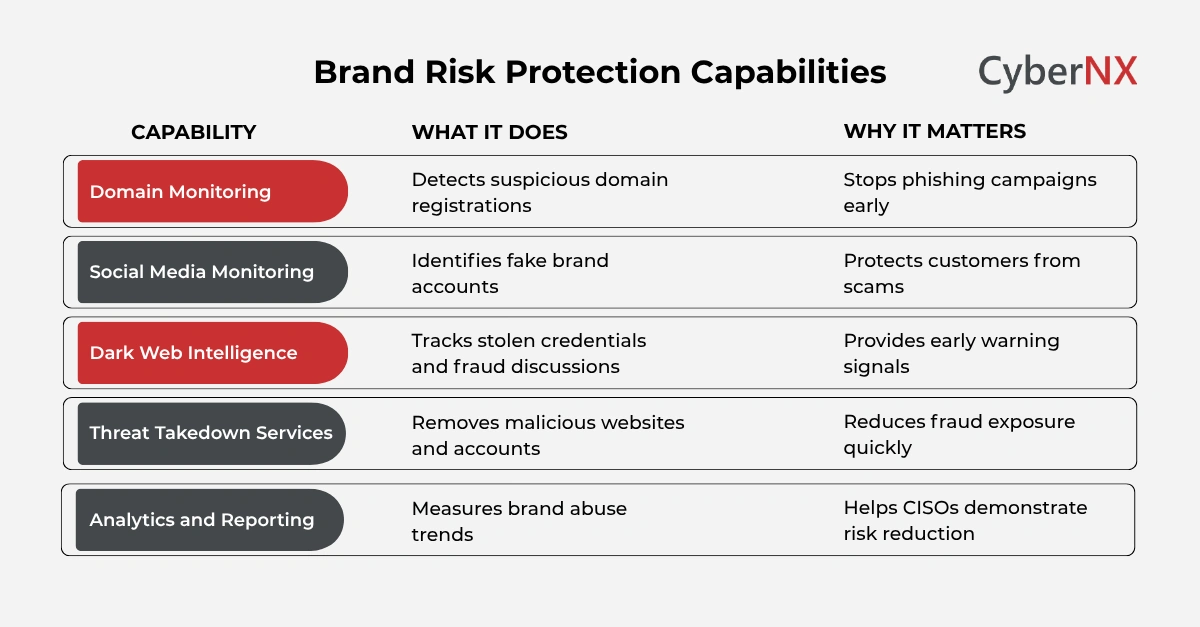
Effective brand protection requires multiple capabilities working together. Security teams should consider the following pillars.
1. Digital asset monitoring
The first step is gaining visibility into how the brand appears across the internet. Security teams monitor:
- Newly registered domains similar to the brand name
- Typosquatting domains
- Fake websites hosting phishing pages
- Social media impersonation accounts
- Mobile apps using brand logos
Early detection significantly reduces the window attackers have to exploit victims.
2. Threat intelligence and dark web monitoring
Threat actors often discuss campaigns or sell phishing kits on underground forums. Monitoring these channels provides valuable intelligence. For example, security teams may detect:
- Stolen credentials linked to the brand
- Fraud campaigns targeting customers
- Sale of fake brand related domains
- Data leaks affecting brand reputation
This intelligence helps organisations prepare responses before attacks escalate.
3. Rapid takedown and incident response
Detection alone is not enough. Response speed matters. Effective brand risk protection programmes include takedown processes for:
- Phishing websites
- Fraudulent domains
- Impersonation accounts
- Malicious mobile apps
The faster these assets disappear, the fewer victims attackers can reach. Our experience with enterprise clients shows a clear pattern. When takedown actions occur within hours instead of days, fraud campaigns lose momentum quickly.
4. Brand abuse analytics and reporting
Security leaders need measurable insights to understand trends. Brand protection platforms provide data such as:
- Number of impersonation attempts detected
- Most targeted regions or industries
- Frequency of phishing domain registrations
- Time taken for takedown actions
These insights help CISOs demonstrate value to executive leadership and improve risk management strategies.
Latest brand protection trends
The evolution of cybercrime means brand protection strategies must keep adapting. Several trends are shaping the next phase of defence.
1. AI driven threat detection
Security platforms are increasingly using machine learning models to identify suspicious brand misuse patterns.
For example:
- Detection of visual similarity in phishing pages
- Analysis of domain registration behaviour
- Identification of coordinated fraud campaigns
AI allows faster identification of threats that traditional monitoring might miss.
2. Integration with security operations centres
Brand abuse monitoring used to operate separately from core cybersecurity teams. In 2026, organisations increasingly integrate brand risk alerts into SOC workflows. This allows security analysts to correlate brand abuse with other indicators such as phishing activity, credential theft, or malware campaigns. The result is stronger situational awareness.
3. Collaboration between security, legal & marketing teams
Brand protection is not purely a cybersecurity issue. Legal teams manage domain disputes and takedown requests. Marketing teams manage brand reputation and public communication.
Leading organisations now run cross functional brand protection programmes where these teams collaborate closely. This coordination ensures faster decisions and consistent messaging during incidents.
Conclusion
Brand reputation is one of the most valuable assets an organisation owns. And without much surprise, it is increasingly targeted by cybercriminals using phishing, impersonation, and fraudulent digital assets. A strong brand risk protection strategy provides the visibility needed to detect abuse early, remove malicious assets quickly, and protect customer trust.
At CyberNX, we combine threat intelligence, continuous monitoring, and rapid response to minimise brand related cyber risks. If your organisation wants to improve its brand protection posture, our experts are ready to support your journey.
Our Digital Risk Protection services help organisations detect impersonation threats, monitor online abuse, and respond quickly before damage spreads. Speak with our cybersecurity specialists today to explore how we can help safeguard your brand reputation.
Brand risk protection FAQs
How is brand risk protection different from traditional cybersecurity?
Traditional cybersecurity focuses on protecting internal systems such as networks, endpoints and applications. Brand risk protection focuses on external threats that misuse a company’s identity, such as phishing websites, fake domains and impersonation accounts.
Which industries face the highest brand impersonation risk?
Financial services, e commerce, healthcare, and technology companies experience high levels of brand impersonation because attackers target organisations with strong customer trust and large user bases.
How quickly should organisations respond to brand impersonation threats?
Ideally within hours. The longer a fraudulent domain or fake account remains active, the greater the risk of financial fraud and reputational damage.
Can brand risk protection prevent phishing attacks completely?
No security control eliminates phishing entirely. However, proactive monitoring and fast takedown significantly reduce the scale and duration of phishing campaigns.