Attack surfaces essentially mean all your digital assets which are exposed and could be targeted by cybercriminals. According to a JupiterOne report, cyber asset inventories grew 133% y-o-y in 2023. That was three years ago. In 2026, you can imagine how exposed your organisation could be with AI adding a new layer of complexity.
Attack surface monitoring helps organisations keep pace with this shift. It provides continuous visibility into both traditional assets and emerging AI-related exposures, helping teams stay ahead of risks before they escalate.
In this guide, we explore every facet of attack surface monitoring and how it can help you in 2026 and beyond.
What is attack surface monitoring?
Attack surface monitoring is proactive process deployed by security teams to continuously identify, analyse, and track all digital assets of an organisation exposed to potential attackers. This includes known systems as well as unknown or unmanaged assets. In addition, there are different types of attack surface monitoring which differ based on the internal and external attack surfaces.
In 2026, it now includes AI integrations, machine learning pipelines, and external data flows that extend beyond traditional infrastructure.
Key characteristics of attack surface monitoring
So, what constitutes attack surface monitoring? Find out below:
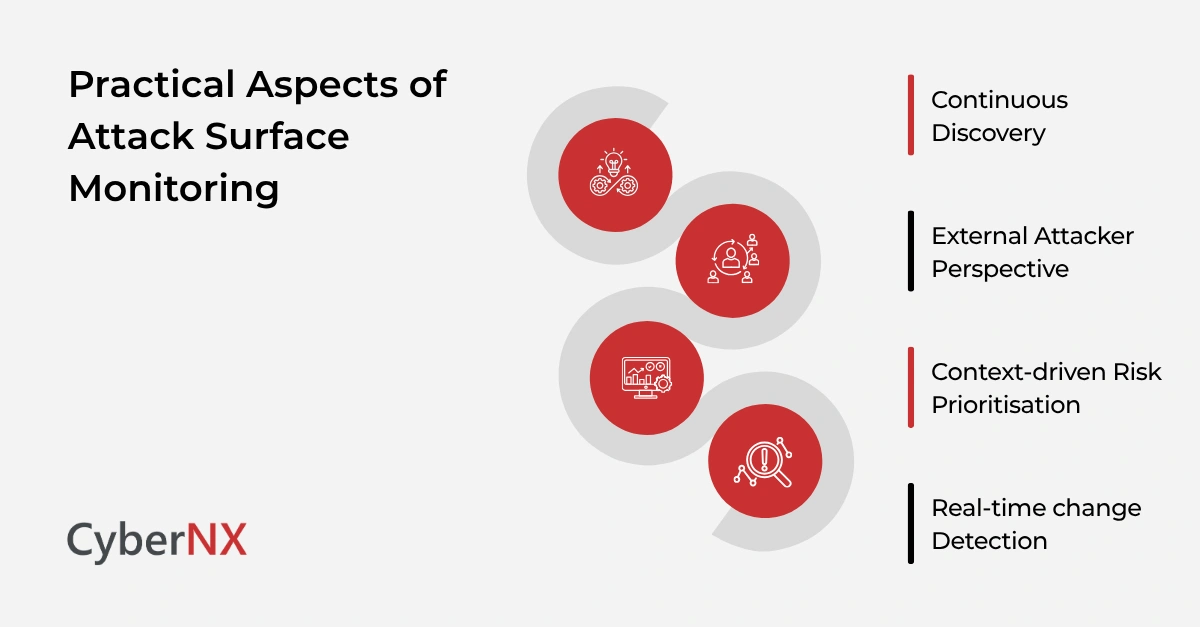
Continuous discovery
Attack surface monitoring continuously scans for assets across cloud, on-premise, SaaS, and AI-driven environments. This includes shadow IT, forgotten domains, and newly deployed AI endpoints.
External attacker perspective
It focuses on what is visible from outside your organisation. This includes exposed APIs, cloud storage, AI interfaces, and publicly accessible services.
Context-driven risk prioritisation
Modern platforms assess risk based on exploitability, business impact, and exposure context. For example, an exposed AI model connected to sensitive data carries higher risk than a test environment.
Real-time change detection
It detects changes as they happen. New assets, configuration changes, or unusual exposure patterns trigger alerts instantly.
In simple terms, attack surface monitoring answers a critical question: what can attackers see today, and how has that changed since yesterday?
Significance of attack surface monitoring in 2026
The urgency around attack surface monitoring has grown due to shifts in technology and attacker behaviour.
AI-driven expansion of attack surfaces
AI is not just a tool. It has emerged as an ecosystem. Organisations now interact with multiple AI services, models, and data pipelines – all of it expanding the attack surface. Each integration introduces new risks such as:
- Unsecured API endpoints
- Data leakage into external AI platforms
- Misconfigured access controls in AI workflows
These exposures are often overlooked in traditional security reviews.
Rapid and decentralised digital growth
Teams deploy resources independently. Developers spin up cloud environments. Marketing teams adopt SaaS platforms. AI tools are integrated without central approval. This decentralisation increases the number of unmanaged assets.
Automated attacker reconnaissance
Attackers now use automation and AI to scan the internet continuously. They identify exposed assets within minutes of deployment. This reduces the window for detection and response.
Expanding regulatory expectations
Regulators now expect organisations to demonstrate continuous visibility. This includes understanding third-party risks, data flows, and external exposures. Attack surface monitoring supports this requirement with real-time insights.
Challenges organisations often face
Even well-funded security teams encounter visibility gaps.
- Hidden AI and SaaS integrations: AI tools are often adopted without security involvement. Employees may connect sensitive datasets to external platforms. These integrations rarely appear in traditional asset inventories.
- Incomplete asset visibility: Organisations struggle to maintain an accurate inventory of internet-facing assets. This includes legacy systems, test environments, and third-party services.
- Overwhelming alert volumes: Security tools generate large volumes of alerts. Without proper context, teams struggle to prioritise effectively.
- Lack of external perspective: Internal security tools focus on known assets. They may miss exposures that are visible to attackers from outside.
The inside workings of attack surface monitoring
An attack surface monitoring process combines discovery, analysis, and continuous tracking, which are explained in detail below:
Asset discovery and relationship mapping
Modern platforms scan the internet to identify assets linked to your organisation. This includes domains, IP ranges, cloud services, SaaS platforms, and AI endpoints. They also map relationships between assets. For example, linking an exposed API to a backend database or AI model. This context helps teams understand potential attack paths.
Exposure and vulnerability analysis
Once assets are identified, they are analysed for risks. This includes:
- Open ports and exposed services
- Misconfigured cloud storage
- Weak authentication mechanisms
- Vulnerabilities in APIs and AI interfaces
Advanced systems also assess how easily an attacker could exploit these issues.
Threat intelligence correlation
Threat intelligence feeds provide additional context. These include:
- Leaked credentials on dark web forums
- Indicators of compromise linked to your assets
- Known attacker infrastructure targeting similar organisations
This helps prioritise risks that are actively being exploited.
Continuous monitoring and adaptive alerts
Attack surface monitoring tracks changes in real time. If a new AI integration is deployed or a cloud configuration changes, alerts are generated immediately. Modern solutions reduce noise by focusing on high-impact changes.
How attack surface monitoring benefits security
A strong monitoring strategy delivers both security and operational value.
- Unified visibility across environments: You gain a consolidated view of all external assets, including AI integrations and third-party services. This eliminates blind spots.
- Reduced time to detect exposure: Continuous monitoring ensures that exposures are identified quickly. This reduces the time attackers have to exploit vulnerabilities.
- Smarter prioritisation: Risk scoring helps teams focus on what matters most. This improves efficiency and reduces alert fatigue.
- Stronger protection against emerging threats: By identifying new exposure types, including AI-related risks, organisations can adapt their security strategies proactively.
It is important that organisations should opt for an advanced and efficient attack surface monitoring tool in 2026 to achieve the set objectives and gain maximum value of it.
Trends shaping attack surface monitoring
Attack surface monitoring is evolving rapidly to meet new challenges.
Convergence with exposure management platforms
Attack surface monitoring is now part of broader exposure management strategies. These platforms combine asset discovery, vulnerability management, and risk prioritisation into a single view.
AI-powered risk analysis and automation
AI is being used defensively to analyse patterns, prioritise risks, and reduce false positives. This helps security teams focus on meaningful threats.
Increased focus on AI and data exposure
Organisations are beginning to monitor how data interacts with AI systems. This includes tracking data flows into external models and identifying potential leakage points.
Third-party and supply chain visibility
Vendors and partners introduce additional risks. Attack surface monitoring now extends to third-party ecosystems.
Implementing attack surface monitoring: best practices to know
A structured approach ensures better outcomes.
- Build a dynamic asset inventory: Start by identifying all external assets. Ensure this inventory updates continuously as new assets are created. Include AI integrations, APIs, and third-party services.
- Prioritise based on business impact: Not all exposures carry the same risk. Focus on assets that handle sensitive data or support critical operations.
- Integrate with security workflows: Connect attack surface monitoring with your SIEM, SOAR, and incident response processes. This ensures faster action.
- Establish ownership and accountability: Assign clear responsibility for different asset categories. This improves response times and reduces confusion.
- Continuously validate and refine: Regularly review your monitoring strategy. As your environment evolves, your approach should adapt.
Conclusion
Attack surface monitoring has become a foundational capability for enterprise security in 2026. As environments expand and AI adoption accelerates, visibility challenges continue to grow.
Without continuous monitoring, organisations risk missing critical exposures. By adopting a modern approach to attack surface monitoring, security teams can stay ahead of emerging threats, reduce risk, and maintain control over their digital footprint.
Want to understand your real attack surface, including hidden AI risks? Connect with CyberNX for a digital risk protection consultation. Our experts will help you uncover exposures, prioritise risks, and build a stronger, more adaptive security strategy.
Attack surface monitoring FAQs
How does attack surface monitoring address AI-related risks?
It identifies exposed AI endpoints, tracks data flows, and highlights misconfigurations that could lead to data leakage or unauthorised access.
Can attack surface monitoring detect data exposure in third-party AI tools?
Yes. Advanced solutions can identify connections between internal systems and external AI platforms, helping detect potential data leakage.
How quickly can new assets be detected?
Most modern solutions detect new assets within minutes or hours, depending on scanning frequency and integration depth.
Is attack surface monitoring relevant for multi-cloud environments?
Yes. It is especially valuable for multi-cloud setups where visibility is often fragmented across platforms.