In 2024, the National Institute of Standards and Technology (NIST) finalised its first set of post-quantum cryptography standards, including ML-KEM and ML-DSA. That milestone has basically reset the clock for every bank or payment platform still using RSA and ECC based encryption.
In May 2026, the Reserve Bank of India moved further and formed its Q-SAFE expert committee to examine quantum risk across the financial system – including cryptographic inventories and crypto agility readiness.
For CTOs and CISOs, this is an urgent problem. Mobile banking apps, core banking systems and payment rails already depend on cryptography for authentication and encryption. Crypto agility and CBOM together give firms the visibility to respond before regulation forces them to do a rushed migration. This guide breaks down what both the terms mean, why BFSI leaders need them now and how to start building a practical roadmap.
What crypto agility and CBOM actually mean
A Cryptographic Bill of Materials is a structured list of every cryptographic asset a company depends on. This includes certificates, keys, algorithms, protocols and libraries, mapped across applications, cloud environments and hardware security modules.
Crypto agility is the operational capability built on top of that list. It is the ability to rotate keys, retire outdated algorithms and adopt new standards, without redesigning core systems each time.
You can think of a CBOM as the map and crypto agility as the ability to change route quickly. One without the other leaves gaps. A detailed inventory with no agility still leaves systems exposed once a weakness surfaces. Agility without an inventory means teams are reacting blind and are unsure which systems even need attention.
Why crypto agility and CBOM matter for BFSI in India
RBI Advisory No.11/2024, along with CERT-In Technical Guidelines Version 2.0, reinforces the need for maintaining documented cryptographic inventories. The RBI’s Q-SAFE committee is also testing the financial sector’s crypto agility and cryptographic inventory directly.
A few forces are converging at once:
- Regulatory expectation: RBI and CERT-In guidance treats a documented CBOM as baseline audit evidence, not an optional exercise.
- Harvest now, decrypt later risk: Adversaries can capture encrypted data today and decrypt it once quantum computing matures, making long-lived financial data a priority target.
- Vendor and third-party exposure: Core banking vendors, HSM providers and payment gateways all need to demonstrate their own PQC roadmaps, and BFSI firms need visibility into that dependency chain.
- Scale of legacy systems: Most banking infrastructure predates 2023 and was never designed with post-quantum algorithms in mind, according to industry readiness assessments from global risk advisories.
Industry estimates suggest a meaningful share of enterprise encrypted data today depends on algorithms considered “quantum-vulnerable”. That gap is exactly what a CBOM is designed to close.
Building a CBOM: Where to start
Getting to a usable CBOM does not need you to fully rebuild on day one. A phased approach keeps the effort manageable while giving auditors and boards something concrete to review early.
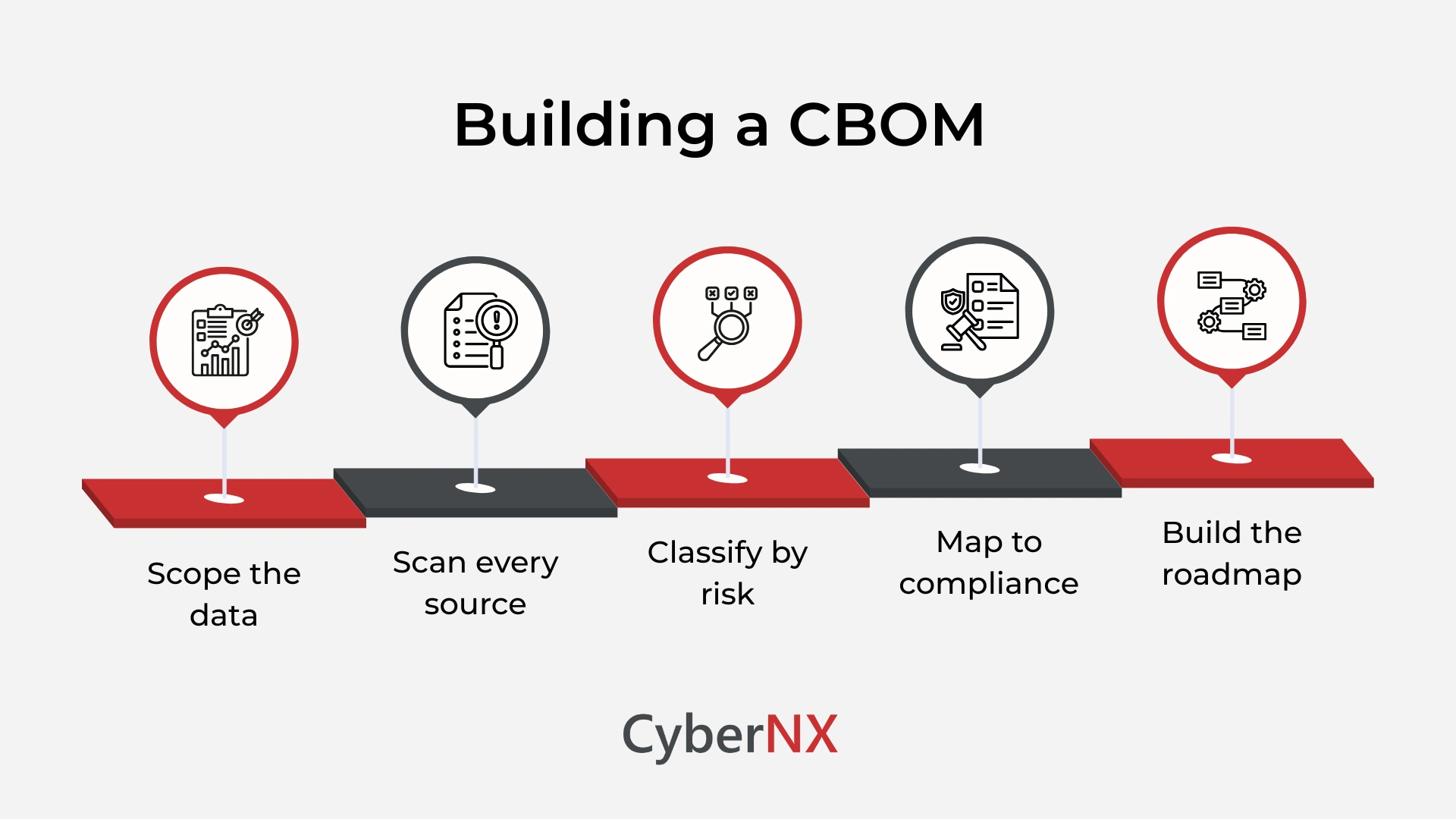
- Scope the inventory: Start with mobile banking apps, core banking platforms and payment systems, since these carry the highest regulatory and customer trust exposure.
- Scan across every source: Combine network scans, source code analysis, build artifact scanning and HSM or key management system integration to avoid blind spots.
- Classify by risk level: Tag each cryptographic asset as critical, high, medium or low risk based on what it protects and how exposed it is.
- Map to compliance requirements: Align findings against RBI Advisory 11/2024, CERT-In Technical Guidelines v2.0 and relevant international standards like those from CycloneDX, an OWASP-backed standard for representing cryptographic assets.
- Build the crypto agility roadmap: Turn the inventory into a phased plan for algorithm updates, key rotation and eventual migration to post-quantum cryptography for the highest risk use cases.
Making crypto agility work in practice
A CBOM answers “what do we have.” Crypto agility answers “how fast can we change it.” Building that capability involves a few practical shifts:
- Centralising key management instead of leaving keys scattered across code, cloud services and third-party libraries.
- Setting rotation schedules for encryption keys tied to risk classification, not just calendar convenience.
- Running quantum-vulnerable algorithm checks as part of regular security assessments, not a one-time project.
- Building vendor accountability into contracts, so payment partners disclose their own PQC timelines.
None of this needs to happen overnight. Global regulatory roadmaps, including the EU’s coordinated PQC timeline, point toward critical system migration by 2030, giving BFSI firms a realistic runway if planning starts now.
Conclusion
Crypto agility and CBOM are no longer separate technical exercises. For BFSI organisations, they form one connected discipline: know what cryptographic assets exist, then build the capability to change them quickly as threats and regulations evolve. With RBI’s Q-SAFE committee actively testing sector readiness, the organisations that start building their CBOM and crypto agility roadmap now will face a far smoother compliance path than those that wait.
CyberNX helps BFSI and regulated firms build audit-ready crypto agility and CBOM programs through NXRadar. It helps to map findings directly to RBI Advisory 11/2024 and CERT-In Technical Guidelines v2.0. Connect with our experts to understand what our CBOM solutions offer, assess where your cryptographic inventory stands today and get customised plans according to your needs.
Crypto Agility and CBOM FAQs
What is the difference between a CBOM and an SBOM?
A Software Bill of Materials lists the software components and dependencies in an application. A Cryptographic Bill of Materials focuses specifically on cryptographic assets – keys, certificates and algorithms, used across those same systems.
Is a CBOM mandatory for Indian BFSI entities?
RBI Advisory No. 11/2024 references CERT-In Technical Guidelines v2.0, which call for a documented cryptographic inventory for regulated entities and critical infrastructure operators. The RBI’s Q-SAFE committee is actively reviewing sector-wide crypto agility and CBOM readiness as part of its quantum risk assessment.
How does crypto agility relate to post-quantum cryptography?
Crypto agility is the operational capability that makes post-quantum cryptography migration possible without disruption. It allows an organisation to swap vulnerable algorithms like RSA and ECC for NIST-approved post-quantum alternatives as they become production-ready.
How long does building a CBOM typically take?
Timelines vary by organisation size and system complexity. A scoped CBOM covering priority applications like mobile banking or payment platforms, can often be completed in weeks when built on automated multi-source scanning rather than manual audits.