CERT-In’s Technical Guidelines v2.0 have already put the cryptographic bill of materials on the compliance map for Indian entities, introducing detailed guidelines for CBOM and QBOM under Section 8. For Indian BFSI organisations, the cryptographic inventory once treated as internal hygiene is turning into something regulators will ask for directly, and the vendor you choose to build it – will matter for years.
A cryptographic bill of materials lists out every algorithm, key and certificate running inside your systems. That catalogue is only as useful as the provider who builds and maintains it. This guide covers what a CBOM vendor actually does, why the choice matters for Indian BFSI in 2026, and the criteria that separate a dependable partner from a one-time scan.
What does a CBOM vendor do?
A CBOM vendor scans source code, containers, cloud infrastructure and sometimes runtime environments to produce a structured inventory of cryptographic assets. This includes algorithms, key lengths, certificate chains, protocols and the libraries implementing them. Most CBOM tools build on CycloneDX, the OWASP-backed bill of materials standard now published as ECMA-424, or SPDX, so the output works with SBOM tooling organisations already run.
The value is much more than just some simple documentation. A capable CBOM vendor flags quantum-vulnerable algorithms like RSA and ECC, maps them to the systems that depend on them and supports a phased post-quantum cryptography migration plan.
Why CBOM vendor selection matters for Indian BFSI in 2026
CERT-In’s Technical Guidelines v2.0 formalise CBOM and QBOM (quantum bill of materials) under Section 8, extending the SBOM model to cryptographic assets and quantum readiness. The Department of Science and Technology’s Task Force recommends phased adoption of CBOMs that includes vendor CBOM submissions beginning from FY 2027-28 under the National Quantum Mission.
SEBI’s CSCRF framework does not mandate a CBOM today, but it emphasizes on strong software and cryptographic asset visibility as part of cyber resilience. RBI has not issued an explicit standalone PQC mandate. Its broader Master Direction and vendor risk expectations still push regulated entities toward stronger cryptographic asset governance.
What to look for in a CBOM vendor
A CBOM vendor evaluation should go beyond a feature checklist. Consider these criteria before choosing a partner:
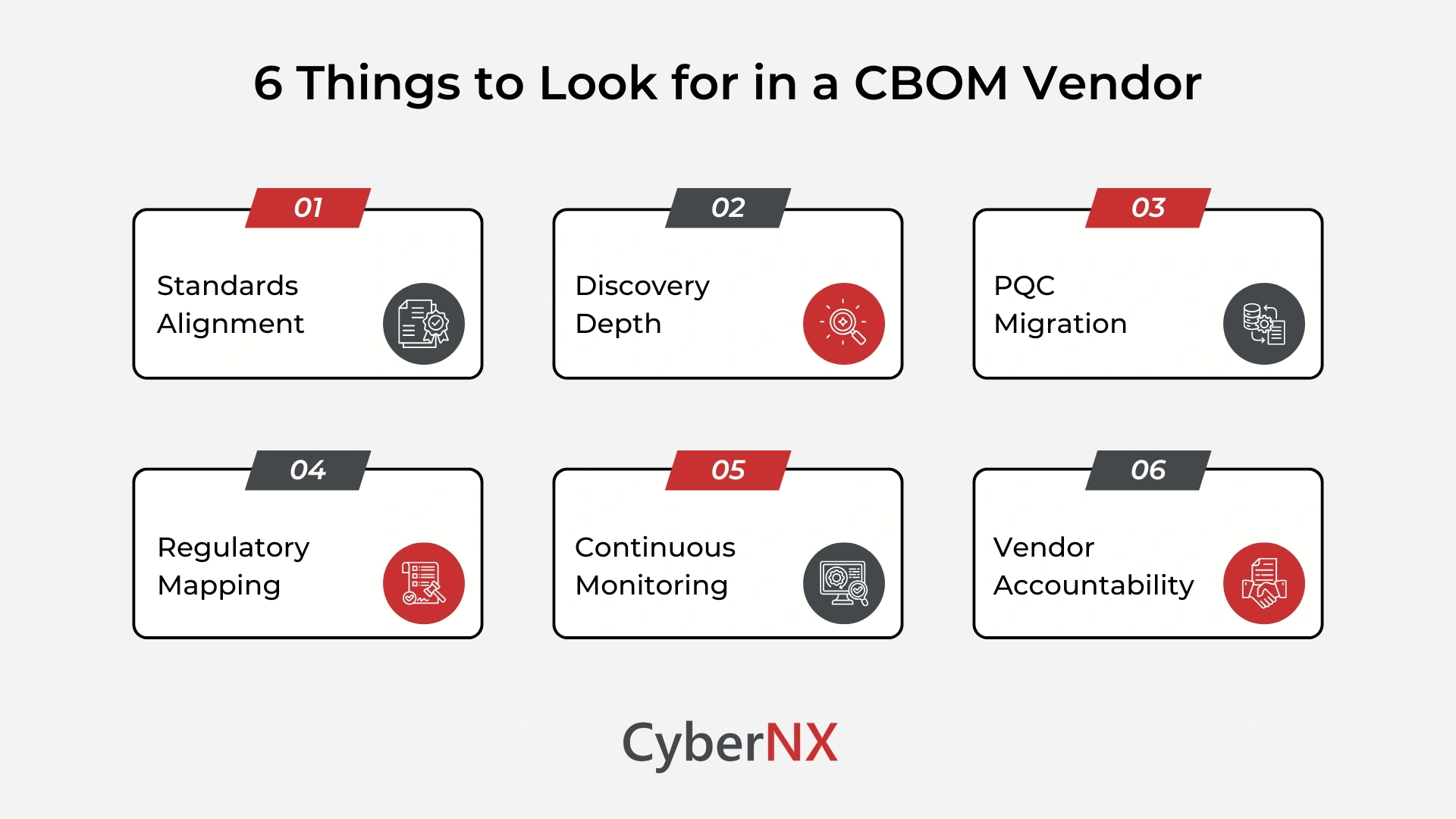
Standards alignment
Confirm that the tools generate CycloneDX (ECMA-424) output. A CBOM built on an open standard works with the SBOM pipelines and registries an organisation already runs, and it stays portable if the tooling changes later. Proprietary formats can lock an organisation into a single vendor’s dashboard, which becomes a problem the moment you need the raw data.
Discovery depth
Look for scanning across source code, dependencies, containers and cloud. Cryptography shows up in places a surface scan might miss: hardcoded keys in configuration files or certificates issued outside a central registry. A provider that only scans source code will miss a large share of an organisation’s real cryptographic footprint.
PQC migration mapping
A strong provider flags quantum-vulnerable algorithms like RSA and ECC and links each one to a realistic migration roadmap. This should include which systems depend on a given algorithm, how sensitive the data behind it is, and a sequence for replacement that understands operational risk – instead of flagging everything as equally urgent.
Regulatory mapping
The provider should translate findings against CERT-In, SEBI CSCRF and RBI expectations, producing evidence an auditor will accept. For BFSI entities, this means the CBOM output should map cleanly to the cryptographic asset inventory expectations already referenced in CSCRF FAQs, and it should be exportable in a form an IT committee or cyber audit can use directly.
Continuous monitoring
Cryptographic inventories change with every release, every certificate renewal and every new cloud service. Choose a solution that integrates with CI/CD and re-scans automatically. A CBOM that is not continuously updated becomes inaccurate very fast.
Vendor accountability
For third-party crypto services, cloud key management providers and embedded components, ask if the vendor supports supplier attestations, similar to SBOM practices already in place. An organisation’s own CBOM is only as complete as the cryptographic disclosures its suppliers are willing to provide, so vendor contracts should build this expectation in from the start.
Conclusion
A CBOM vendor decision shapes how ready a BFSI organisation is for CERT-In, SEBI CSCRF and eventual RBI expectations around cryptographic asset governance. Standards alignment, discovery depth, PQC migration mapping and regulatory reporting should carry more weight than a features list. NXRadar brings these together for Indian BFSI teams who are building their cryptographic inventory ahead of the compliance curve. Connect with our experts and check out our vendor solutions to see how they fit your regulatory roadmap.
CBOM Vendor FAQs
What is a CBOM vendor?
A CBOM vendor is a provider of tools or platforms that generate and maintain a cryptographic bill of materials, inventorying algorithms, keys, certificates and protocols across an organisation’s systems.
Is a CBOM mandatory for SEBI regulated entities?
Not yet as a standalone requirement. CSCRF’s cryptographic asset inventory and PQC prioritisation expectations create strong grounds to build one ahead of formal mandates.
How is a CBOM different from an SBOM
An SBOM lists software components and dependencies. A CBOM focuses specifically on cryptographic assets, including algorithms, keys and certificates, often using recognised BOM formats like CycloneDX or SPDX.
When should a BFSI organisation start CBOM vendor evaluation?
Now. The DST Task Force’s recommends introducing CBOM submissions from FY 2027-28, and cryptographic discovery is typically the slowest phase of any inventory project.