All three vendors (CrowdStrike Falcon, SentinelOne Singularity and Microsoft Defender for Endpoint) land in the Leaders quadrant of Gartner’s Magic Quadrant for Endpoint Protection Platforms heading into 2026, which makes it difficult for decision-makers to make the choice. We are here to help you based on our hands-on experience.
At CyberNX, we have deployed and managed all three platforms across Indian enterprises. Therefore, we aim to give you a better framework to understand the CrowdStrike vs SentinelOne vs Microsoft reality and then decide.
What is attacking Indian enterprises right now?
Before comparing platforms, you need to understand what you are defending against. Because the threat profile in India is specific and it changes which platform capabilities can make real difference.
India is now the most ransomware-targeted country in the Asia-Pacific region. Incidents rose 165% year on year in Q1 2026, according to Cyble’s Asia and Pacific Threat Landscape Report.
| Sector | Primary threats | What this means for your EDR choice |
| BFSI | Credential harvesting, deepfake fraud, supply chain intrusions | Identity correlation and named-adversary tracking matter most |
| Healthcare | Ransomware, double extortion, legacy system exploits | Autonomous rollback and offline protection become critical |
| Manufacturing | OT/IT convergence attacks, SCADA exploitation | OT/IoT coverage and air-gapped environment support are key |
| IT/GCC | APT campaigns, DLL sideloading, insider threats | Behavioural detection depth and cross-platform parity are essential |
The global MITRE ATT&CK benchmark is a useful signal. But it tests against simulated adversaries in a lab and does not test against ransomware groups running spray-and-pray campaigns against Indian manufacturers, or credential attacks targeting wealth management platforms in Mumbai. Keep that in mind as you evaluate.
Does your team have the skills to run what you are buying?
Only 7% of organisations in India have achieved a mature level of cybersecurity readiness, according to Cisco’s 2025 Cybersecurity Readiness Index. Most security teams are stretched, and analyst capacity is limited. And the platform that looks best on paper can become a liability if your team cannot operate it effectively.
Here is how the three platforms behave in lean SOC environments:
| Platform | What it demands from your team | What happens when that demand is not met |
| CrowdStrike Falcon | Tier 2/3 analyst capability to act on high-fidelity alerts; or OverWatch MDR to fill the gap | Alerts go uninvestigated; threat intelligence depth goes unused |
| SentinelOne Singularity | Lighter analyst load; autonomous response handles containment without human input | Less of an issue — the platform is designed for lean teams |
| Microsoft Defender | Significant tuning time upfront; KQL query skills for effective hunting | High false-positive volume; analysts get buried before tuning is complete |
What CrowdStrike’s OverWatch changes
If your team does not have Tier 2 depth today, that does not rule out CrowdStrike. Its OverWatch managed threat hunting service provides 24/7 proactive hunting inside your telemetry. For many of our BFSI clients, OverWatch effectively becomes an extension of their SOC, covering the analyst capacity they do not have in-house. That changes the comparison significantly.
SentinelOne’s autonomous Storyline correlation reduces raw alert volume which is a genuine advantage for teams managing a high-ticket load. Defender rewards investment but it requires that investment first.
How each platform maps to compliance obligations
Indian enterprises are answering to CERT-In, the Reserve Bank of India (RBI), the Securities and Exchange Board of India (SEBI) and the Digital Personal Data Protection Act (DPDPA). As a result, your EDR platform needs to support those obligations, not create gaps in them.
| Compliance requirement | CrowdStrike | SentinelOne | Microsoft Defender |
| CERT-In 6-hour breach reporting | Strong — real-time telemetry and rapid incident timeline construction | Strong — Storyline compresses investigation time significantly | Moderate — requires tuning and Sentinel integration for full pipeline |
| DPDPA data residency | Cloud processing; review data sovereignty terms carefully | Cloud processing; review data sovereignty terms carefully | Azure data centres with India region options; stronger residency story for M365 clients |
| RBI cybersecurity framework | Falcon Identity covers Active Directory and credential abuse well | Identity module less mature; credential baselining has gaps | Strong for M365-integrated environments; weaker for non-Microsoft identity stacks |
| SEBI CSCRF audit trail requirements | Detailed telemetry and forensic depth; well-suited to SEBI audit requirements | Good telemetry; data retention configurable | Requires Sentinel integration for full retention coverage |
If you are a BFSI organisation with RBI obligations and an Active Directory-heavy environment, CrowdStrike’s identity correlation gives you coverage that directly maps to how credential-based attacks actually unfold in your sector.
A practical architecture for Indian enterprises
Here is what we recommend to clients who are trying to make sense of this choice: stop thinking about one platform for every endpoint. Think in layers.
The tiered model that works in practice
A growing number of Indian enterprises – particularly large BFSI organisations and conglomerates – run a dual-vendor architecture. Defender for Endpoint is deployed across the general fleet where M365 E5 already provides it. CrowdStrike is layered on crown-jewel assets: domain controllers, critical servers, treasury workstations and senior leadership endpoints.
This approach delivers vendor concentration risk reduction at roughly 45% the cost of an all-CrowdStrike deployment. The trade-off is two consoles to manage. That trade-off is worth it for organisations with the SOC maturity to run both.
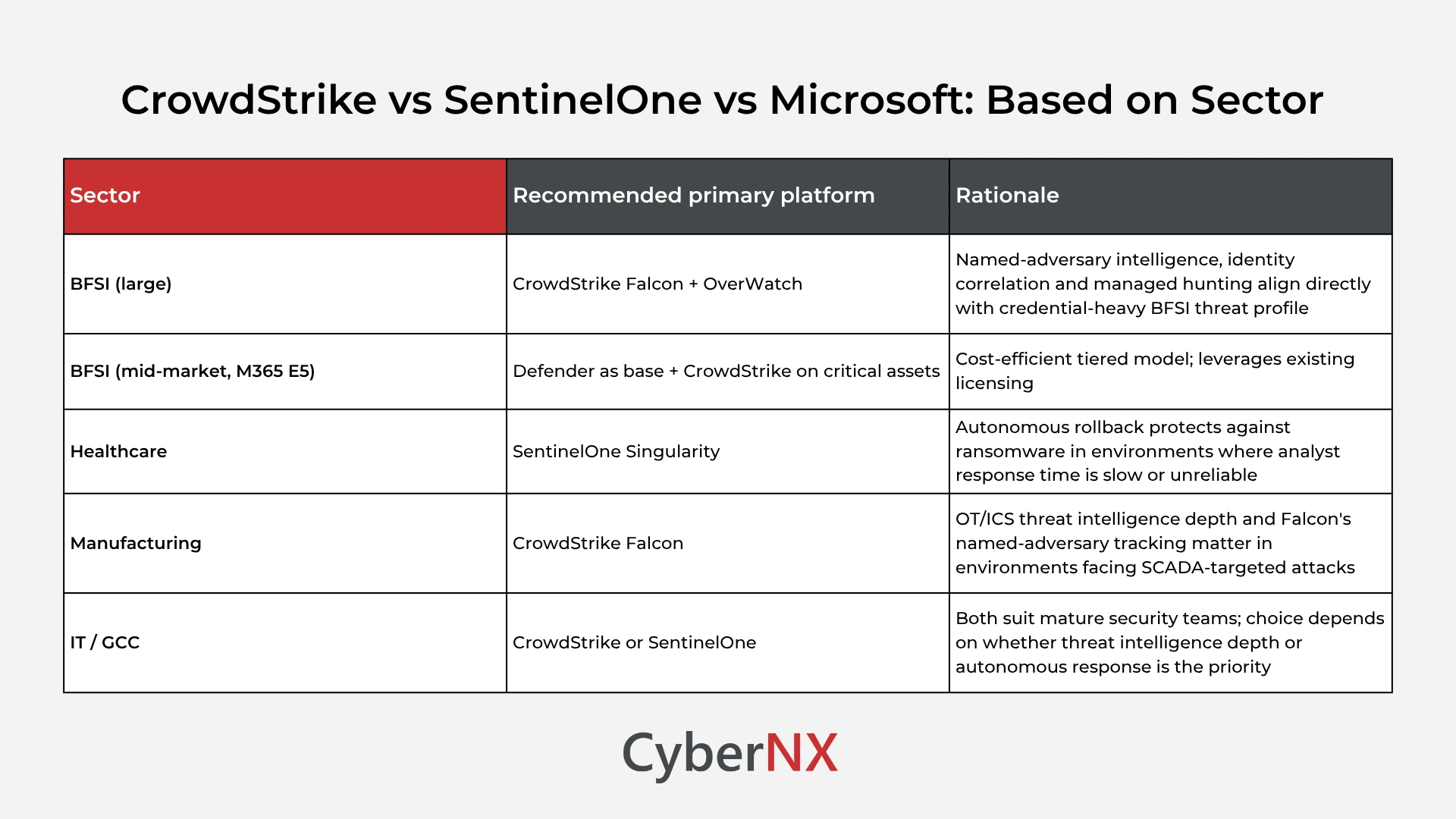
Sector-level recommendations
Conclusion
The right choice between CrowdStrike, SentinelOne and Microsoft Defender is specific to your threat exposure, your team’s capacity, compliance obligations and your existing technology stack. What we have seen across Indian enterprises is that the organisations that get this right start with an honest assessment of where they actually stand.
At CyberNX, our managed SOC team has hands-on experience deploying and operating all three platforms across BFSI, healthcare and manufacturing environments in India. We can help you assess your current posture, identify the right architecture for your environment and manage the platform once it is in place. In addition, we offer CrowdStrike Consulting services too. Ready to make the right call for your organisation? Talk to our experts.
CrowdStrike vs SentinelOne vs Microsoft Defender FAQs
Which EDR platform is best for Indian BFSI organisations?
For large BFSI organisations, CrowdStrike Falcon with OverWatch is the strongest fit. Its identity correlation, named-adversary intelligence and managed threat hunting address the specific vectors – credential abuse, supply chain intrusions and targeted attacks – that dominate the Indian BFSI threat landscape. Mid-market BFSI organisations on M365 E5 can achieve strong protection with a tiered Defender-plus-CrowdStrike architecture at lower total cost.
Does Microsoft Defender work without a dedicated security team?
Not well. Defender produces high false-positive volume in complex environments out of the box and requires significant tuning to reach useful signal quality. Without a team capable of writing KQL queries and managing detections, the platform is unlikely to deliver the protection it promises. Pairing it with a managed SOC service substantially changes that equation.
How does CrowdStrike OverWatch help organisations without a full in-house SOC?
OverWatch is CrowdStrike’s 24/7 managed threat hunting team that actively hunts inside your telemetry – not just responding to alerts but looking for threats that have not yet triggered one. For Indian enterprises that cannot staff a Tier 3 analyst function in-house, it effectively bridges that gap without requiring you to build the capability yourself.
Is SentinelOne the right choice if ransomware is my biggest concern?
If ransomware is your primary threat and your SOC has limited capacity for rapid manual response, SentinelOne’s one-click autonomous rollback is a genuine differentiator. It reverses encryption using volume shadow copy snapshots without requiring cloud connectivity or human approval. No other platform in this comparison automates ransomware recovery at the same level.