This blog is part of our ongoing series on CrowdStrike NG-SIEM, where we unpack how modern security teams can extract more value from their security stack.
Traditional SIEM platforms were built in a different era. They focused on centralising logs from firewalls, servers and endpoints. At that time, data volumes were manageable and cloud was limited. Today, environments are hybrid. Users work from anywhere, applications live across SaaS and IaaS plus data flows constantly. Traditional SIEM tools struggle under this weight.
Before exploring CrowdStrike NG-SIEM vs Traditional SIEM in depth, we need to understand the pain points security teams face.
Why traditional SIEM models are struggling
Here are the 3 key reason why old SIEM models are not effective anymore:
1. High data ingestion costs
Legacy SIEM pricing often depends on data volume. As log data grows, so do costs. Teams are forced to filter logs aggressively. This creates blind spots. Security leaders often ask us whether they are seeing everything. In many cases, the answer is uncomfortable.
2. Alert fatigue and limited context
Traditional SIEM platforms rely heavily on correlation rules. These rules generate alerts based on predefined logic. However, attackers do not follow fixed patterns. As a result, analysts receive thousands of alerts daily. Many lack context. Investigations take longer. Mean time to respond increases.
3. Complex infrastructure management
On-prem SIEM solutions require hardware, storage, tuning and constant maintenance. Even cloud hosted variants demand significant configuration effort. SOC teams spend time managing the tool instead of focusing on threats.
What makes CrowdStrike NG-SIEM Different
When assessing CrowdStrike NG-SIEM, the shift is architectural, operational and strategic. It is built natively in the cloud and tightly integrated with endpoint, identity and threat intelligence capabilities within the CrowdStrike ecosystem. For example, it integrates seamlessly with CrowdStrike Falcon platform. This changes how detection and response work.
1. Cloud-native architecture at scale
Traditional SIEM tools were retrofitted for cloud. CrowdStrike NG-SIEM is designed for it. Because it runs on a cloud-native architecture, it scales elastically. You do not need to plan hardware capacity years in advance. Storage and compute scale as required. This flexibility reduces operational overhead. It also aligns with how modern enterprises operate.
2. Unified telemetry and deeper context
One of the most important aspects is telemetry depth. Traditional SIEM aggregates logs from multiple tools. Context often remains fragmented.
CrowdStrike NG-SIEM unifies endpoint telemetry from the Falcon platform with third-party data sources. This provides enriched context across users, devices and workloads. The difference is subtle but powerful. Analysts do not just see an IP address. They see behaviour, process lineage and threat intelligence in one view.
3. AI-driven detection and threat intelligence
Legacy SIEM depends heavily on manual rule creation. That requires constant tuning. CrowdStrike NG-SIEM leverages AI models and threat intelligence derived from real-world adversary activity. This improves detection fidelity.
4. Faster investigation and response workflows
Security teams measure success through metrics like mean time to detect and mean time to respond. In the CrowdStrike NG-SIEM vs Traditional SIEM debate, response capability is a major differentiator.
CrowdStrike integrates detection with response actions. Analysts can isolate endpoints, investigate process trees and pivot across datasets without switching consoles. Traditional SIEM tools often require integration with separate SOAR platforms to achieve similar outcomes. This increases complexity.
Operational impact for security leaders
For CISOs and IT heads, the CrowdStrike NG-SIEM vs Traditional SIEM discussion is not about features alone. It is about outcomes. Let us examine the strategic implications.
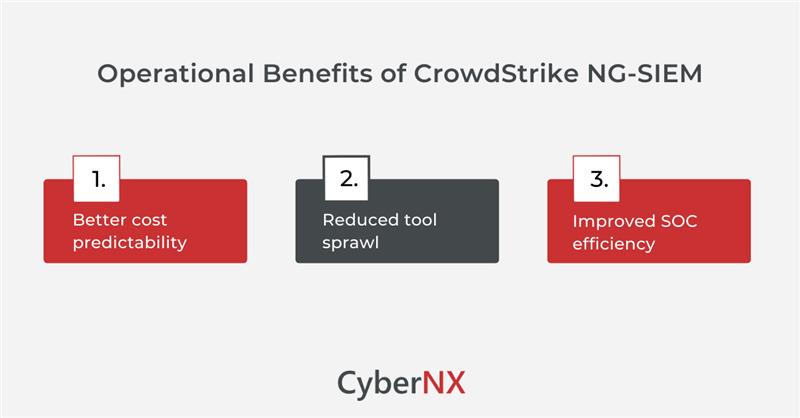
1. Better cost predictability
Data ingestion models in legacy SIEM often lead to unpredictable costs. Organisations reduce logging to control budgets. This weakens visibility.
CrowdStrike NG-SIEM offers flexible ingestion and storage options. This allows leaders to align costs with risk priorities rather than raw log volume. Our experience shows that small changes in logging strategy can significantly improve both visibility and cost efficiency.
2. Reduced tool sprawl
Many enterprises operate multiple point solutions. Logs flow into SIEM. Alerts trigger SOAR. Endpoint tools sit separately.
With CrowdStrike NG-SIEM, detection and response converge more tightly within a unified platform. This reduces integration gaps. Fewer tools often mean fewer misconfigurations.
3. Improved SOC efficiency
Alert fatigue remains one of the biggest frustrations among SOC analysts. By combining behavioural analytics with global threat intelligence, CrowdStrike NG-SIEM aims to reduce noise. Analysts focus on high-confidence alerts. This improves morale. It also improves retention, which is a growing concern across cybersecurity teams.
A practical comparison
When we advise clients, we avoid theory and focus on operational reality. Here is how the comparison typically plays out in enterprise environments.
1. Deployment speed
Traditional SIEM deployments can take months. Hardware procurement, log onboarding and rule tuning require sustained effort. CrowdStrike NG-SIEM, being cloud-native, accelerates deployment timelines. Integration with existing CrowdStrike agents simplifies data ingestion. For organisations already using CrowdStrike Falcon, this transition can be smoother.
2. Threat hunting capabilities
Threat hunting in legacy SIEM often requires complex queries across large datasets. Performance can degrade with scale. CrowdStrike NG-SIEM provides high-performance search across unified telemetry. Hunters can pivot quickly between endpoints, identities and cloud workloads. This supports proactive detection, not just reactive alert handling.
3. Board-level reporting
Security leaders need to communicate risk clearly to the board.
Traditional SIEM dashboards often focus on technical metrics. Translating them into business risk requires additional work. CrowdStrike NG-SIEM aligns detections with adversary tactics and threat intelligence. This makes reporting more contextual and business-focused.
Key trends driving the shift
The CrowdStrike NG-SIEM vs Traditional SIEM discussion is also shaped by broader industry trends.
- Cloud adoption continues to grow. Remote work remains common. Attackers increasingly target identity and cloud workloads.
- Continued consolidation is the trend now in security platforms, with organisations preferring integrated solutions over fragmented stacks. This reflects a desire for simplicity and visibility.
Security leaders are asking a simple question. Can our current SIEM keep pace with modern threats? If the answer is uncertain, it may be time to evaluate next-generation approaches.
Conclusion
The debate around CrowdStrike NG-SIEM and traditional SIEM is not just about technology. It reflects a shift in how security operations must function.
Traditional SIEM platforms centralised logs. CrowdStrike NG-SIEM aims to unify telemetry, intelligence and response in one cloud-native ecosystem. For modern security teams facing alert fatigue, skill shortages and evolving threats, this shift can improve speed, clarity and resilience.
If you are exploring your next SIEM strategy, our experts at can help you evaluate CrowdStrike NG-SIEM in the context of your environment. Let us assess your current state and build a roadmap that supports your growth securely. Connect with for a CrowdStrike consulting today.
CrowdStrike NG-SIEM vs Traditional SIEM FAQs
1. Can CrowdStrike NG-SIEM replace an existing SIEM completely?
In many cases, yes. However, replacement depends on compliance needs, existing integrations and data retention requirements. A phased evaluation is often recommended.
2. How does CrowdStrike NG-SIEM support hybrid environments?
It ingests telemetry from endpoints, cloud workloads and third-party tools. This enables unified visibility across hybrid and multi-cloud infrastructures.
3. Is migration from Traditional SIEM to CrowdStrike NG-SIEM complex?
Migration complexity depends on log sources, custom rules and integrations. A structured transition plan reduces disruption and maintains visibility during the shift.
4. Does CrowdStrike NG-SIEM improve incident response times?
Yes. By combining detection with integrated response capabilities and enriched context, security teams can reduce investigation time and accelerate containment.