Does your enterprise run on cloud workloads, hybrid identities and distributed endpoints? If yes, it is high time to say goodbye to fragmented monitoring tools. Logs sitting in one platform, endpoint alerts in another and identity signals somewhere else is not an ideal place to be. It creates blind spots, slows response and increases unwanted risk.
CrowdStrike NG-SIEM for cloud, identity & endpoint correlation offers a new approach. It brings cloud telemetry, identity events and endpoint signals into a single, high-speed analytics layer. The result is faster detection, clearer context and measurable reduction in response time.
For CISOs and IT leaders, it simplifies operations while improving visibility across the attack surface. This blog is a part of our series on CrowdStrike NG-SIEM and covers facets related to cloud, identity and endpoint.
Why old SIEM falls behind in modern environments
Most legacy SIEM platforms were built for on-premise networks. They were not designed for elastic cloud infrastructure, remote users or SaaS-first environments.
The challenges are clear:
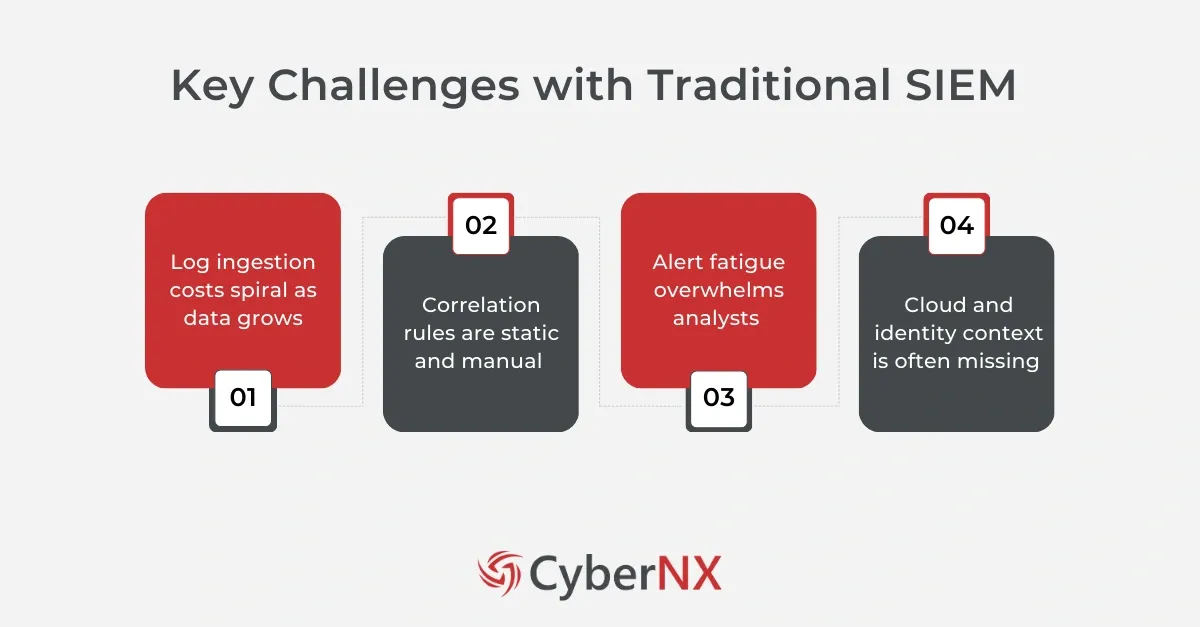
- Log ingestion costs spiral as data grows
- Correlation rules are static and manual
- Alert fatigue overwhelms analysts
- Cloud and identity context is often missing
When an attacker compromises a cloud workload, escalates identity privileges and laterally moves to endpoints, traditional tools may see isolated events. They rarely see the full story.
Security leaders today desperately want fewer alerts. They want better context and more importantly, they want speed.
How CrowdStrike reimagines SIEM
At the core of this evolution is the CrowdStrike NG-SIEM, built on the CrowdStrike Falcon platform. Unlike legacy architectures, it operates natively in the cloud. It ingests and correlates high-volume telemetry across endpoints, identities and cloud workloads without the heavy infrastructure burden.
This shift matters for three reasons:
- First, performance. The platform processes massive data streams with speed, enabling near real-time detection.
- Second, cost control. Cloud-native design reduces storage overhead and unpredictable licensing models.
- Third, unified telemetry. Endpoint, identity and cloud data live in the same ecosystem, making correlation automatic rather than forced.
We often see organisations investing heavily in multiple detection tools yet struggling to stitch insights together. A unified approach reduces complexity and sharpens visibility.
Cloud telemetry that sees beyond misconfigurations
Cloud security is no longer just about scanning for open ports or weak configurations. Attackers exploit APIs, abuse credentials and pivot across accounts.
1. Deeper behavioural insight
NG-SIEM ingests cloud activity logs, container events and workload telemetry. It correlates them with endpoint behaviour and identity signals. For example, if a developer credential is used from an unusual region and triggers anomalous API calls, the system connects those signals instantly.
2. Faster incident triage
Instead of reviewing separate dashboards, analysts view a single attack narrative. This reduces investigation time and lowers the risk of overlooking lateral movement. Cloud security becomes contextual, not reactive.
Identity correlation that stops privilege abuse early
Identity is now the primary attack vector. Compromised credentials remain one of the most common breach entry points.
1. Unified identity visibility
By integrating identity telemetry into the SIEM layer, suspicious authentication events are not treated as standalone logs. They are linked to endpoint actions and cloud changes.
Imagine this scenario. A user account authenticates successfully. Minutes later, that account modifies IAM roles and executes unusual commands on a server. Traditional monitoring might flag these separately. Correlated analytics flag them as a coordinated pattern.
2. Reduced false positives
Correlation reduces noise. It highlights genuine risk rather than isolated anomalies. Security teams gain confidence in alerts because they are backed by cross-domain evidence.
Endpoint signals that complete the attack picture
Endpoints remain critical. They often serve as both entry points and pivot points.
The Falcon sensor captures behavioural telemetry, not just signature-based detections. When NG-SIEM correlates this data with cloud and identity activity, it creates a multi-layered view of attacker behaviour.
This holistic visibility supports:
- Rapid containment decisions
- Accurate root cause analysis
- Improved threat hunting outcomes
Instead of chasing fragmented logs, analysts follow a coherent storyline.
Operational wins CISOs and security leaders will love
Here are the top operational benefits NG-SIEM offers:
1. Consolidation without compromise
Many enterprises run separate tools for endpoint detection, cloud security posture management and SIEM. Consolidation often feels risky. However, platform-based correlation reduces tool sprawl while maintaining deep capability. It simplifies procurement, management and reporting.
2. Improved MTTR
Correlation drives speed. Speed limits impact. When cloud anomalies, identity abuse and endpoint behaviour are analysed together, security teams act faster. Incident response becomes more decisive.
3. Scalable architecture for growth
As organisations expand into new cloud regions or onboard new SaaS platforms, telemetry volume grows. Cloud-native SIEM scales with this demand. It avoids the painful hardware upgrades common with traditional systems. For fast-growing enterprises, scalability is not optional. It is foundational.
Real-World use case: detecting a multi-stage attack
Consider a mid-sized financial services firm migrating workloads to the cloud. An attacker compromises a contractor’s credentials through a phishing campaign. The attacker:
- Authenticates to a cloud console
- Creates a new access key
- Launches a compute instance
- Attempts lateral movement to internal endpoints
In a fragmented environment, each step might trigger isolated alerts. Analysts would need to manually connect them.
With NG-SIEM correlation, the system automatically links the authentication anomaly, IAM modification and endpoint behaviour. The security team sees one high-confidence incident. Containment begins immediately. This reduction in investigative friction can save hours during critical windows.
Aligning with Zero Trust and modern security strategy
Zero Trust demands continuous verification across users, devices and workloads. Correlation is central to this model. By linking cloud, identity and endpoint telemetry, organisations move closer to contextual access control. They gain visibility into how identities behave across environments.
This supports:
- Stronger governance reporting
- Better compliance posture
- Clearer board-level risk communication
Security leaders can translate technical telemetry into business impact. That shift improves executive confidence.
Conclusion
Cloud workloads, hybrid identities and distributed endpoints define the modern enterprise. Fragmented monitoring cannot keep pace with sophisticated threats. CrowdStrike NG-SIEM for cloud, identity & endpoint correlation delivers unified telemetry, high-speed analytics and meaningful context across environments. It reduces noise, accelerates response and strengthens enterprise visibility.
If you are reviewing your SIEM strategy or modernising your detection architecture, this is the right time to act.
Speak with our experts for a CrowdStrike Consultation and discover how we can help you design a smarter, more resilient security monitoring strategy.
CrowdStrike NG-SIEM for cloud, identity & endpoint correlation FAQs
How does NG-SIEM differ from traditional log management tools?
Traditional log management focuses on storage and search. NG-SIEM integrates behavioural analytics and cross-domain correlation, providing actionable detection rather than passive log retention.
Can NG-SIEM replace multiple security tools?
In many cases, it can consolidate SIEM, log management and certain detection capabilities. However, integration strategy should be tailored to existing security architecture and risk profile.
Is cloud-native SIEM secure for regulated industries?
Yes, provided it aligns with compliance standards such as ISO 27001, GDPR and sector-specific regulations. Proper configuration and governance are essential.
How long does implementation typically take?
Deployment timelines vary based on environment complexity. Mid-sized organisations may complete initial integration within weeks, while larger enterprises require phased rollouts.