CrowdStrike MDR is often positioned as a complete managed detection and response service for modern enterprises. For CISOs and IT leaders facing talent shortages, rising ransomware threats and alert fatigue, the promise of an expert-led, 24 by 7 service is compelling.
According to the 2024 IBM Cost of a Data Breach Report, the global average cost of a breach reached 4.45 million dollars. At the same time, many organisations struggle to staff their SOC fully. This gap has fuelled demand for managed detection and response services.
In this guide, we break down CrowdStrike MDR in plain terms. We explain what is included, what is not, and how it fits into a broader enterprise security strategy. Our goal is simple: help you decide with clarity.
What is CrowdStrike MDR?
CrowdStrike MDR refers to the managed detection and response service built around the CrowdStrike Falcon platform. It is designed to provide continuous threat monitoring, investigation and response, delivered by CrowdStrike’s security experts.
The service is commonly associated with Falcon Complete Next Gen MDR, which combines endpoint protection technology with human-led threat hunting and response.
At its core, CrowdStrike MDR aims to reduce dwell time and improve response speed. It uses telemetry from endpoints, identity, cloud workloads and other sources within the Falcon ecosystem. The human team then validates alerts, investigates suspicious activity and takes action.
However, understanding CrowdStrike MDR requires looking beyond the marketing headline. You need to know what you are buying into.
What is included in CrowdStrike MDR?
Before making a strategic decision, security leaders should clearly understand the operational scope of CrowdStrike MDR. Based on publicly available information from CrowdStrike, the service includes the following core capabilities.
24/7 threat monitoring and detection
CrowdStrike MDR provides round the clock monitoring of telemetry collected through the Falcon platform. The service leverages behavioural analytics, threat intelligence and machine learning to identify malicious activity.
Human analysts validate alerts. This reduces false positives and helps internal teams focus on genuine incidents.
For organisations with limited SOC capacity, this continuous coverage can reduce the burden of overnight or weekend staffing.
Managed threat hunting
A key component of CrowdStrike MDR is proactive threat hunting. Analysts actively search for advanced or hidden adversary activity that may bypass automated controls.
Threat hunting uses intelligence gathered from CrowdStrike’s global visibility into adversary behaviour. This global dataset is often highlighted as a differentiator, as it feeds into detection logic and investigation workflows.
For enterprises concerned about advanced persistent threats, this hunting capability can add depth beyond reactive alerting.
Incident investigation and response actions
CrowdStrike MDR does not stop at detection. It includes investigation and guided response. Depending on the service configuration and permissions granted, analysts can take direct response actions such as isolating endpoints or killing malicious processes.
This is particularly relevant for ransomware scenarios. Rapid containment can significantly reduce impact.
CrowdStrike has stated publicly that its Falcon Complete service includes hands on remediation support, which can extend to remote containment and clean up activities.
Integration with the Falcon platform
CrowdStrike MDR is tightly integrated with the Falcon platform modules, including endpoint detection and response, identity protection and cloud security capabilities where licensed.
This integrated approach simplifies telemetry collection and response orchestration. For organisations already standardised on CrowdStrike technology, the MDR layer adds human expertise without requiring additional agents.
However, this integration also defines the boundaries of the service. We will explore that next.
What is not included in CrowdStrike MDR?
Security leaders often assume that managed detection and response equals complete security outsourcing. That assumption can lead to gaps.
It is important to clarify what CrowdStrike MDR does not inherently provide.
Full security programme ownership
CrowdStrike MDR focuses on detection and response within the Falcon ecosystem. It does not replace the need for governance, risk management, compliance oversight or security architecture design.
Your organisation still needs internal ownership for policy, asset management, third party risk and business alignment. MDR enhances operations. It does not replace strategic leadership.
Broad multi-vendor visibility by default
CrowdStrike MDR is optimised for environments running the Falcon platform. While integrations may exist, it is not designed as a fully vendor agnostic SOC replacement covering every security tool in your stack out of the box.
If your estate includes diverse endpoint, network and cloud security tools, you must assess integration depth carefully. In some cases, additional SIEM or XDR layers may be required.
On site incident response by default
CrowdStrike MDR includes remote investigation and response. However, physical on site digital forensics and incident response services are typically separate professional services engagements.
If your regulatory or operational requirements demand on site response guarantees, you should clarify service level commitments during procurement.
Vulnerability management and penetration testing
Managed detection and response is focused on active threats. It does not replace proactive security testing, vulnerability management programmes or regular penetration testing.
We often see organisations assume MDR covers all operational security needs. In reality, it addresses one critical layer. Preventive controls and continuous validation remain essential.
What’s new in CrowdStrike MDR in 2025-26?
CrowdStrike MDR has evolved through several Falcon platform enhancements in 2025 and early 2026. These updates strengthen visibility, automation and cross domain detection.
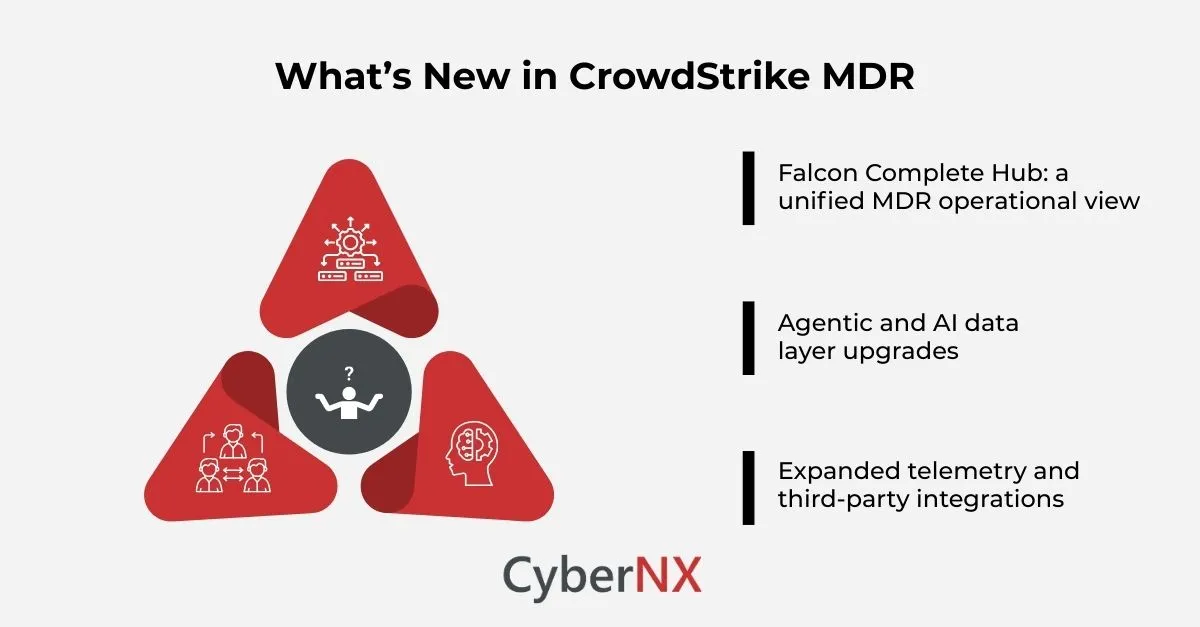
Falcon Complete Hub: a unified MDR operational view
In 2025, CrowdStrike introduced Falcon Complete Hub, delivering a single, unified MDR operational view within the Falcon platform. It centralises active incidents, remediation status, prioritised actions and performance metrics.
For CISOs, this improves transparency and simplifies reporting. Internal teams gain clearer insight into what the MDR analysts are doing and why. During incidents, shared visibility helps accelerate decisions and reduce confusion.
Agentic and AI data layer upgrades
CrowdStrike enhanced its Falcon data layer with expanded AI and agentic capabilities. These upgrades support automated correlation across endpoint, identity and cloud signals.
For CrowdStrike MDR customers, this means faster investigation workflows, improved alert prioritisation and stronger behavioural detection. Analysts spend less time stitching data together and more time responding to verified threats.
Expanded telemetry and third-party integrations
CrowdStrike also expanded telemetry ingestion through deeper SIEM capabilities and selected third party integrations. This broadens detection coverage beyond endpoints.
With richer cross domain visibility, CrowdStrike MDR can better identify lateral movement and complex attack chains. However, integration depth depends on deployment design and licensing scope.
Together, these upgrades enhance detection accuracy, response speed and operational clarity, while keeping the core MDR focus on managed detection and response.
Strategic considerations for CISOs
Understanding what CrowdStrike MDR includes and excludes is only the first step. The bigger question is strategic fit.
Alignment with your operating model
If you are moving towards SOC consolidation or partial outsourcing, CrowdStrike MDR can act as an extension of your internal team. It reduces alert fatigue and provides expert support.
However, if your strategy centres on building a fully independent in-house SOC with multi-vendor telemetry, you may need complementary technologies or services.
Our experience shows that clarity around operating model drives better outcomes than feature comparison alone.
Response authority and accountability
One critical discussion point is response authority. How much control will you delegate to the MDR provider? Will they isolate systems automatically? What approval workflows exist?
Clear governance avoids confusion during high pressure incidents.
In ransomware scenarios, minutes matter. Predefined response playbooks aligned with business risk tolerance are essential.
Regulatory and industry requirements
Certain sectors require specific logging retention, reporting workflows or incident notification timelines. While CrowdStrike MDR supports detection and response, compliance mapping remains your responsibility.
CISOs should validate how MDR outputs integrate with regulatory reporting obligations.
Latest Trends Driving MDR Adoption
The growth of services such as CrowdStrike MDR reflects broader market shifts.
First, the cybersecurity skills gap continues to widen. ISC2 has reported millions of unfilled cybersecurity roles globally. Many organisations cannot hire experienced threat hunters at scale.
Second, ransomware groups are becoming more operationally mature. According to various industry reports, ransomware remains one of the most disruptive threats facing enterprises. Rapid containment is now a board level concern.
Third, attackers increasingly target identity and cloud environments. MDR services are expanding beyond endpoint telemetry to cover identity signals and cloud workloads. CrowdStrike MDR aligns with this trend by integrating multiple Falcon modules where deployed.
These factors explain why MDR is moving from tactical purchase to strategic pillar.
Where CrowdStrike MDR Fits in a Layered Security Strategy
CrowdStrike MDR should be viewed as a detection and response accelerator. It strengthens your ability to identify and contain threats quickly.
However, it works best within a layered model that includes:
- Preventive controls such as endpoint protection and identity security.
- Continuous vulnerability management and patch governance.
- Regular security validation including red teaming and penetration testing.
- Clear incident response plans and executive communication protocols.
We often advise clients to treat MDR as the operational backbone of their SOC, while maintaining independent validation and strategic oversight.
Conclusion
CrowdStrike MDR offers continuous monitoring, proactive threat hunting and managed response built on the Falcon platform. It can significantly reduce detection and containment time, especially for organisations facing resource constraints.
However, it does not replace governance, compliance ownership, vulnerability management or independent testing. Security leaders must assess scope, integration depth and response authority before committing.
At CyberNX, we assess architecture, identify gaps and design layered strategies that align with business risk. If you are considering CrowdStrike MDR, speak to our experts for a focused CrowdStrike consultation. Together, we can build a resilient, balanced security programme and help you get maximum value from the Falcon platform.
CrowdStrike MDR FAQs
How is CrowdStrike MDR different from traditional SOC outsourcing?
CrowdStrike MDR is tightly integrated with the Falcon platform and focuses on detection and response. Traditional SOC outsourcing may include broader log monitoring across multiple tools and custom workflows.
Can CrowdStrike MDR support hybrid and multi cloud environments?
Yes, when relevant Falcon modules are deployed across endpoints, identity and cloud workloads. However, coverage depth depends on licensing and integration scope.
Does CrowdStrike MDR guarantee breach prevention?
No MDR service can guarantee breach prevention. CrowdStrike MDR aims to reduce detection and response time, limiting impact rather than eliminating risk entirely.
How should organisations measure the effectiveness of CrowdStrike MDR?
Key metrics include mean time to detect, mean time to respond, incident containment time and reduction in false positives. Executive level reporting should align with business risk indicators.