Choose Language
Google Translate
Skip to content
Facebook X-twitter Instagram Linkedin Youtube
  • sales@cybernx.com
  • +91 90823 52813
CyberNX Logo
  • Home
  • About
    • About Us
    • CERT-In Empanelled Cybersecurity Auditor
    • Awards & Recognition
    • Our Customers
  • Services

    Peregrine

    • Managed Detection & Response
    • AI Managed SOC Services
    • Elastic Stack Consulting
    • CrowdStrike Consulting 
    • Threat Hunting Services
    • Digital Risk Protection Services
    • Threat Intelligence Services
    • Digital Forensics Services
    • Brand Risk & Dark Web Monitoring
    • Full Stack Observability

    Pinpoint

    • Red Teaming Services
    • Vulnerability Assessment
    • Penetration Testing Services
    • Secure Code Review Services
    • Cloud Security Assessment
    • Phishing Simulation Services
    • Breach and Attack Simulation Services

    nCompass

    • Cybersecurity Audit Services
    • Virtual CISO Services
    • DPDP Act Consulting
    • ISO 27001 Consulting
    • RBI Master Direction Compliance
    • SEBI CSCRF Framework Consulting
    • SEBI Cloud Framework Consulting
    • Security Awareness Training
    • Cybersecurity Staffing Services

    NXRadar

    • SBOM Solutions
    • CBOM Solutions
    • AIBOM Solutions
  • Industries
    • Banking
    • Financial Services
    • Insurance
  • Resources
    Blogs
    Case Studies
    Downloads
    Whitepapers
    Buyer’s Guide
    Research & Guides
    Data Sheets
  • Careers
  • English
Contact Us
CyberNX Logo
  • English
  • Home
  • About
    • About Us
    • CERT-In Empanelled Cybersecurity Auditor
    • Awards & Recognition
    • Our Customers
  • Services

    Peregrine

    • Managed Detection & Response
    • AI Managed SOC Services
    • Elastic Stack Consulting
    • CrowdStrike Consulting
    • Threat Hunting Services
    • Digital Risk Protection Services
    • Threat Intelligence Services
    • Digital Forensics Services
    • Brand Risk & Dark Web Monitoring
    • Full Stack Observability

    Pinpoint

    • Red Teaming Services
    • Vulnerability Assessment
    • Penetration Testing Services 
    • Secure Code Review Services
    • Cloud Security Assessment
    • Phishing Simulation Services
    • Breach and Attack Simulation Services

    nCompass

    • Cybersecurity Audit Services
    • Virtual CISO Services
    • DPDP Act Consulting
    • ISO 27001 Consulting
    • RBI Master Direction Compliance
    • SEBI CSCRF Framework Consulting
    • SEBI Cloud Framework Consulting
    • Security Awareness Training
    • Cybersecurity Staffing Services

    NXRadar

    • SBOM Solutions
    • CBOM Solutions
    • AIBOM Solutions
  • Industries
    • Banking
    • Financial Services
    • Insurance
  • Resources
    Blogs
    Case Studies
    Downloads
    Whitepapers
    Buyer’s Guide
    Research & Guides
    Data Sheets
  • Careers
  • Contact

Continuous Vulnerability Scanning: Staying ahead of Fast-Moving Threats

3 min read
4 Views
  • Vulnerability Assessment

More than 48,000 new software vulnerabilities were published in 2025, and a growing share of them face active exploitation within days of exposure. For security teams that run quarterly or annual scans, this speed creates a massive, dangerous gap between when a flaw appears and when someone finally looks for it.

Continuous vulnerability scanning closes that gap. Instead of point in time reviews, it gives security teams an ongoing view of where their systems are exposed – across cloud workloads, on premise servers, applications and endpoints. For BFSI organisations and firms working under CERT-In, SEBI CSCRF and RBI cybersecurity requirements, this shift is quite important. Regulators expect continuous monitoring instead of periodic checklists.

This guide covers what this practice means, how it works and where it fits into an Indian enterprise’s risk and compliance strategy.

Table of Contents

What is continuous vulnerability scanning?

It is the practice of checking IT systems, applications and cloud assets on an ongoing basis – instead of scheduled intervals like monthly or quarterly. It automatically finds new assets, checks them against known vulnerability databases and flags fresh weaknesses as soon as they appear.

Think of a traditional vulnerability assessment as a health check done once every few months. This approach works more like a fitness tracker. It monitors constantly and raises an alert the moment something changes.

This distinction is important because new CVEs (Common Vulnerabilities and Exposures) are published every day. An old scan offers no visibility into a flaw disclosed last week.

Why this matters for Indian enterprises

Indian regulators have moved firmly toward continuous, evidence-based security postures. CERT-In empanelled auditors already expect regular VAPT (Vulnerability Assessment and Penetration Testing) cycles. SEBI’s Cybersecurity and Cyber Resilience Framework (CSCRF) pushes regulated entities toward ongoing vulnerability management rather than one-off audits, and RBI’s Master Direction on cybersecurity places similar weight on regular assessments for banks and NBFCs.

The pace of exploitation makes this urgent. There are multiple independent reports that suggest there’s a huge gap between when a vulnerability is found by attackers and when it is patched by organisations. A gap where systems stay exposed.

This approach helps close that gap by supporting:

  • Faster detection: New weaknesses surface as soon as they appear, not at the next scheduled scan
  • Regulatory alignment: Ongoing evidence of monitoring supports CERT-In, SEBI CSCRF and RBI audit requirements
  • Prioritised remediation: Security teams can rank fixes by exploitability and business impact, not just severity scores
  • Reduced exposure window: Less time between disclosure and detection means less time for attackers to act

How the process works

A programme like this typically follows five steps:
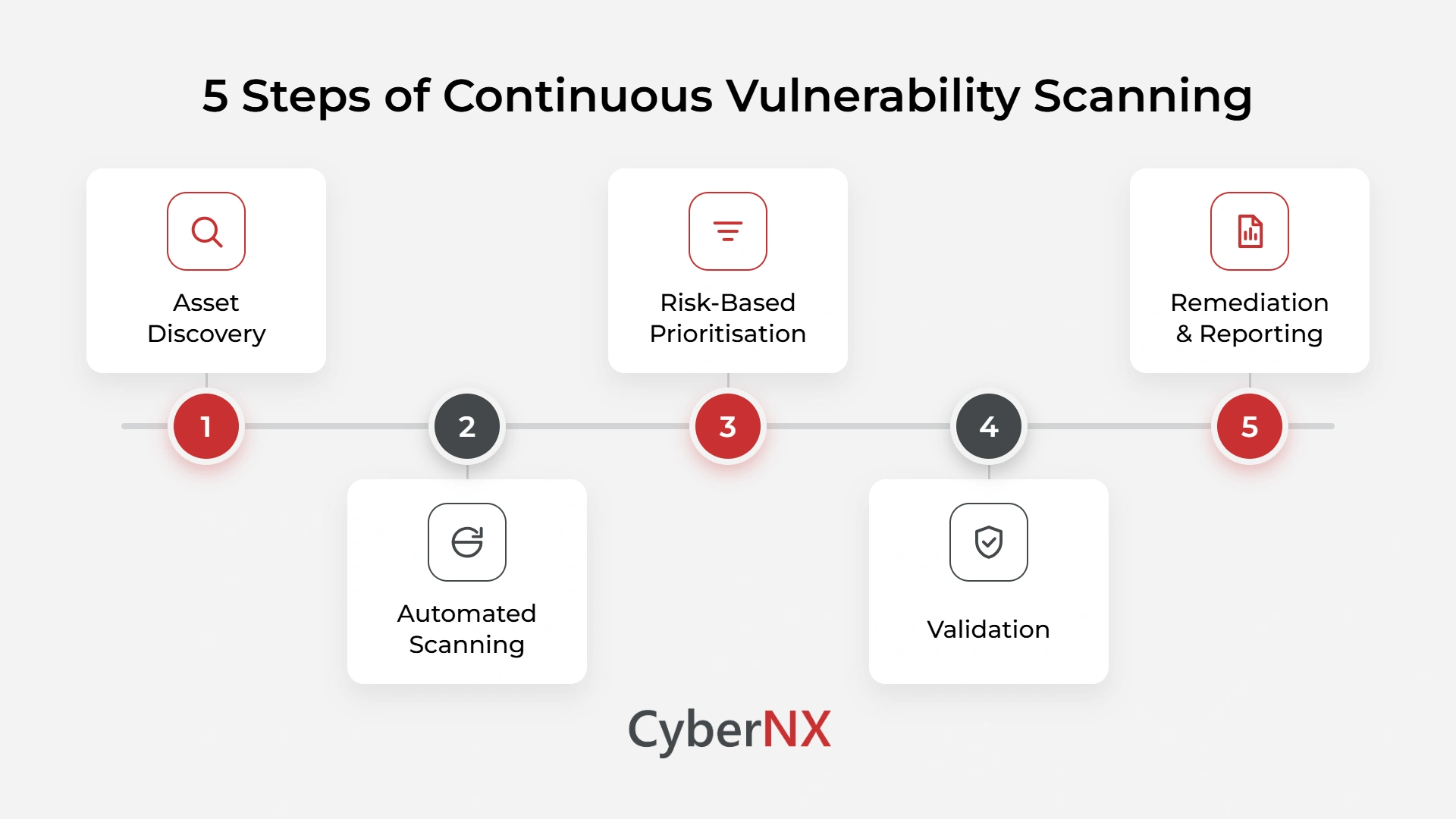
  • Asset discovery: Every server, application, cloud workload and endpoint gets identified and added to a live inventory
  • Automated scanning: Scanning tools run on an ongoing schedule rather than a one-time basis, checking assets against updated vulnerability databases
  • Risk-based prioritisation: Findings get ranked by exploitability, exposure and business criticality, not CVSS score alone
  • Validation: Security experts confirm which flaws are genuinely exploitable, cutting down false positives
  • Remediation and reporting: Teams receive a clear, prioritised plan, along with documentation for compliance audits

Continuous vulnerability scanning example

A few practical scenarios show how this plays out for Indian enterprises.

  • A bank migrating workloads to the cloud uses this approach to catch misconfigured storage buckets or exposed APIs as soon as they go live, instead of waiting for the next quarterly assessment
  • An NBFC handling customer data runs ongoing scans across its core banking application to meet RBI’s cybersecurity framework requirements and maintain audit-ready evidence
  • A fintech platform builds continuous scanning into its software development pipeline, catching vulnerable dependencies before code reaches production

Across these cases, the value stays the same: fewer surprises, faster fixes and a clear audit trail.

Conclusion

New vulnerabilities appear faster than most companies can track manually, and Indian regulators are slowly but continuously raising the bar on ongoing security evidence. This approach gives BFSI organisations and enterprises a practical way to stay ahead of both.

CyberNX’s continuous vulnerability assessment services help identify, prioritise and resolve risks before attackers find them, backed by CERT-In empanelled expertise. Connect with our team of security experts if you are planning to build a strong continuous vulnerability scanning system for your firm, that is suited to your environment.

Continuous Vulnerability Scanning FAQs

How is continuous vulnerability scanning different from a one-time VAPT engagement?

A VAPT engagement is a point in time exercise with a defined scope and timeline. This approach runs constantly in the background, feeding ongoing data that a periodic VAPT can then validate and deepen.

Is continuous vulnerability scanning mandatory under Indian regulations?

CERT-In, SEBI CSCRF and RBI frameworks do not always name “continuous scanning” explicitly, but each pushes toward regular, evidence-backed vulnerability management, which continuous scanning supports directly.

What kinds of assets should be covered?

Cloud infrastructure, on premise servers, web and mobile applications, APIs and employee endpoints should all sit within scope, since attackers do not limit themselves to one layer.

Can continuous vulnerability scanning replace penetration testing?

No. Scanning identifies known weaknesses at scale. Penetration testing validates how those weaknesses could actually be exploited. Both work best together.

Author
Bhowmik Shah
LinkedIn

Bhowmik is a seasoned security leader with hands-on experience operating large-scale SOC environments, leading offensive security teams, and performing cloud security assessments across AWS, Azure & Google Cloud. He has worked with enterprise CISOs across India & APAC to strengthen detection engineering, threat hunting & SIEM/SOAR effectiveness. Known for aligning red-team insights with SOC improvements, he brings practical, field-tested expertise in building resilient, high-performing security operations.

Share on

WhatsApp
LinkedIn
Facebook
X
Pinterest

For Customized Plans Tailored to Your Needs, Get in Touch Today!

Connect with us

RESOURCES

Related Blogs

Explore our resources section for insightful blogs, articles, infographics and case studies, covering everything in Cyber Security.
Vulnerability Management Metrics: KPIs That Prove Security ROI

Vulnerability Management Metrics: The KPIs That Prove Your Security Program Works

Vulnerability exploitation has overtaken every other entry point into corporate networks. It is now responsible for 31% of all initial

Automated Vulnerability Scanning: How to Make Security Continuous, Accurate, and Actionable

Automated Vulnerability Scanning: Make Your Security Accurate and Actionable

Security teams today are focused on moving faster than attackers. Automated vulnerability scanning offers a dependable way to run repeatable

Which are the Top 10 Vulnerability Scanning Tools in 2026

Which are the Top 10 Vulnerability Scanning Tools in 2026

Imagine you’re sipping coffee on a Monday morning. Scanning through your inbox, you find an urgent email from your security

RESOURCES

Cyber Security Knowledge Hub

Explore our resources section for insightful blogs, articles, infographics and case studies, covering everything in Cyber Security.

BLOGS

Stay informed with the latest cybersecurity trends, insights, and expert tips to keep your organization protected.

CASE STUDIES

Explore real-world examples of how CyberNX has successfully defended businesses and delivered measurable security improvements.

DOWNLOADS

Learn about our wide range of cybersecurity solutions designed to safeguard your business against evolving threats.
CyberNX Footer Logo
Book a Free Call

Peregrine

  • Managed Detection & Response
  • AI Managed SOC Services
  • Elastic Stack Consulting
  • CrowdStrike Consulting
  • Threat Hunting Services
  • Digital Risk Protection Services
  • Threat Intelligence Services
  • Digital Forensics Services
  • Brand Risk & Dark Web Monitoring
  • Full Stack Observability

Pinpoint

  • Red Teaming Services
  • Vulnerability Assessment
  • Penetration Testing Services
  • Secure Code Review Services
  • Cloud Security Assessment
  • Phishing Simulation Services
  • Breach and Attack Simulation Services

nCompass

  • Cybersecurity Audit Services
  • Virtual CISO Services
  • DPDP Act Consulting
  • ISO 27001 Consulting
  • RBI Master Direction Compliance
  • SEBI CSCRF Framework Consulting
  • SEBI Cloud Framework Consulting
  • Security Awareness Training
  • Cybersecurity Staffing Services

NXRadar

  • SBOM Solutions
  • CBOM Solutions
  • AIBOM Solutions
  • About
  • CERT-In
  • Awards
  • Careers
  • Sitemap
Facebook Twitter Instagram Youtube

Copyright © 2026 CyberNX | All Rights Reserved | Terms and Conditions | Privacy Policy

  • English
Copyright © 2026 CyberNX | All Rights Reserved | Terms and Conditions | Privacy Policy
Scroll to Top

WhatsApp us

Not Sure Where to Start with Cybersecurity?

We value your privacy. Your personal information is collected and used only for legitimate business purposes in accordance with our Privacy Policy.