Somewhere in an old codebase, an RSA-2048 key is doing what it was told to do years ago, and nobody has looked at it since. That is the concerning reality of cryptography inside modern software: it gets written once, buried inside a library, and left to run untouched through hundreds of releases. A DigiCert-commissioned global survey of over 1,000 senior security leaders found that 69% of them understand the risk that comes with quantum computing for current encryption, and still only 5% have implemented quantum-safe alternatives.
That gap does is not fixed in an audit. It gets fixed inside the pipeline, at the point where code, containers and infrastructure templates already get built and tested. A cryptographic bill of materials (CBOM) brings cryptographic assets into that same visibility. It turns encryption from a blind spot into a tracked, auditable part of every release. This guide covers how CBOM in CI/CD pipeline works, why it matters under India’s regulatory framework, and what it takes to build.
What a cryptographic bill of materials actually tracks
A CBOM lists every cryptographic asset tied to an application. That includes algorithms (RSA, AES, ECC), key lengths, certificates, protocols and the libraries that implement them. It extends the same logic as a Software Bill of Materials (SBOM), but for cryptography specifically.
The difference is important because cryptographic risk behaves differently from a normal vulnerability. An outdated library gets flagged and patched. But a weak algorithm can sit inside a certificate or a third-party dependency for years without triggering any alert. CBOM in CI/CD pipelines closes that gap by scanning for cryptographic assets at the same point where code, containers and infrastructure templates are already being built and tested.
How CBOM works inside a CI/CD pipeline
Generating a CBOM as part of the build process follows a consistent sequence, no matter which toolchain you use.
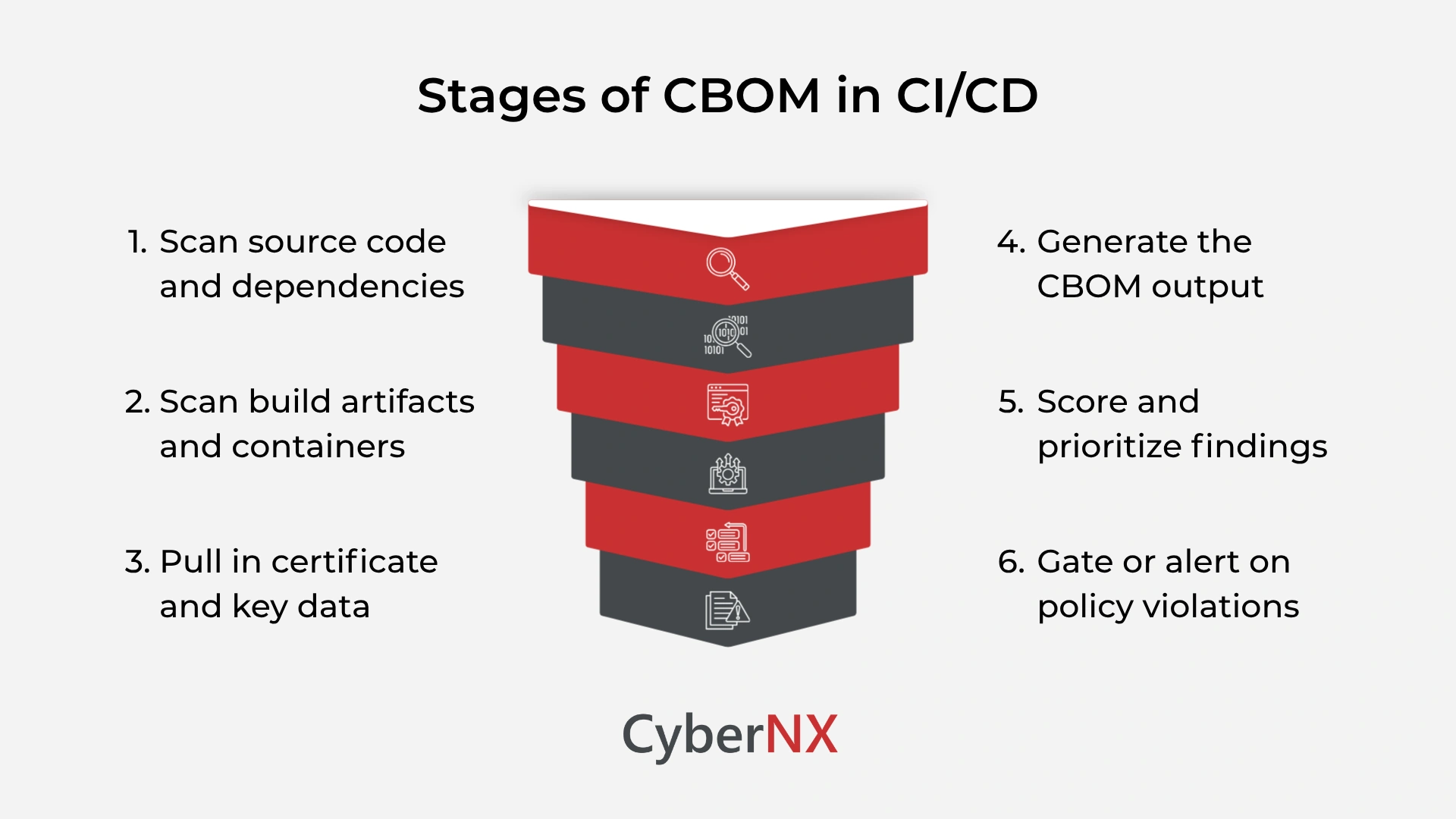
- Scan source code and dependencies: Static analysis tools parse the codebase for cryptographic API calls, constants and known libraries during the build stage.
- Scan build artifacts and containers: Binary and container scanning catches statically linked libraries and third-party components that source scanning alone would miss.
- Pull in certificate and key data: Integration with HSMs and KMS platforms adds certificate expiry, key length and rotation status to the inventory.
- Generate the CBOM output: Findings are compiled into a standardized format, commonly built on the CycloneDX schema, and stored as a build artifact alongside the release.
- Score and prioritize findings: Quantum-vulnerable algorithms, weak key lengths and expiring certificates get flagged and ranked by exploitability, not just by algorithm type.
- Gate or alert on policy violations: CI/CD policies can block a build when a disallowed algorithm or an unapproved crypto library shows up in the scan.
Regulatory pressure behind CBOM in India
For BFSI and other regulated entities, CBOM in CI/CD pipelines is more like a compliance requirement than a best practice. RBI Advisory 11/2024 references CERT-In Technical Guidelines v2.0, which set out cryptographic inventory expectations for regulated and critical-infrastructure entities. NIST’s 2024 post-quantum cryptography (PQC) standards, ML-KEM and ML-DSA among them, further increase the urgency by giving organisations a defined migration path away from RSA and ECC.
Auditors expect evidence, not assurances. A pipeline-generated CBOM produces that evidence automatically, mapped to specific applications, release dates and algorithm versions. For organisations working through RBI Master Direction compliance, this makes it a continuous, low-effort output of the existing development process.
Building crypto agility from a pipeline-native CBOM
A CBOM is only as useful as the action it enables. Once cryptographic assets are visible, three practices help to convert that visibility into resilience:
- Prioritize by exposure, not by algorithm alone: A quantum-vulnerable algorithm on an internet-facing authentication service guarantees faster action than the same algorithm buried in an internal tool.
- Track post-quantum migration progress per application: A live CBOM shows exactly which services have moved to NIST-approved algorithms and which have not.
- Feed findings into incident response: When a new cryptographic library vulnerability surfaces, a current CBOM identifies every affected application within hours.
Crypto agility – the ability to swap out algorithms without re-architecting an application – depends entirely on knowing where cryptography lives in the first place. Pipeline-native CBOM generation is what keeps that knowledge current.
Conclusion
Cryptographic risk hides in plain sight, spread across code repositories, containers, certificates and key stores. Building CBOM in CI/CD pipelines turns that risk into a single, constantly updated inventory that keeps up with how software actually ships. CyberNX’s CBOM solutions build that inventory directly from live pipeline mapped to regulatory frameworks and post-quantum readiness from day one. Connect with our team to see how our CBOM solutions in can fit CBOM into your existing release process.
CBOM in CI/CD pipelines FAQs
What is a cryptographic bill of materials (CBOM)?
A CBOM is a structured inventory of cryptographic assets, algorithms, keys, certificates and libraries used within a software system. It gives security and compliance teams a clear view of an organisation’s cryptographic posture.
Why integrate CBOM generation into CI/CD instead of running periodic audits?
Periodic audits capture a single point in time and go stale as soon as code changes. CBOM in CI/CD pipelines generates an updated inventory with every build, keeping the record accurate as applications evolve.
Is CBOM mandatory for Indian financial institutions?
RBI Advisory 11/2024 references CERT-In Technical Guidelines v2.0, which set cryptographic inventory expectations for regulated entities and critical-infrastructure operators.
How does a CBOM support post-quantum cryptography migration?
A CBOM identifies where quantum-vulnerable algorithms like RSA and ECC are in use, letting security teams scope and sequence a migration to NIST-approved post-quantum algorithms based on actual exposure.