In this blog, you will understand what is the difference between APM and Observability, where each approach fits best and how full stack observability takes monitoring to the next level.
Understanding APM
First, let’s understand APM. Application Performance Monitoring (APM) is a category of tools designed to track the performance and availability of software applications. APM tools measure response times, error rates, throughput and transaction traces. They help engineering and IT teams answer one core question: is the application performing as expected?
How APM tools work
APM solutions work by instrumenting your application code, often automatically, and collecting predefined metrics. These metrics flow into dashboards that show you the health of key transactions and services.
Popular APM tools include Dynatrace, New Relic and AppDynamics. They are well-suited for monolithic or early microservice architectures where performance bottlenecks are relatively predictable.
Where APM falls short
APM tools are built around known failure patterns. They alert you when a metric crosses a threshold. But in distributed, cloud-native environments, failures often emerge from interactions between dozens of services, none of which may appear broken individually.
APM also tends to focus on application-layer signals. It rarely gives you visibility into infrastructure, network behaviour or the experience of individual users in real time.
Understanding observability
Observability is a property of a system, not just a tool category. A system is observable when you can infer its internal state by examining its external outputs. In practice, observability means your system generates enough high-quality telemetry data that engineers can ask any question about it, even questions they have never asked before.
The three pillars of observability
Observability is built on three core data types. Metrics, the numerical measurements over time (CPU usage, request rate, latency). Logs, the timestamped records of discrete events (errors, warnings, user actions) and Traces, the end-to-end records of a request as it travels through distributed services. Together, these three signals let your team correlate events across your entire stack, from the network layer to the application to the end user.
Why observability matters for modern architectures
Microservices, containers, serverless functions and multi-cloud deployments have made environments far more dynamic. In these systems, you cannot predefine every failure mode. Observability gives your team the ability to explore unknown unknowns-problems you did not know to monitor for.
APM vs Observability: what is the difference between them?
The question of what is the difference between APM and Observability comes down to scope, flexibility and the type of questions you can answer.
APM is a monitoring approach. It watches a set of predefined metrics and alerts when something deviates. The key here is to know it is reactive. Whereas observability is a system design philosophy. It gives you the raw telemetry and tooling to investigate any condition, known or unknown and it is exploratory. Here is a direct comparison across key dimensions:
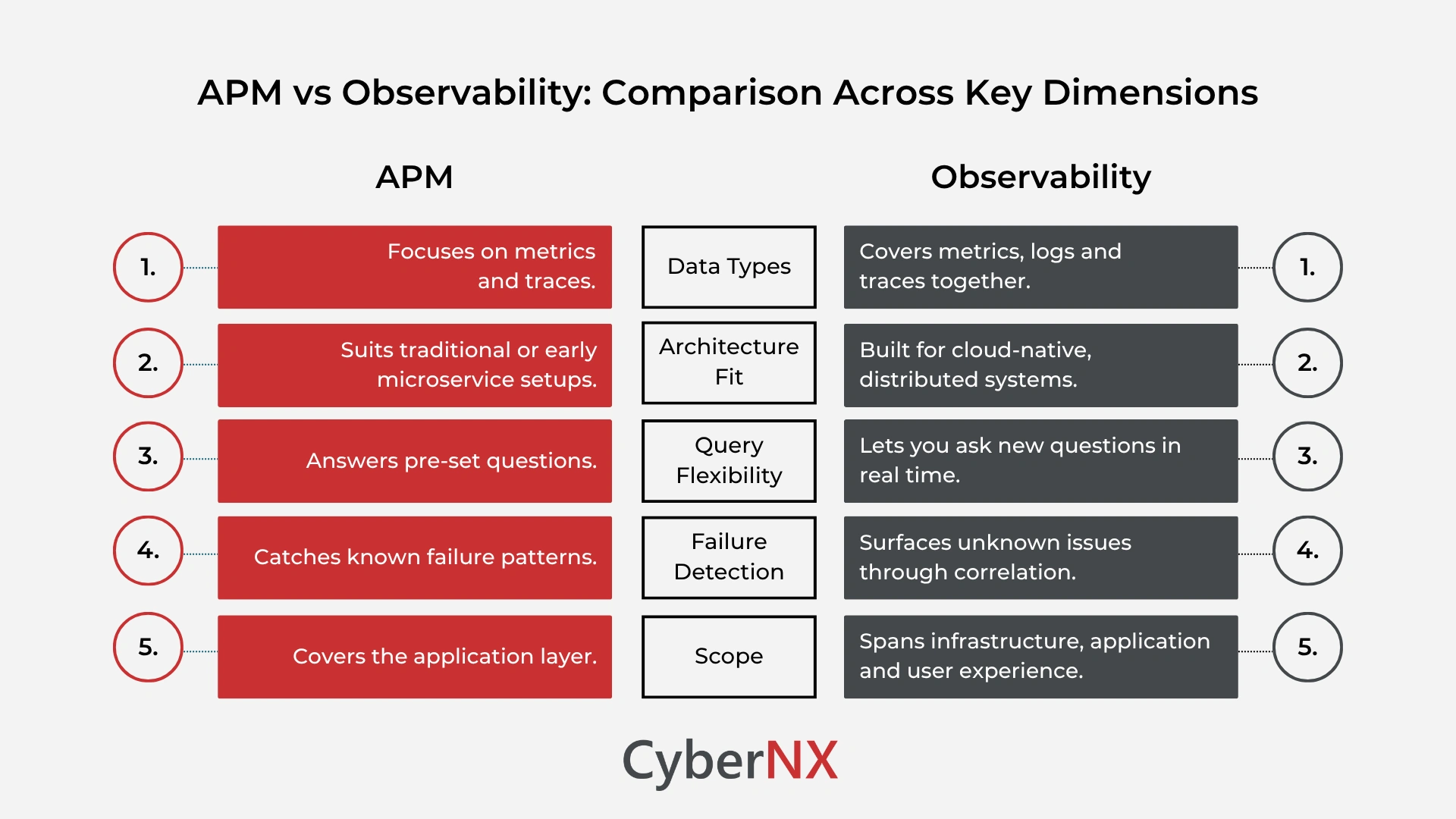
- Data types: APM focuses on metrics and traces. Observability covers metrics, logs and traces together.
- Architecture fit: APM suits traditional or early microservice setups. Observability is built for cloud-native, distributed systems.
- Query flexibility: APM answers pre-set questions. Observability lets you ask new questions in real time.
- Failure detection: APM catches known failure patterns. Observability surfaces unknown issues through correlation.
- Scope: APM covers the application layer. Observability spans infrastructure, application and user experience.
APM is not obsolete. It is a component within a broader observability strategy. The real shift is from monitoring what you know to understanding what you do not yet know.
Why full stack observability goes further
Full stack observability extends the observability model across every layer of your technology environment-infrastructure, network, application and end-user experience. It treats all of these layers as connected and gives your team a unified view.
If you want a deeper understanding of how full stack observability works in practice-including the architecture, tools and implementation steps-our Full Stack Observability Guide walks you through it end to end.
What full stack observability covers
Full stack observability gives your team visibility into three interconnected layers:
- Infrastructure layer: Server health, container performance, cloud resource utilisation
- Application layer: Service response times, error rates, dependency maps
- User experience layer: Real user monitoring, session traces, conversion impact
The security dimension of observability
Observability has significant implications for cybersecurity. When your team can trace every request across your stack and correlate logs with network events, you can detect anomalies that traditional monitoring misses-lateral movement, privilege escalation or unusual data flows. This is why security and engineering teams increasingly share observability platforms. A single source of telemetry truth accelerates both incident response and threat hunting.
Choosing the right approach for your organisation
The APM vs Observability decision is not binary. Most mature engineering and security teams use both. APM for application-specific performance tracking and observability for broader, cross-layer investigation.
When APM is enough
APM remains effective when your application footprint is relatively contained. If you run a few tightly scoped services, track well-understood SLAs and want fast alerting on application-layer metrics, APM tools deliver strong value with lower complexity.
When you need full observability
You need a full observability strategy when your environment is distributed, your services are containerised or your team regularly encounters issues they cannot explain with metrics alone. If your mean time to resolution (MTTR) is high or your team spends hours correlating logs manually, observability is the right investment.
Conclusion
APM and Observability serve different purposes and the gap between them matters. APM tells you when something is wrong with your application. Observability tells you why, where and how, across your entire stack.
As environments grow more distributed and threats more sophisticated, full stack observability is no longer optional. It is the foundation for both operational resilience and security awareness.
At CyberNX, we help organisations build and secure observable infrastructure, from monitoring architecture to threat detection across every layer of your stack. Our Full Stack Observability Solutions give your team the visibility, speed and confidence to stay ahead of both performance issues and security incidents.
Ready to move beyond reactive monitoring? Talk to our team and let us help you build observability that actually works.
APM vs Observability FAQs
What is the difference between APM and Observability?
APM monitors predefined application metrics and alerts on known thresholds. Observability gives you the telemetry and tooling to investigate any system state-including issues you have never seen before. APM is a subset of observability.
Can APM tools provide observability?
Some APM vendors are expanding into observability by adding log correlation and distributed tracing. However, true observability requires a system designed to emit rich, correlated telemetry from the ground up-not just an APM tool with added features.
Is observability only for large organisations?
No. Any organisation running distributed or cloud-native workloads can benefit from observability. The tooling has become more accessible and the cost of not having observability-in MTTR, missed threats and poor user experience-outweighs the investment.
How does observability relate to cybersecurity?
Observability gives security teams the same rich telemetry that engineering teams use for debugging. Correlating application traces with network logs and infrastructure events helps detect attacks faster and respond more precisely.