A Reserve Bank of India survey under the FREE-AI Committee found that a small fraction of regulated entities were using or building AI systems, yet fraud detection, credit scoring and customer chatbots already run on models that nobody has fully catalogued. This gap between AI use and AI visibility is why an AIBOM Maturity Model is necessary for companies.
An AIBOM Maturity Model gives you a proper organised way to measure how much visibility your company has into the models, datasets and dependencies that power its AI systems. For Indian BFSI teams working under CERT-In, RBI and SEBI oversight, this is slowly becoming an important governance and compliance practice.
This guide walks through what it looks like, why it matters right now and the five AIBOM levels you can use to understand where your firm stands today.
What is an AIBOM maturity model?
An AI Bill of Materials (AIBOM) is a structured record of every model, dataset, framework and dependency behind an AI system. It extends the Software Bill of Materials (SBOM) concept that security teams already use for code and libraries.
An AIBOM Maturity Model measures how well an organisation manages that record over time as part of its broader AI supply chain security programme. It looks at coverage, automation, ownership and how AIBOM data feeds into audits and incident response. CERT-In’s Technical Guidelines v2.0 (Jul 2025) document AIBOM alongside SBOM, CBOM and QBOM as part of its technical guidance. These CERT-In AIBOM guidelines are the closest thing India has to a national standard for this practice today.
Why AIBOM maturity matters for Indian BFSI now
AI oversight in Indian finance has moved from guidance to structure. The RBI’s FREE-AI framework recommends board-level governance and structured oversight of AI systems. The RBI’s draft Model Risk Management guidance, released in Jun 2026, goes further. It proposes risk-based model tiering and human oversight requirements for every AI and ML model in use, including models bought from vendors.
SEBI’s consultation on responsible AI and ML usage in securities markets points in the same direction for capital market participants. Add CERT-In’s AIBOM guidance to this and a pattern is clear: regulators want a documented, current answer to “what AI models are running, and what is inside them.”
An AIBOM model gives compliance and security teams a common language to show regulators exactly where that answer stands.
The 5 levels of the AIBOM maturity model
Use this scale to place your organisation and plan the next step. Each of the five AIBOM levels builds on the one before it.
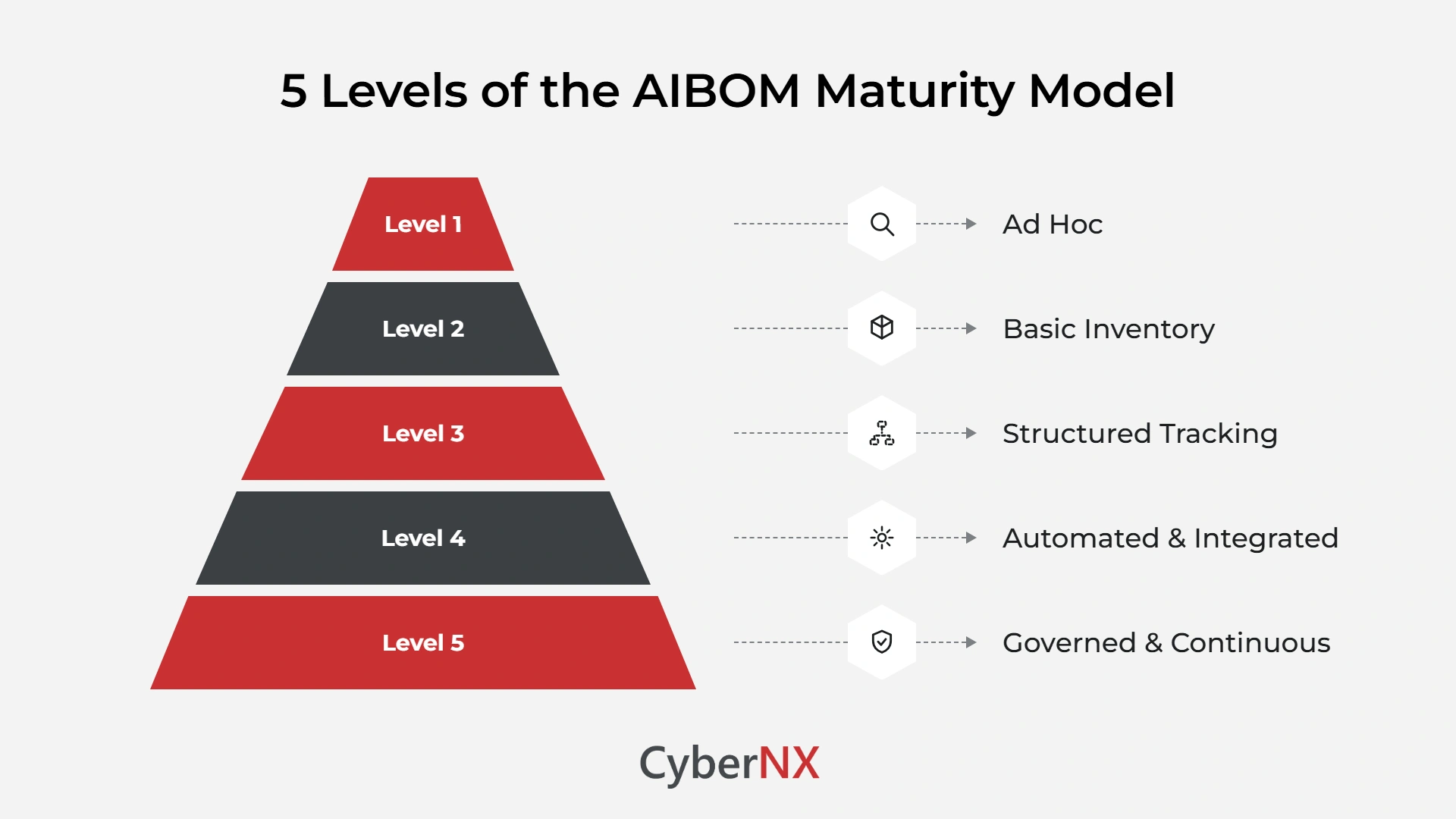
- Ad hoc: No formal AIBOM exists. AI model details live in spreadsheets, emails or a data scientist’s memory. Nobody owns the inventory.
- Basic inventory: A manually maintained list covers major models and datasets. Updates happen occasionally, usually before an audit.
- Structured tracking: AIBOMs follow a standard format such as CycloneDX or SPDX. Fields cover models, training data, frameworks and providers, and a named owner keeps them current.
- Automated and integrated: AIBOM generation is built into MLOps pipelines. Updates happen automatically when a model changes, and the AIBOM connects to vulnerability and risk tools.
- Governed and continuous: AIBOM data feeds board reporting, vendor risk assessments and regulatory submissions. Every model carries a clear chain of accountability from build to retirement.
Most Indian BFSI companies are likely to sit between levels 2 and 3 today. Reaching level 4 is realistic within a year for teams that already run SBOM programmes, since much of the tooling and process discipline carries over directly.
How to move up the AIBOM maturity model
Progress across these levels usually follow the same practical sequence, regardless of how many AI systems an organisation runs.
- Build a single inventory: Bring every known AI model, internal or vendor-supplied, into one register before adding detail.
- Standardise the format: Move to CycloneDX or SPDX so the AIBOM stays machine-readable and auditable.
- Assign ownership: Give each model a named owner responsible for keeping its AIBOM entry current.
- Automate generation: Wire AIBOM creation into existing CI/CD or MLOps workflows so it updates without manual effort.
- Connect to governance: Link AIBOM data to vendor risk reviews, board reporting and CERT-In, RBI and SEBI audit evidence.
Conclusion
Moving up the AIBOM Maturity Model is less about buying new tools and more about giving AI the same discipline BFSI teams already apply to software and cryptographic assets. Each level, from a basic list to a fully governed, automated inventory, closes a specific gap regulators are starting to ask about directly.
CyberNX helps organisations build that inventory and keep it current by providing reliable AIBOM solutions built for CERT-In, RBI and SEBI-regulated environments. Connect with our experts to test where your organisation sits on the AIBOM maturity model and plan the next step.
AIBOM Maturity Model FAQs
What is the difference between an AIBOM and an SBOM?
An SBOM inventories software components such as libraries and dependencies. An AIBOM extends this to AI-specific elements, including models, training datasets and inference frameworks, as outlined in CERT-In’s Technical Guidelines v2.0.
Which level of the AIBOM maturity model should a bank or NBFC target first?
Level 3, structured tracking, is a realistic near-term target. It gives regulators a standard, auditable format without requiring full MLOps automation on day one.
Does RBI mandate a specific AIBOM format?
No. RBI has not issued a standalone AIBOM mandate. Its FREE-AI framework and draft Model Risk Management guidance expect model inventories and governance, and CERT-In’s guidelines are the practical reference organisations use to structure that inventory.
How does AIBOM maturity help with vendor risk management?
A mature AIBOM shows exactly which third-party models, datasets and frameworks sit inside a vendor’s product. This lets risk teams assess vendor AI exposure directly instead of relying on vendor assurances alone.