Your organisation runs AI models across products, teams and vendors, and each one carries its own training data, dependencies, version history etc. When a security review or a customer question asks what exactly powers that AI system, pulling together a clear answer takes days of digging through emails, contracts and engineering notes.
An AI Bill of Materials solves this by giving you a single, structured inventory of every model and dependency behind your AI systems. CERT-In made this concrete in July 2025, formally defining AIBOM in its Technical Guidelines, and its May 2026 blueprint now folds AIBOM adoption into a 60-day implementation roadmap for AI-related cyber risk.
This blog covers what AIBOM means, why it matters for Indian enterprises and the AIBOM best practices you can follow to build one that actually holds up during an audit.
What is an AIBOM
An AIBOM is a structured list of everything that goes into an AI system. That includes models, training datasets, dependencies and the tools used to build and run them.
Think of it as an extension of the software bill of materials you already maintain. An SBOM tells you what code and libraries sit inside your applications. An AIBOM does the same for your AI models, adding visibility into data provenance, model lineage and version history.
Without this visibility, you will find it difficult to answer basic questions during a security review like:
- Where did this training data come from?
- Which base model was this fine-tuned from?
- Has this model been updated since it went into production?
An AIBOM gives you those answers on demand.
Why AIBOM matters for Indian enterprises
CERT-In’s Technical Guidelines v2.0 formally defined AIBOM, placing it in the same regulatory category as SBOM, QBOM and CBOM. The May 2026 blueprint builds on this, referencing the same guidelines and recommending third-party and supply chain governance – including vendor tests and dependency visibility – according to legal coverage of the blueprint.
Sector regulators add further weight. Banks and NBFCs work within RBI’s Master Direction on cybersecurity, while market infrastructure institutions follow SEBI’s CSCRF. Both frameworks expect companies to know what runs inside their systems, and AI components are no exception.
Global frameworks remain useful context. The EU AI Act introduced documentation obligations for general-purpose AI providers from August 2025, and its Annex IV documentation requirements map closely to what an AIBOM already captures. For Indian enterprises, though, CERT-In’s guidelines and sector-specific mandates are the frameworks that carry direct compliance weight.
Best practices for building an AIBOM
Building an AIBOM is like an operating discipline that needs to keep up with how often AI systems change. These five AIBOM best practices form a solid starting point.
Map every AI entry point
Start with a clear map of where models live, whether internal, cloud-hosted or sourced from third parties. Most visibility gaps sit at these integration points, so this step makes every later step faster.
Capture full model lineage
Record the base model and the training datasets, not only the final fine-tuned version. Licensing issues and data poisoning risks sometimes hide in that earlier layer.
Automate generation at build time
Manual AIBOMs cannot keep up with regular model updates. Generate the inventory inside your existing CI/CD pipeline so it always reflects what is actually running in production.
Score completeness and flag gaps
Where a vendor or upstream model stays silent on the history or ownership of an item, treat that as a point of investigation and not a blank field to accept.
Map findings to compliance frameworks
Tie your AIBOM output directly to CERT-In, RBI and SEBI CSCRF requirements so audit preparation becomes like a report, not a scramble.
Common AIBOM implementation challenges
Most organisations run into the same set of hurdles when they start building an AIBOM.
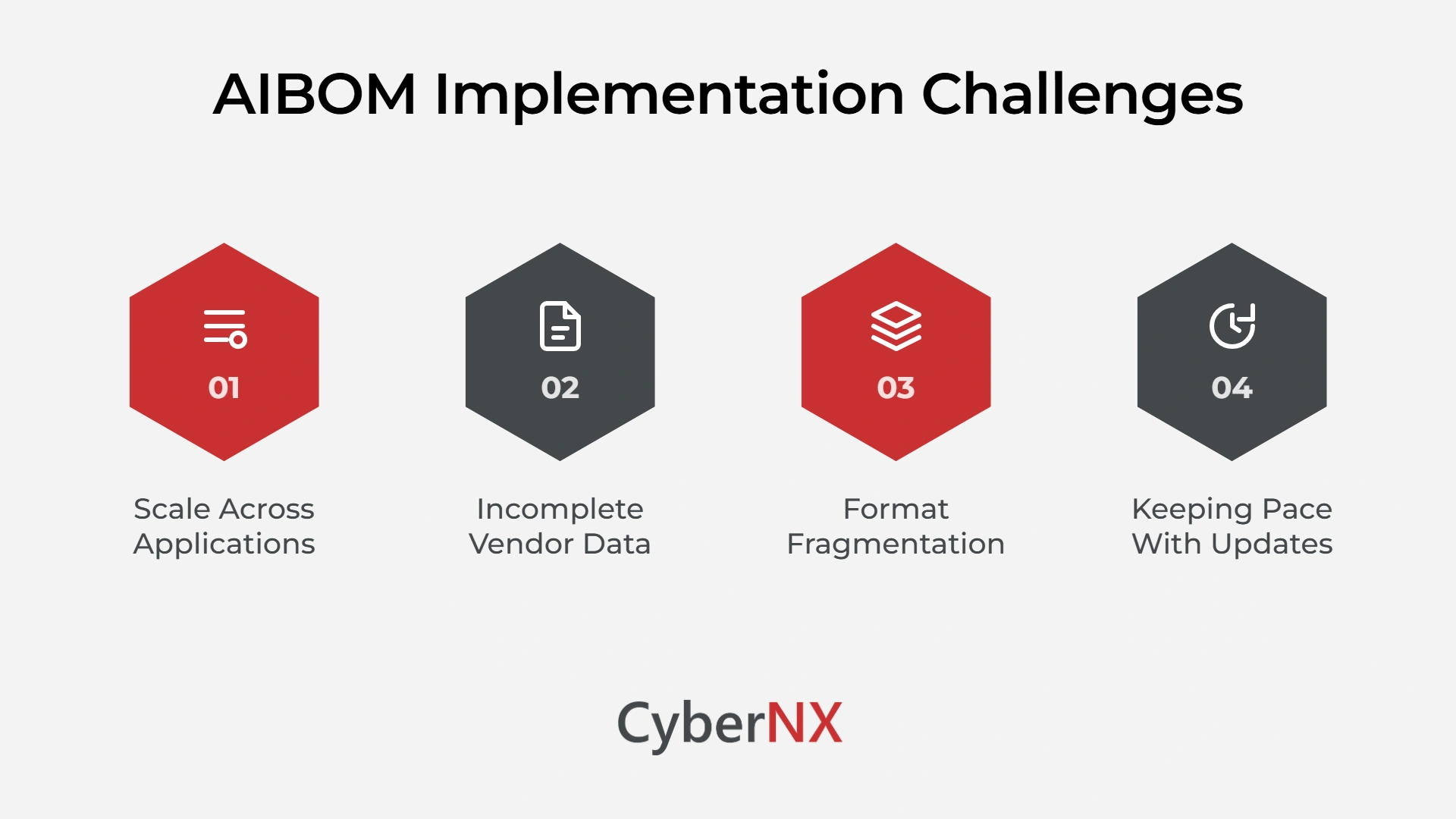
- Scale across applications: AI models are often spread across dozens of teams and products, hence it is difficult to maintain a single consistent inventory manually.
- Incomplete vendor data: Third-party models often arrive with gaps in documentation around training data or licensing.
- Format fragmentation: CycloneDX ML-BOM and SPDX’s AI profile serve different purposes, and choosing one without a translation plan can lead to some rework later.
- Keeping pace with updates: Models get retrained or updated often, so a static AIBOM can become quickly outdated without automation.
Working through these challenges early on, saves a lot of audit stress later, particularly as CERT-In’s guidelines continue to shape sector expectations.
Conclusion
AIBOM has moved from a niche security concept to a recognized best practice within CERT-In’s technical guidance in under a year. Following the right AIBOM best practices now, from mapping AI entry points to automating generation at build time, puts your firm ahead of the compliance curve.
Our AIBOM solutions help enterprises build and manage software supply chain visibility mapped to CERT-In, RBI and SEBI CSCRF requirements. If you are working through AIBOM best practices for your organisation, our team can help you build an inventory that holds up to regulatory scrutiny. Talk to us to get started.
AIBOM Best Practices FAQs
What is the difference between AIBOM and SBOM?
An SBOM lists the software components and libraries inside an application. An AIBOM extends this to AI-specific elements such as models, training datasets and fine-tuning data, giving visibility into how an AI system was built and trained.
Which Indian regulations reference AIBOM?
CERT-In’s Technical Guidelines v2.0, published in July 2025, formally define AIBOM in Section 8. CERT-In’s May 2026 blueprint on AI-assisted threats builds on these guidelines and recommends third-party and supply chain governance for AI systems.
How often should an AIBOM be updated?
An AIBOM should be generated at build time, ideally through your CI/CD pipeline, so it updates automatically whenever a model is trained, fine-tuned or redeployed. Manual updates struggle to keep pace with typical AI release cycles.
Do smaller organisations need an AIBOM?
Any organisation using or building AI systems will benefit from the visibility an AIBOM provides, regardless of size. Sector-regulated businesses, including BFSI entities under RBI and SEBI frameworks, face added pressure to maintain it as compliance expectations mature.